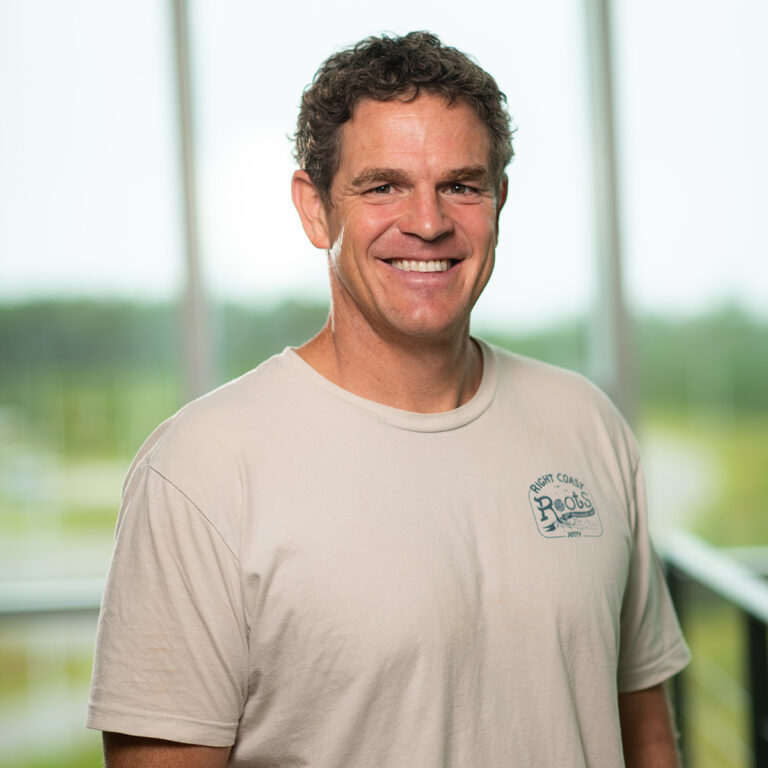
Mike Muglia
East Carolina University
Dr. Mike Muglia is the Interim Executive Director of the Coastal Studies Institute and a Research Associate Professor in East Carolina University’s Department of Earth, Environment, and Planning. His research focuses on Gulf Stream variability, coastal ocean circulation, and the exchange of water between the continental shelf and deep ocean, particularly off Cape Hatteras, North Carolina. He also works with interdisciplinary teams to develop marine renewable energy (MRE) solutions.
Muglia is currently involved in an NSF-funded collaborative project with Anthony Kirincich of Woods Hole Oceanographic Institution (WHOI) and Harvey Seim of the University of North Carolina at Chapel Hill (UNC-Chapel Hill) examining the stirring and mixing of different water masses along the southern Mid-Atlantic Bight continental shelf. The project combines high-frequency (HF) radar measurements of ocean surface currents with observations from OOI’s Pioneer Array to better understand how water moves and mixes across the shelf. The Outer Banks region is particularly complex, where waters from the Chesapeake and Albemarle-Pamlico system interact with the Mid-Atlantic Bight Cold Pool, South Atlantic Bight shelf water, Sargasso Sea waters, and Shelf Break Jet. Just offshore, the Deep Western Boundary Current also passes beneath the Gulf Stream.
The Pioneer Array is located just offshore of the Atlantic Marine Energy Center’s Wave Energy Test Site at Jennette’s Pier in Nags Head, North Carolina. Muglia also uses Pioneer Array observations to assess the potential for generating renewable energy from ocean currents and waves, while incorporating biogeochemical measurements to help inform environmental permitting for marine renewable energy devices.
His research demonstrates the value of sustained ocean observations for advancing our understanding of coastal circulation and the dynamic interactions between offshore and coastal waters.