
Multi-span distributed fiber sensing on the Ocean Observatories Initiative Regional Cabled Array
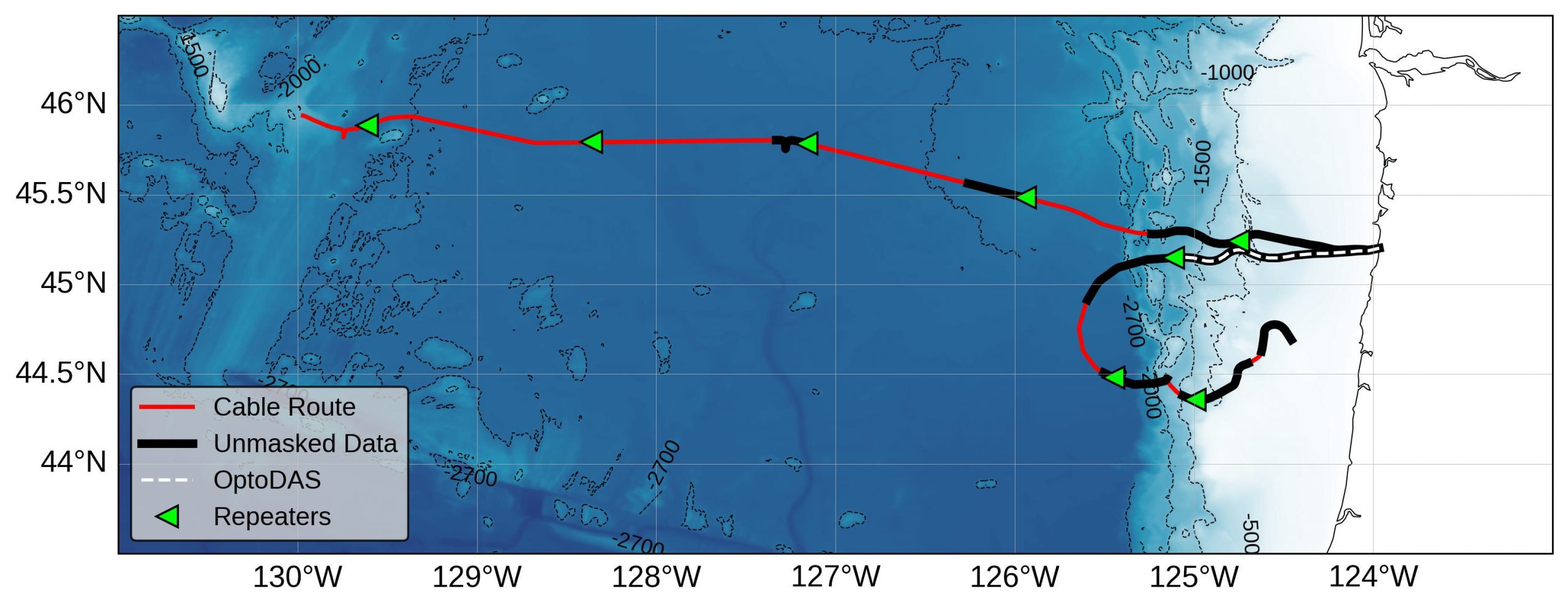
For 3 months beginning in November 2025, a team of scientists at the University of Washington comprising William Wilcock, Brad Lipovsky, Marine Denolle and Shima Abadi collaborated with Mikael Mazur and Nicolas Fontaine at Nokia Bell Labs to conduct a test of a novel multi-span distributed acoustic sensing (DAS) technique on the two submarine cables of the OOI Regional Cabled Array (RCA) extending off Pacific City, Oregon. DAS uses backscattered light to measure strain along a fiber with a spatial resolution of meters, creating a dataset that allows for diverse observations of submarine phenomena including earthquakes, ocean waves, and marine mammals. Previous DAS experiments on the OOI tested conventional DAS instruments to collect data over only the first portion of the cables before the first optical repeater, out to ~65 km on the northern cable and ~95 km on the southern cable. The DAS system tested in this experiment, provided by Nokia Bell Labs, uses the high-loss loopback couplers within optical repeaters to extend DAS measurements beyond repeaters to the entirety of a given seafloor cable (see Mazur et al., 2025). The northern OOI cable has a length of ~480 km and runs roughly perpendicular to shore, across the Juan de Fuca plate out to Axial Seamount. The southern RCA cable has a length of ~350 km and runs southward across the continental shelf, crossing onto the Juan de Fuca plate before looping eastward back towards shore.
On November 5 2025, the Nokia multispan DAS system was deployed on both the north and south cables of the RCA. Each of the RCA cables has two optical fibers, the transmit and receive fibers for the observatory data. The Nokia multispan DAS system sends light down the transmit fiber and receives backscattered light from each optical repeater via the receive fiber. The system was multiplexed such that data could be collected while the RCA continued operating. Data were collected continuously using this system until January 28 2026, with outages from November 12-18, December 8-9, and December 17-23. The spatial and temporal sampling rates were periodically varied, with channel spacing varying between 10-200 m.
Upon initial testing, it became clear that significant nonlinearities within the RCA fibers and an observatory-related synchronization signal on the fibers of both cables was distorting the data collection via strong crossphase modulation. These combined effects mean that significant portions of the cable did not record physically accurate data. Following investigation of these effects, starting on December 2, a spatial mask was applied to the data from both cables to limit the available data to only the portions that were minimally affected by the observatory noise. This spatial masking results in 165 km and 275 km of the northern and southern cable spans being saved, out to 300 km and 350 km maximum distance along the cable, respectively. These unmasked data includes portions beyond three repeaters on each cable. The spatially masked data still contains some non-physical noise, and should be treated with caution. Further investigation into the characteristics of this noise are ongoing and updates will be made to the documentation moving forward. Data post-processing also revealed that, due to latency in the processing chain, the absolute timestamps associated with the data are delayed (behind real-time) by several seconds. Details on this absolute timing delay can be found in the Github documentation.
To facilitate comparison between the Nokia multispan DAS system and conventional DAS interrogators, the first span of the southern cable (out to ~95 km) was also instrumented using an OptoDAS interrogator from Alcatel Subsea Networks. The system was multiplexed such that data could be collected while the observatory continued operating. OptoDAS data were collected continuously from November 12 2025 to January 28 2026, with an outage from November 27 to December 5. The spatial and temporal sampling rates were varied periodically.
Low sample rate (~8 Hz) data from the experiment is now available at http://piweb.ooirsn.uw.edu/das25/data.The Nokia multispan DAS data for both cables is available as binary files that contain both data arrays and metadata, with a total dataset size of 3.9 TB. The OptoDAS data for the south cable is available as hdf5 files, with a total dataset size of 1.2 TB. Information on how to read the data, specific data availability times, changes in acquisition parameters, the spatial mask for the Nokia system, and timing offsets on the Nokia system can be found at https://github.com/uwfiberlab/OOI_DAS_2025.
Access N/A Data