CI Compass Interns Showcase Innovative Summer Research with OOI
The CI Compass Fellowship Program (CICF), funded by the U.S. National Science Foundation (NSF), prepares undergraduate students for careers in cyberinfrastructure through both training and applied research opportunities. The program begins with a 12-week virtual Spring Program, where students are introduced to skills essential for cyberinfrastructure careers at NSF Major or Mid-scale Facilities. Following the spring training, students may apply for the Summer Program, which places a limited number of Fellows in hands-on projects at collaborating NSF facilities.
Through this pathway, CI Compass Fellows Ejay Aguirre and Dylan Hermosillo earned internships with OOI this summer, where they applied their training to advance projects at the intersection of ocean science, cyberinfrastructure, and data analysis.
One project focused on connecting large-scale climate phenomena with accessible environmental data. Ejay Aguirre, an undergraduate at the University of Utah, integrated datasets from OOI, Ocean Networks Canada (ONC), and the National Ecological Observatory Network (NEON) to investigate how the El Niño Southern Oscillation (ENSO) is reflected across different monitoring sites. Using Python and Jupyter Notebook, he built a workflow for retrieving, cleaning, and comparing data across infrastructures. The analysis revealed that site characteristics, particularly latitude, influence the visibility of ENSO signals, with higher-latitude sites exhibiting weaker short-term patterns. Future work includes expanding the study to additional sites for broader spatial coverage, incorporating other climate indicators such as the Pacific Decadal Oscillation (PDO) and North Pacific Gyre Oscillation (NPGO), and publishing a publicly accessible, fully documented Jupyter Notebook to support reusability within the research community.
The second project addressed the challenge of monitoring ice conditions in the North Atlantic. Dylan Hermosillo, who will begin a PhD program in Bioinformatics at North Carolina State University, developed a convolutional neural network for ice detection using images collected by cameras mounted on a surface buoy at the OOI Irminger Array. The project stemmed from anomalies in buoy sensor data caused by iced-over instruments, which prompted the addition of cameras as supplementary monitoring tools. He worked with approximately 256,000 images, applying preprocessing steps such as pixel normalization and consistency checks. Tools like Dyno v2 and Facebook AI’s image similarity search were used to sort and filter the dataset. While challenges remained with image resolution and varying camera perspectives, the project demonstrated the feasibility of using buoy-mounted cameras to detect ice flows. Future directions include applying similar methods to cloud separation studies and exploring the integration of instruments such as solar meters to enhance atmospheric observations.
Reflecting on their progress, Jeffrey Glatstein, Senior Manager of Cyberinfrastructure at OOI noted, “Both Ejay and Dylan demonstrated how student researchers can make meaningful contributions when given the opportunity, providing fresh perspectives and impactful solutions that help advance OOI’s mission.”
As the CI Compass Fellowship Program continues to grow, it provides an important opportunity for developing the next generation of scientists and researchers engaged in cyberinfrastructure and data-intensive science.
Learn more about the CI Compass Fellowship Program by visiting the CI Compass website.
For those interested in the application process of the program, please visit the CI Compass Fellowship Program’s application process webpage.
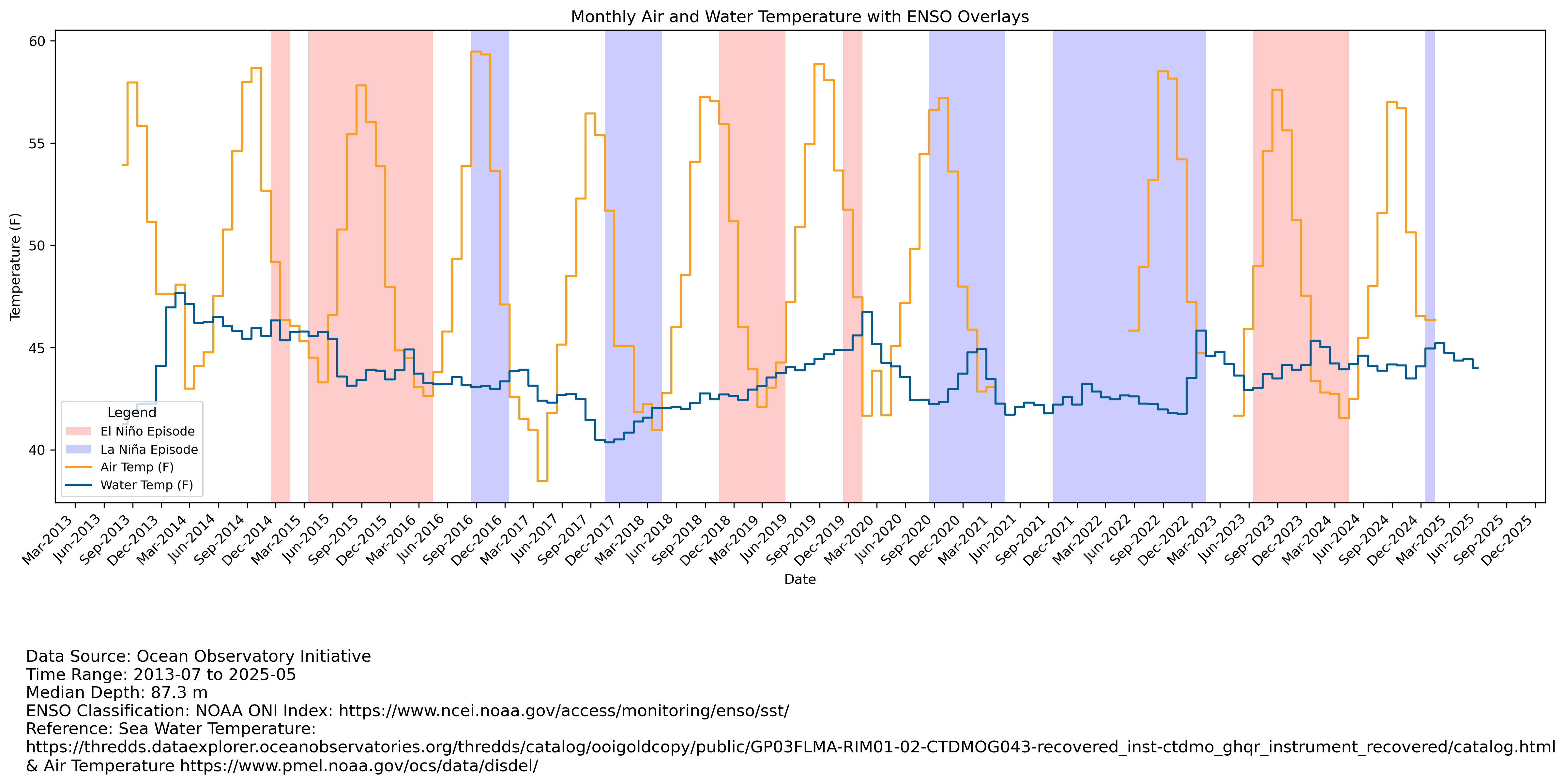
Air and water temperature plot generated from OOI data.