
A Carbon Budget for the Upper Mesopelagic Zone
(Adapted from Stephens et al., 2025)
Upper ocean carbon budgets are difficult to constrain, and those for the mesopelagic zone come with particular challenges. A recent paper by Stephens et al. (2025) took on the challenge of a comprehensive carbon system budget for the upper mesopelagic zone (100-500 m) based on data from the EXport Processes in the Ocean from RemoTe Sensing (EXPORTS) program (Siegel et al., 2016). The 2018 EXPORTS field campaign was conducted at Ocean Station Papa in the Northeast Pacific to take advantage of the relatively modest surface forcing, shallow summer mixed layer, tightly coupled food web, and low mesoscale kinetic energy. Nevertheless, the study found that a steady-state assumption for the carbon system was likely not appropriate.
Measuring organic carbon supply and demand is challenging due to a variety of factors. Supply includes sinking particles, migrating zooplankton and fish, disaggregation, mixing and subduction. Demand comes primarily from bacteria and zooplankton. Measurement methods for each supply and demand term have errors, conversions to rates have uncertainties, and each process being measured may have a unique timescale over which a rate integration makes sense. EXPORTS was notable for increasing the number and variety of measurements available for monitoring the mesopelagic carbon budget. Stephens et al. take advantage of this by combining multiple measurement methods, quantifying errors and applying statistical methods for error analysis.
The authors used observations from multiple sources. Near-surface data came from the PMEL Station Papa surface mooring. Shipboard profile data come from two ships operating during the EXPORTS field campaign as well as the OOI Station Papa cruise in 2018. Additional water column data came from two OOI Slocum gliders, one EXPORTS-operated Seaglider, and BGC Argo floats. The authors examined each carbon supply and demand estimate, calculating an uncertainty and discussing potential limitations (Stephens et al., Table 1). A Monte Carlo approach was used to assess overall uncertainty in supply and demand terms, resulting in the conclusion that supply was insufficient to meet demand (e.g. Fig. 1 below). The error analysis allowed the authors to conclude that the mismatch was not the result of problems in estimating supply or demand, but rather a problem with the assumption that supply and demand would balance within the analysis period. In other words, the system was not in steady state.
This project highlights the complexity of the carbon system in the upper ocean and the broad suite of observational tools necessary to address the carbon budget. The authors make three specific recommendations for improved quantification of the biological carbon pump: including the relevant midwater processes, capturing the range of relevant timescales, and providing redundancy in methodology.
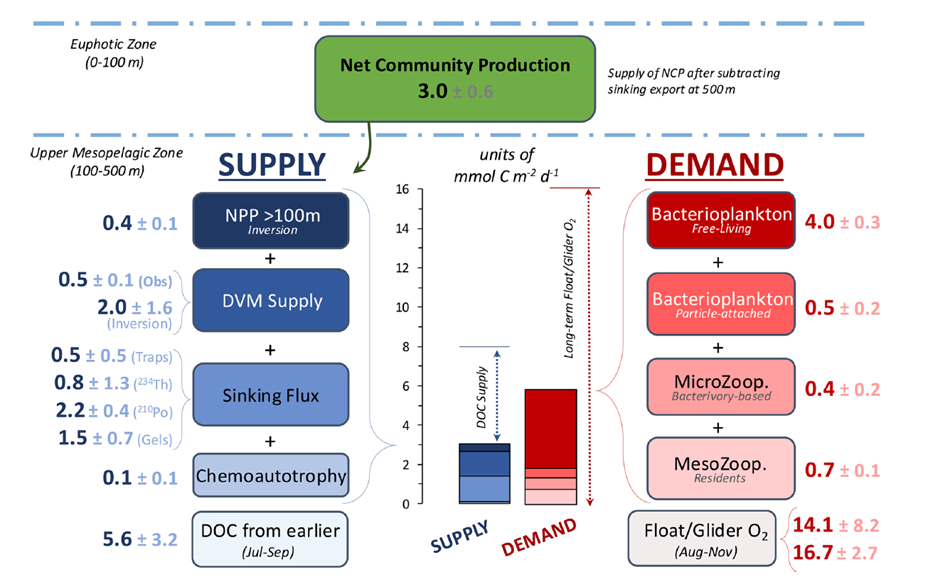
Assessment of the organic carbon budget in the upper mesopelagic zone during EXPORTS. Estimated individual contributions to supply (left) and demand (right) are provided along with error estimates. Terms with multiple measurement methods (far left, far right) were averaged. The center panel shows the cumulative supply and demand relative to a vertical scale in units of mmol C per (m^2 day). From Stephens et al., 2025.
___________________
References:
Stephens, B.M., and 20 co-authors, 2025. An upper-mesopelagic-zone carbon budget for the subarctic North Pacific, Biogeosciences, 22, 3301-3328, https://doi.org/10.5194/bg-22-3301-2025.
Siegel, D.A., K.O. Buesseler, M.J. Behrenfeld, C.R. Benitez-Nelson, E. Boss, M.A. Brzezinski, A. Burd, C.A. Carlson, E.A. D’Asaro, S.C. Doney, M.J. Perry, R.H.R. Stanley and D.K. Steinberg, 2016. Prediction of the Export and Fate of Global Ocean Net Primary Production: The EXPORTS Science Plan, Front. Mar. Sci., 3:22, https://doi.org/10.3389/fmars.2016.00022.