The Regional Cabled Array Seen Through the Eyes of Students
One of the OOI’s greatest strengths is its ability to inspire and train the next generation of ocean scientists through immersive, hands-on research at sea and through the analysis and application of large, complex data sets. Students gain authentic, real-world experience in oceanography—working aboard global-class research vessels utilizing advanced robotic vehicles and learning how to communicate their science effectively to broad and diverse audiences. Through the UW VISIONS at-sea experiential learning program more than 200 students have developed these skills while participating in Regional Cabled Array cruises.
Student outcomes are showcased on Interactiveoceans and span an impressive breadth of scientific inquiry. Recent VISIONS’25 projects include short documentaries demystifying hydrophones and distributed acoustic sensing, genetic analyses of deep-sea organisms, and newly developed technologies to probe the metabolomics of life thriving in the extreme environments of hydrothermal vents. These experiences have translated into numerous senior theses with many students presenting their work at professional scientific conferences.
Among the highlights at Ocean Sciences 2026 conference are VISIONS’24–25 student-led presentations that integrated artificial intelligence and computer vision to quantify benthic communities and spatial ecology at Southern Hydrate Ridge. These innovative analyses revealed new connections between biological patterns and methane seep activity, offering fresh insight into the dynamics of this highly active and rapidly changing environment.
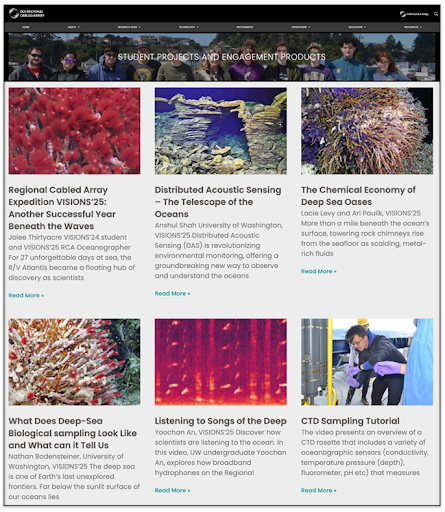
RCA Science Highlight: Student Projects and Engagement Products