
Multi-Span Fiber Sensing Expands Reach of OOI Regional Cabled Array
From November 2025 through January 2026, scientists from the University of Washington (UW) and Nokia Bell Labs carried out a successful demonstration of a novel multi-span distributed acoustic sensing (DAS) system on the U.S. National Science Foundation (NSF) Ocean Observatories Initiative (OOI) Regional Cabled Array (RCA).
The UW investigators William Wilcock, Brad Lipovsky, Marine Denolle and Shima Abadi collaborated with Mikael Mazur, and Nicolas Fontaine at Nokia Bell Labs to test an exciting new approach that extends sensing across the full length of submarine fiber optic cables, far beyond previous limits.
“This experiment shows that we can transform existing subsea cables into powerful, large-scale sensing systems,” said William Wilcock, professor of Oceanography at the UW. “It’s a powerful new tool to observed ocean and Earth processes continuously over hundreds to thousands of kilometers.”
Extending Sensing Across the Full Cable
DAS works by measuring strain along a fiber using backscattered light, enabling detection of earthquakes, ocean waves, and marine mammals such as whales. Earlier NSF-funded RCA experiments were limited to the first cable segments, reaching about 65 km (north) and 95 km (south) offshore, due to signal loss at optical repeaters.
The Nokia Bell Labs system overcomes this barrier by using high-loss loopback couplers within the optical repeaters to extend sensing across the entire cable span. “We thought the most important function of subsea cables was transporting petabits per second of data across our oceans. In reality, it’s how we can turn these cables into an array of acoustic sensors spaced every 10 meters or so, spanning entire ocean basins,” said Nicolas Fontaine of Nokia Bell Labs.
The two RCA cables extend offshore from Pacific City, Oregon. The northern cable (~480 km) runs roughly perpendicular to shore and reaches Axial Seamount. The southern cable (~350 km) crosses the continental shelf, continues onto the Juan de Fuca Plate, and loops back toward shore off Newport Oregon.
“In the Pacific Northwest, much of the earthquake hazard is concentrated offshore, where there are still relatively few instruments,” said Zoe Krauss, a postdoctoral researcher at the UW. “This new multi-span DAS capability on the RCA could be a game changer for offshore earthquake monitoring and may ultimately improve earthquake early warning in the region.”
Deployment, Data & Access
The system was deployed on November 5, 2025, and operated continuously, alongside normal observatory functions, through January 28, 2026. Sampling rates and spatial resolution (~10–200 m) were varied throughout the test.
For comparison, a conventional DAS system from Alcatel Subsea Networks was also deployed on the first span of the southern cable.
Nonlinear optical effects and observatory signals introduced noise in portions of the data. To address this, researchers applied spatial masks starting December 2, preserving 165 km and 275 km of usable data on the northern and southern cables, respectively. Some noise and small timing offsets remain, and users are advised to interpret the data carefully as analysis continues.
Low sample rate (~8 Hz) data are now available:
For full experiment details, metadata, and documentation, visit the project page.
Datasets include 3.9 TB of Nokia multi-span DAS data from both cables and 1.2 TB of OptoDAS data from the southern cable, along with documentation and tools for access and analysis.
Looking Ahead
This experiment highlights the potential of using existing ocean infrastructure as a large-scale, distributed sensing network.
“The Regional Cabled Array was designed to support innovation, and this project is a great example of how we can expand its capabilities in new and exciting ways,” said Deb Kelley, Director of OOI’s Regional Cabled Array. “By leveraging existing infrastructure, we’re unlocking unprecedented new pathways for discovery across the ocean and seafloor.”
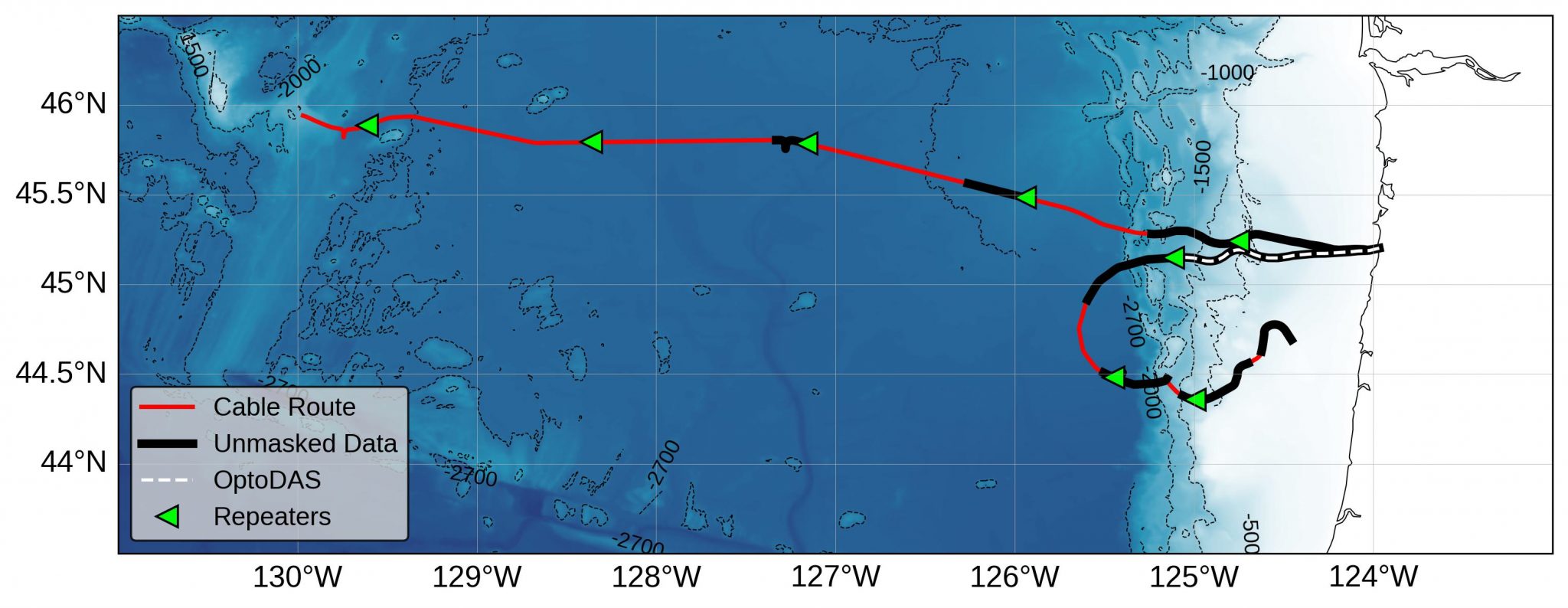
Location of the OOI RCA cables off the Oregon coast, shown in red. The portions of the cables that were successfully interrogated with the Nokia multi-span system during the experiment are shown in black. White dashed lines overlain on the first span of the South Cable show the portion of the cable interrogated with the OptoDAS system. The locations of the optical repeaters are shown in green. Credit: Z. Krauss, University of Washington.