NSF OOI Descoping Update for the Community
June 18, 2026 | NSF Update on the Ocean Observatories Initiative →
Dear OOI Community,
As many of you may now be aware, the U.S. National Science Foundation (NSF) has initiated a major descoping of the Ocean Observatories Initiative (OOI) Major Facility. The official statement is available here.
The OOI recognizes the importance of this announcement to the many researchers, educators, students, engineers, partners, and community members who have contributed to and relied upon OOI data over the past decade. We want to provide additional context for the community as we work through the details of this transition.
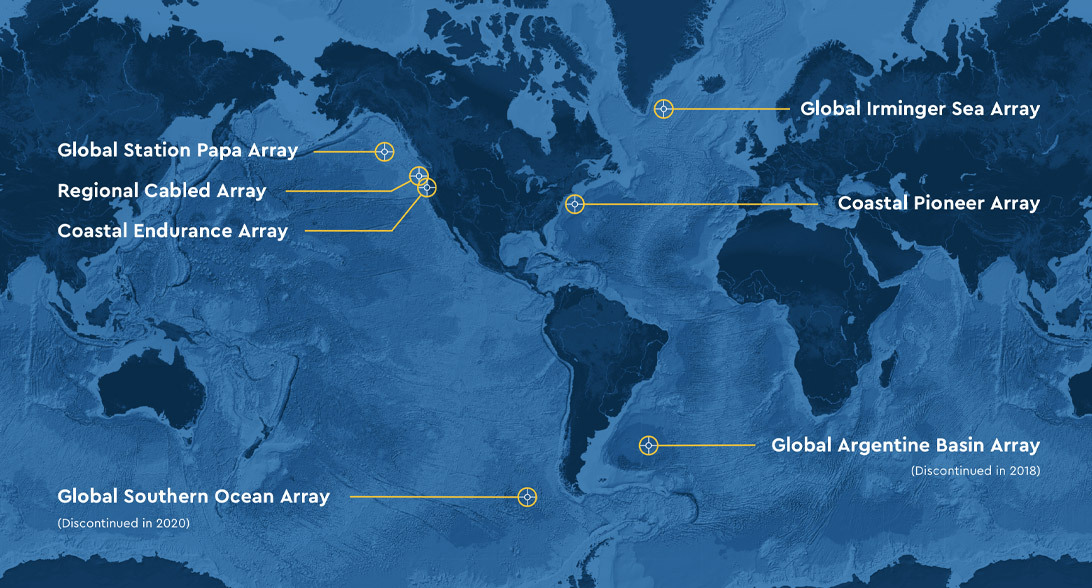
NSF’s descoping plan includes the phased recovery and removal of in-water infrastructure from the Endurance, Pioneer, Irminger Sea, and Station Papa Arrays over the next approximately 15 months. At the Endurance Array, the descoping process is already underway, with final recovery activities scheduled for June 2026. Recovery of the Pioneer Array is currently planned for June 2027, while the Irminger Sea and Station Papa Arrays are expected to be recovered during the summer of 2027, subject to ship scheduling and operational constraints.
As infrastructure is recovered from each array, the associated real-time data streams and observing capabilities at those locations will come to an end. However, all previously collected OOI data will remain accessible through the OOI Data Center. The Regional Cabled Array (RCA), the OOI Data Center, the Program Management Office (PMO), and Community Engagement activities will continue operating through September 30, 2028.
We encourage investigators to continue:
- Using OOI datasets in proposals, publications, and presentations
- Referencing OOI-enabled science outcomes in community discussions and reports
- Supporting student and early-career researcher engagement with OOI data
- Identifying opportunities for data driven research and cross-program collaborations using the existing observational record
Over more than a decade, OOI has delivered the world’s most advanced continuously operating ocean observing systems, supporting science, engineering, education, and workforce development across the ocean sciences community. We are profoundly grateful for the extraordinary efforts of the scientists, engineers, operators, educators, students, and partners who made this facility possible and who continue to advance its legacy through the use of its data.
Thank you for your continued engagement and support.
Best regards,
Jim Edson
Principal Investigator, NSF Ocean Observatories Initiative
Senior Scientist, Woods Hole Oceanographic Institution