
AMOC Heat Transport from Reanalyses
(Adapted from Winkelbauer et al., 2026)
Oceanic heat transport is important for understanding the Atlantic Meridional Overturning Circulation (AMOC), and ocean reanalysis models provide a means of evaluating transport variability and trends. A recent paper by Winkelbauer et al. (2026) evaluated the extent to which reanalyses reproduce transports estimated from observations. Their results show that the reanalyses capture the overall character of heat transport in the subpolar North Atlantic, but have limitations in particular times and regions.
The authors used observations from the Overturning in the Subpolar North Atlantic Program (OSNAP) data set compiled by Fu et. al. (2023), which includes both OSNAP-West (Labrador Shelf to West Greenland) and OSNAP-East (East Greenland to Scotland). The OSNAP-East array incorporates the OOI Irminger Sea Flanking moorings. The observation-based transport estimates were compared to those from several reanalysis models. A composite (mean) product was produced from four models with ¼ degree resolution that are based on the Copernicus Marine Service Global Reanalysis Ensemble Product (GREP). A higher resolution product, the Global Ocean Reanalysis System (GLORYS12V1) was also used in the comparison. All of the reanalyses are based on Nucleus for European Modeling for the Ocean (NEMO). It is notable that none of the reanalyses assimilate ocean velocity observations. This means that ocean transports differences will depend largely on velocity differences between observations and models.
Comparisons during the OSNAP observation period (2015-2020) include temperature, velocity and transport. Temperatures are relatively well reproduced by the reanalysis models, albeit with some systematic biases – cold biases in the basin interiors and warm biases on the shelves. The broad structure of ocean currents can be seen in the models, but there are discrepancies in both strength and location of the Labrador Current, West Greenland Current and East Greenland Current. However, it is also noted that limited observations in a few key regions compromise comparisons there. For transport, the reanalyses capture overall variability, and most are well correlated with observations over the ~6 year period (Fig. 3). However, none of the reanalyses capture the 2015 transport peak observed by OSNAP.
The authors dig deeper into the 2015 transport discrepancy and find that it is associated with a region of the OSNAP line near the Iceland and Rockall-Hatton Basins where glider transects supplemented the moored array in the upper ocean. They speculate that changes in the observational coverage due to gliders contribute to the 2015 transport peak that is not captured by the models.
Overall, this comparison study is a relatively strong endorsement of the reanalysis models, which “generally reproduce the broad structure of the AMOC and its associate heat transport”, although not without bias (5-10% in the mean and 60-80% for some times and locations). In addition, some key boundary currents are not well represented in the models. Interestingly, the case study for 2015 shows that the OSNAP moored array also has limitations, and can be improved by the use of gliders to resolve upper-ocean structure between mooring stations.
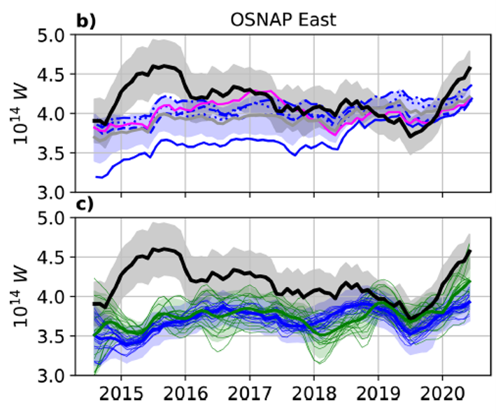
Figure 1. Time series of heat transport from OSNAP observations (black) compared to reanalysis models. Upper panel compares five different reanalysis products (colors) and the mean of the ¼ degree products (gray). Lower panel compares OSNAP to indirect heat flux estimates. From Winkelbauer et al., 2026.
___________________
References:
Fu, Y. and 25 co-authors, 2023. Meridional Overturning Circulation Observed by the Overturning in the Subpolar North Atlantic Program (OSNAP) Array from August 2014 to June 2020, Georgia Institute of Technology [data set], https://doi.org/10.35090/gatech/70342.
Winkelbauer, S. I Winterer, M. Mayer, Y. Fu and L. Haimberger, 2024. Subpolar Atlantic meridional heat transports from OSNAP and ocean reanalyses – a comparison, Ocean Sci, 22, 629-651, https://doi.org/10.5194/os-22-629-2026.