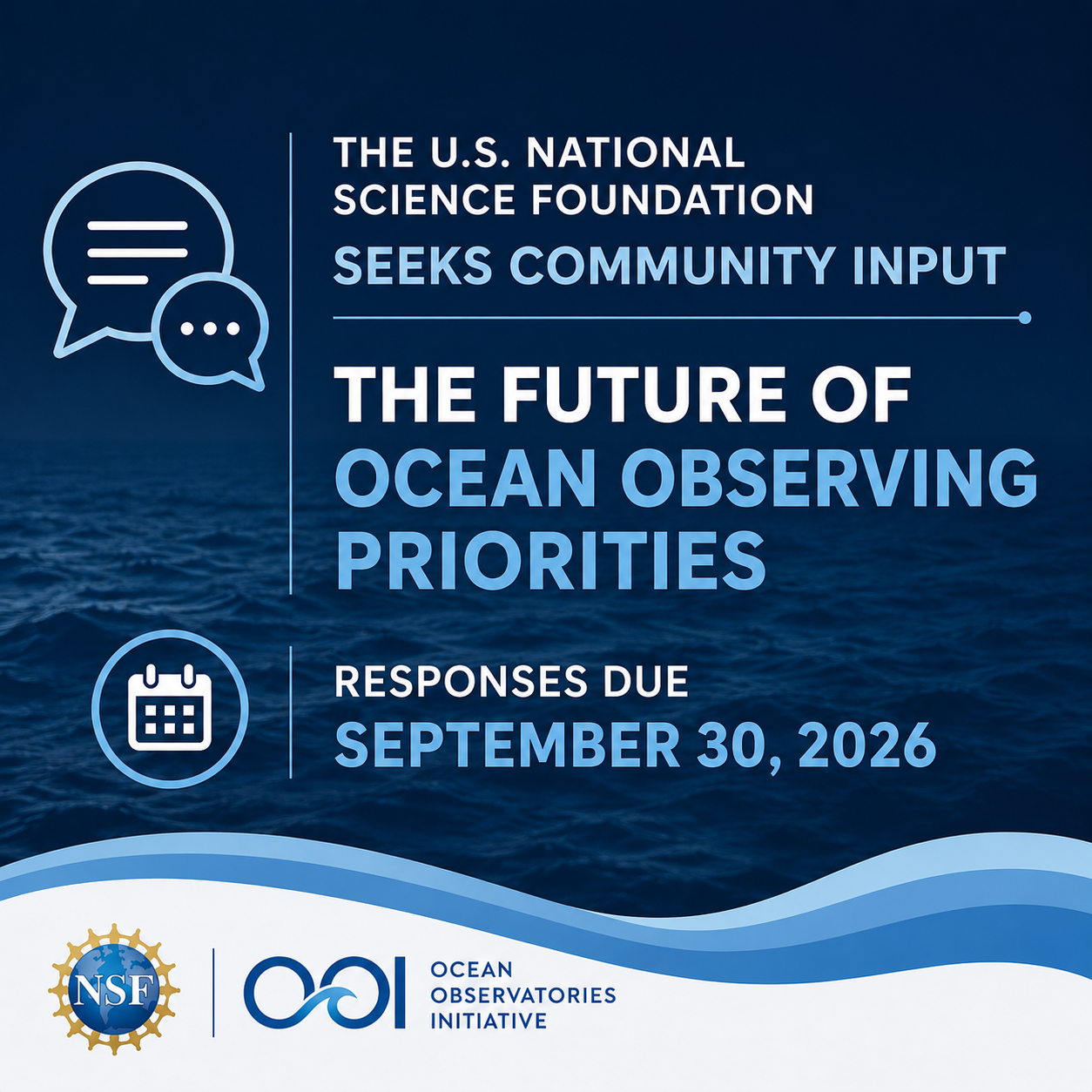
NSF Seeks Community Input on Future Ocean Observing Priorities
The U.S. National Science Foundation (NSF) has issued a Dear Colleague Letter (DCL) seeking input from the ocean science community on future ocean observing priorities. The DCL provides an opportunity for the community to share perspectives on the future of NSF-supported ocean observing. NSF is asking about observing gaps, fixed and mobile assets, new technologies, coordination with other programs, operational uses and stakeholders, measures of value, and which elements of its existing observing portfolio should be maintained or updated.
OOI has now been operating for more than a decade, providing openly available multidisciplinary data across a range of ocean environments. The program was designed around an anticipated 30-year operating life, with infrastructure that is reconfigurable, extensible, and relocatable so that arrays, instruments, and platforms can move and change as science priorities and technologies evolve. The relocation of the Pioneer Array from the New England Shelf to the Mid-Atlantic Bight, following NSF and community workshops, is one example.
OOI combines sustained observations from instrumented moorings with the spatial coverage provided by autonomous platforms and supports the incorporation of new sensors and observing technologies. In addition to the observing assets and long-term data records, OOI now has more than a decade of experience deploying, operating, maintaining, and modifying a sustained ocean observing system.
Those who use OOI data, assets, or capabilities can bring their experience to the broader discussion by telling NSF what has worked, what should continue or change, and how OOI can help address future ocean observing priorities.
OOI encourages researchers, educators, students, data users, technology developers, partner organizations, and other stakeholders to review the DCL and provide input directly to NSF.
Responses may be submitted by individuals or as aggregated responses from groups or organizations and are due September 30, 2026.
Read the NSF Dear Colleague Letter and submit your response.
NOTE: The U.S. Climate Variability and Prediction Program (CLIVAR) posted a list of Observing Efforts here.