
Global Estimate of Turbulent Heat Flux
(Adapted from Wang et al., 2026)
The net heat exchange between atmosphere and ocean is composed of radiative and turbulent components. Radiative components are the net shortwave and longwave fluxes. Turbulent components are the sensible heat flux (SHF) and latent heat flux (LHF), which are an important part of the global atmosphere-ocean heat exchange. The turbulent fluxes can be measured directly, but are often parameterized based on air-sea temperature and humidity differences and the wind stress. These parameterizations are sometimes called semi-empirical bulk formulas, as exemplified by the COARE algorithm (Edson et al., 2013). The bulk formulas for turbulent flux are tuned using available observations, but may not perform well in environmental conditions where validation is lacking. Thus, there is interest in improving global fields of SHF and LHF using other approaches.
A recent study by Wang et al. (2026) used a neural network approach to create high-resolution (0.25 degree) global ocean flux fields. For ground truth, the authors utilized nearly 200 buoys from 13 projects and arrays, including 6 buoys from OOI. The OOI Southern Ocean, Argentine Basin and Irminger Sea Arrays were particularly important for extending the geographic coverage to high latitude where long-term marine meteorological data are scarce (Fig. 3). The analysis period (1993 to 2017) was determined by the availability of the in-situ datasets.
The in-situ meteorological variables were used to compute turbulent heat fluxes using the COARE 3.6 algorithm (Edson et al., 2013). A unique aspect of the processing was to quality-control the fluxes using the expected values for the Bowen ratio, defined as B = SHF/LHF. The quality-controlled, observation-based fluxes were then used to train and validate the neural network model. The model jointly estimated SHF and LHF while constrained by limits to the Bowen ratio based on observations. The model was further trained using multiple “learning data sets”, which included atmospheric reanalysis products, sea surface temperature, salinity, wind and wave products, and satellite-derived sea surface height.
The results were compared to 7 different global flux products. Notable in the comparisons was the consistently low RMS error in Bowen ratio across all ocean basins for the neural network model. Considering temporal trends over the analysis period (Fig. 2), showed that the neural network model had significant positive trends in SHF (different from all but one of the products) and LHF (similar to four of the products). Spatial maps of the trends indicated that the positive trends tend to be at high latitude for SHF and in the tropics and mid-latitudes for LHF.
This study highlights the value of long-term ocean observations, and in particular the importance of meteorological observations at high latitude. The constrained neural network approach showed good results compared to other global flux products. The resulting 0.25 degree, gridded global turbulent flux field is an important complement to existing reanalysis fluxes and has the advantage of more accurate representation of the Bowen ratio. As noted by the authors, improved understanding of turbulent heat fluxes on a global scale is an important step towards achieving global closure of the ocean surface energy budget.
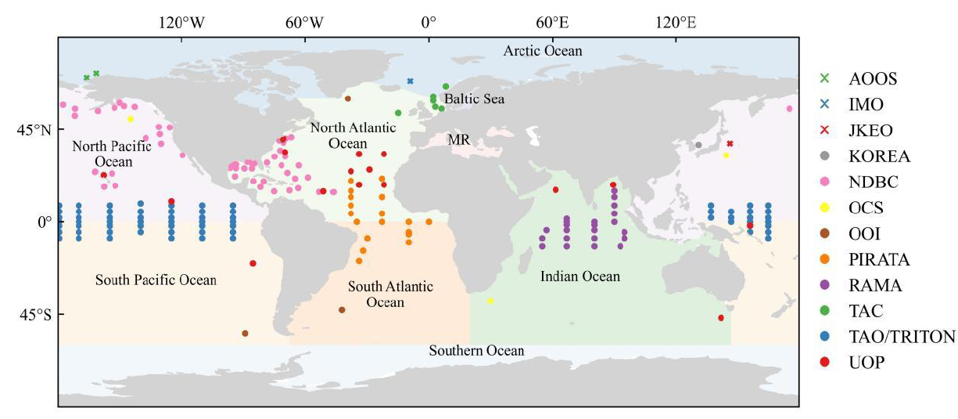
Figure 1: Locations of 197 buoy sites used in the analysis. Note the relative scarcity of sites in the southern oceans and in the high latitude Atlantic Ocean. From Wang et al., 2026.
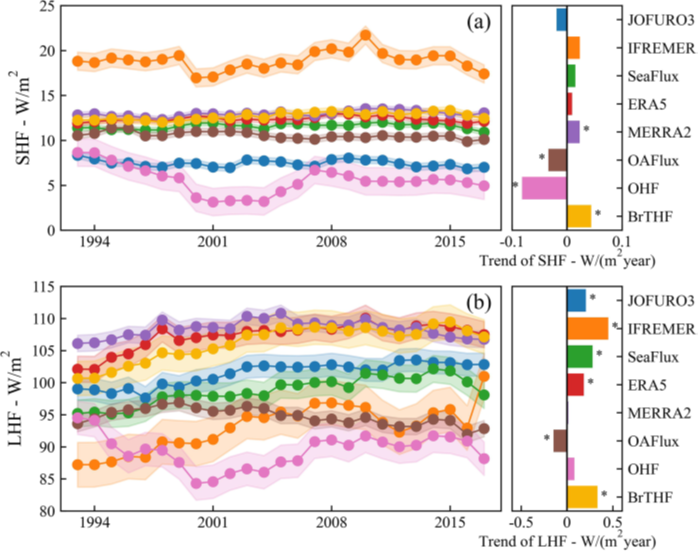
Figure 2: Time variability of global-mean sensible (upper) and latent (lower) heat flux for the neural network (BrTHF) and seven other flux products. Trends (right hand panel) that pass a significance test are shown with an asterisk. From Wang et al., 2026.
___________________
References:
Wang, Y., R. Tang, M. Liu, L. Huang and Z.-L. Li, 2026. Bowen ratio-constrained global dataset of bulk air-sea turbulent heat fluxes from 1993-2017, Earth Sys. Sci. Data, 18, 3391-3414, https://doi.org/10.5194/essd-18-3391-2026.
Edson, J.B., K. Venkata, R. A. Weller, S.P. Bigorre, A.J. Plueddemann, C. Fairall, S.D. Miller, L. Mahrt, D. Vickers and H. Hersbach. 2013. On the Exchange of Momentum over the Open Ocean, J. Phys. Oceanogr., 43, 1589–1610, https://doi.org/10.1175/jpo-d-12-0173.1.