
Active Protothrusts and Fluid Highways: Seismic Noise Reveals Hidden Subduction Dynamics in Cascadia
This first of a kind study by Kidiwela et al., (2026) “Active protothrusts and fluid highways: Seismic noise reveals hidden subduction dynamics in Cascadia” (1) applies ambient seismic noise interferometry to a decade of RCA broadband seismometer data at Slope Base and Southern Hydrate Ridge, and on Ocean Networks Canada >400 km to the north at Clayoquot Canyon, to resolve spatio-temporal variations in seismic velocity across the Cascadia Subduction Zone. Along-strike heterogeneity in megathrust behavior, with a strongly coupled (locked) segment in northern Cascadia is in sharp contrast to a weakly coupled central segment characterized by distributed deformation along active protothrusts with slow-slip events. Temporal velocity reductions are suggested to correlate with fluid migration along permeable structures at the plate interface and the subsidiary strike slip Alvin Canyon Fault, indicating that elevated pore-fluid pressures modulate fault mechanical properties. These “fluid highways” facilitate transient weakening and influence stress partitioning, potentially inhibiting the lateral propagation of seismic rupture.
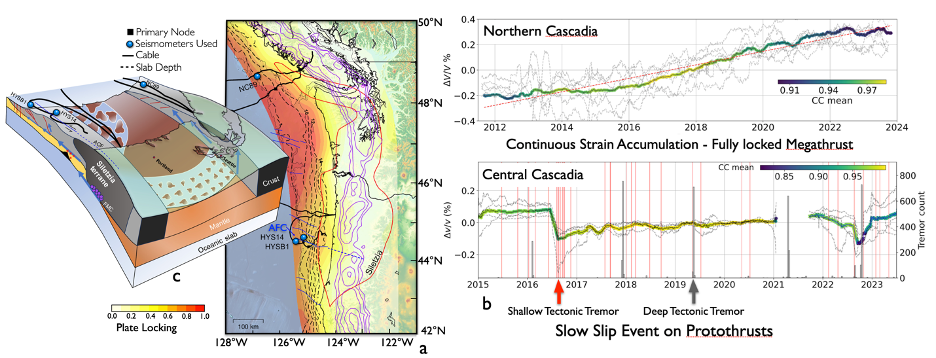
Figure 1 (after Kidiwela Figs 1-3) a) Cascadia Subduction Zone showing a model for the distribution of locking, depth to the down-going slab, strike-slip faults (blue lines) and location of Regional Cabled Array and Ocean Network Canada broadband seismometers used in this study. The Siletzia terrain, a large buried accreted basaltic body is outlined in red. b) Cross sections showing temporal changes in seismic velocities (dv/v) for the Northern and Central Caldera sites. Histograms for shallow (red) and deep (grey) tremor events shown for Central Caldera. c) The cross section shows fluid migration (blue arrows), splay faults and protothrusts (red lines) and the Alvin Canyon Fault (ACF). Down dip tremor, purple dots, match small locked proportions of the slab, Fluid transport along the décollement and the Alvin Canyon Fault are thought to modulate earthquake behavior.
The study demonstrates that seismic noise–derived velocity changes provide a sensitive proxy for real-time monitoring of fault zone hydromechanical processes. It provides new constraints on subduction zone segmentation, coupling, and earthquake rupture dynamics and demonstrates a powerful new way to monitor offshore fault zones, ultimately improving our understanding of when and how large earthquakes might occur in Cascadia.
___________________
Reference:
1Kidiwela, M., Denolle, M.A., Wilcock, W.S.D., and Feng, K-F (2026) Active protothrusts and fluid highways: Seismic noise reveals hidden subduction dynamics in Cascadia. Science Advances, 12; https://www.science.org/doi/10.1126/sciadv.aea3684.