
Life on Plastics: Deep-Sea Foraminiferal Colonization Patterns and Reproductive Morphology
Burkett (2025) reports plastic debris has become a persistent feature of deep-sea ecosystems, yet its role as a habitat for calcifying organisms remains poorly understood. Foraminifera colonization has been observed in significant numbers on plastic surfaces, suggesting that these materials serve as novel and significant deep-sea colonization sites for these abundant calcifying organisms. Her study uses deep-sea experimental plastic substrates to examine the colonization and reproductive morphology of the benthic foraminifera Lobatula wuellerstorfi across three locations. Two sampling locations used OOI platforms on the Oregon continental margin: the Endurance Oregon Offshore site (575 m), and the Regional Cabled Array Southern Hydrate Ridge site (774 m). The third location, Station M (4000 m) was on the abyssal plain off central California. 482 individuals were analyzed for morphometric traits to investigate reproductive morphotypes. One feature examined was the proloculus diameter. The proloculus is the first chamber formed by the foraminifera. In L. wuellerstorfi, the proloculus is the spherical feature visible at the foraminifera center (see Fig. 2, specimen 4f).
The more traditional test morphology of L. wuellerstorfi —characterized by a flattened, biconvex test and consistently elevated and pore-free sutures — is well represented in the Oregon specimens. These samples also displayed a clear bimodal proloculus size distribution, consistent with alternating reproductive strategies, while Station M populations exhibited a broader, less defined bimodal distribution skewed toward megalospheric forms. This variation likely reflects environmentally driven morphologic responses rather than taxonomic divergence. Burkett’s findings demonstrate that plastics can serve as persistent colonization sites for deep-sea foraminifera, offering a unique experimental platform to investigate benthic population dynamics, ecological plasticity, and potential geochemical implications, as well as the broader impacts of foraminifera on deep-sea biodiversity and biogeochemical cycling.
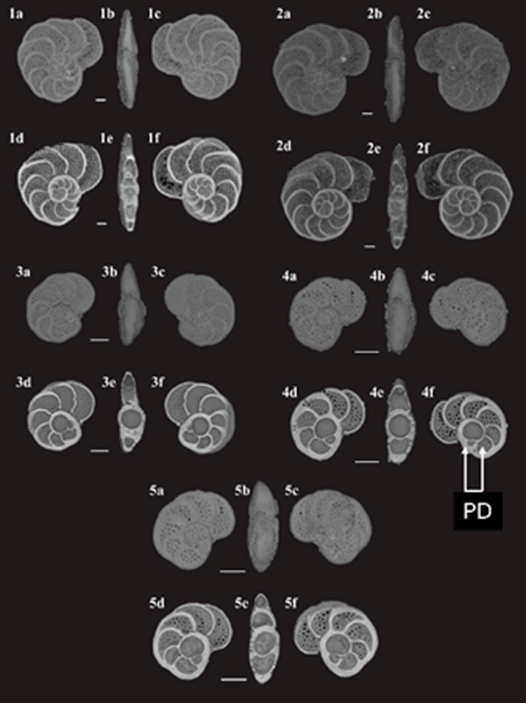
Lobatula wuellerstorfi specimens recovered from plastic substrates at the OOI Endurance Oregon Offshore (575 m water depth) after 264 days of deployment. Each specimen (1–5) is shown in six standardized views for comparative analysis. Specimens 1 and 2 represent microspheric forms; specimens 3–5 are megalospheric individuals that recently completed their first whorl and are smaller in overall test diameter. All scale bars = 100 μm. The proloculus diameter, PD, is indicated on specimen 4f.
___________________
Reference:
Burkett, A.M. Life on Plastics: Deep-Sea Foraminiferal Colonization Patterns and Reproductive Morphology. J. Mar. Sci. Eng. 2025, 13, 1597. https://doi.org/10.3390/jmse13081597