
Archive for June 2020
Return to Sea in the COVID-19 era
The R/V Neil Armstrong returned to its home port in Woods Hole, MA, on 16 June 2020, having completed a successful 10-day mission to service the Pioneer Array, 75 nautical miles south of Martha’s Vineyard. Its crew and nine-member science party from Woods Hole Oceanographic Institution proved that it is possible to work onboard while adhering to strict precautionary measures to prevent the spread of the coronavirus.
The expedition was the first science mission to have departed Woods Hole, MA following a “pause” in research expeditions imposed in March by UNOLS (University-National Oceanographic Laboratory System). UNOLS coordinates the U.S. academic research fleet ship schedules and has established guidelines for COVID prevention and mitigation aboard these ships.
“The preparation was arduous and comprehensive” said Al Plueddemann, Chief Scientist for the Pioneer Array expedition. “That preparation paid off with a cruise that completed everything we set out to do.” Plueddemann led the scientific team in a partial “turn” of the moored array, which means that equipment that had been deployed was recovered for refurbishment, and replaced with equipment that could undergo the rigors of being at sea, collecting, and recording data for the next six months. Over the 10 days, the team deployed five Coastal Profiler Moorings (CPMs) and recovered seven CPMs. In addition to the mooring turns, the expedition included many CTD casts (measuring Conductivity, Temperature and Depth) in the vicinity of the Pioneer Array, and the collection of shipboard meteorological and oceanographic data, both while on station next to the moorings, and while underway along specific track lines.
On top of what would be accomplished under normal operating conditions, the team was able to provide data in real-time to scientists who would normally be onboard, but whose participation was limited due to COVID-19 restrictions. Through an innovative use of data telemetry from the ship, WHOI’s Shipboard Scientific Services Group made it possible for members of the Northeast U.S. Shelf Long-Term Ecological Research (NES-LTER) team to receive data and images of phytoplankton and microzooplankton in near-real-time along the cruise track. The data were collected by Imaging FlowCytobots (IFCBs), which provide long term, high-resolution measurements of phytoplankton abundance and their cell properties.
“Our ability to conduct a near-normal cruise in the midst of the COVID-19 pandemic is a testament to the commitment to preparation from UNOLS and WHOI, and a reflection of the strong team within OOI and on the Armstrong” said Plueddemann. “We were all excited to get back to sea”.
The following is a collection of images from this successful mission.
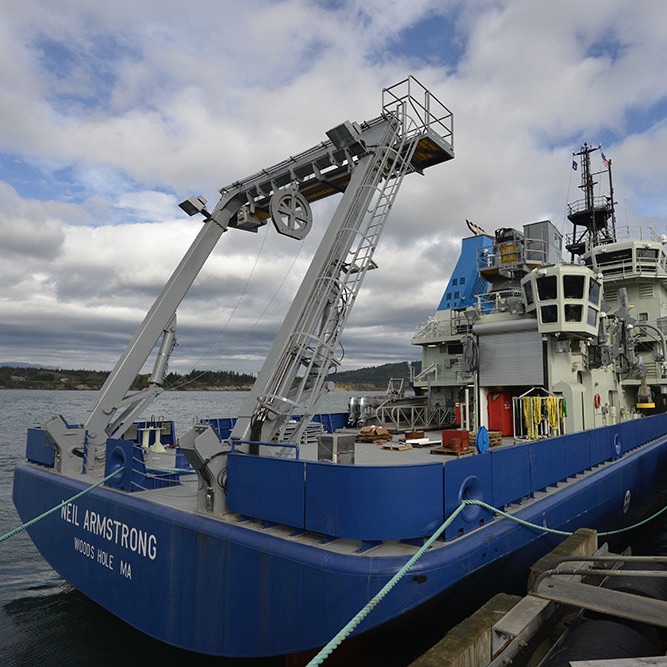
After 14 days of quarantine, a nine-person science team from Woods Hole Oceanographic Institution boarded the R/V Neil Armstrong on 5 June 2020 to prepare for a 10-day expedition to service the Pioneer Array, 75 nautical miles south of Martha’s Vineyard in the Atlantic Ocean.The expedition was the first science mission to depart Woods Hole, MA, with new COVID-19 precautions in place. Photo: © Woods Hole Oceanographic Institution, Rebecca Travis
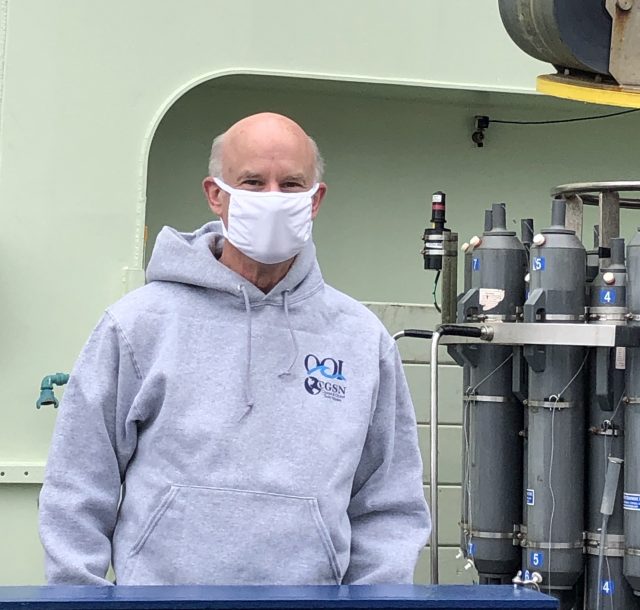
Chief Scientist of the Pioneer 14 Expedition, Al Pluedemann, models the uniform de rigueur —mandatory mask-wearing for the duration of the 10-day cruise. It was one of many stringent precautions taken to address the coronavirus pandemic. Photo: © Woods Hole Oceanographic Institution, Darlene Trew Crist
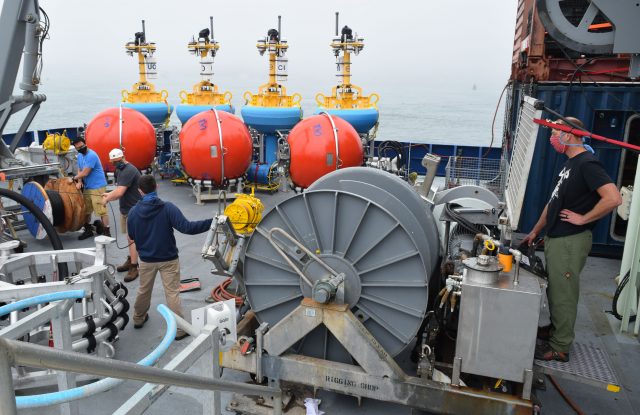
WHOI technicians (from left) Dan Bogorff, Nico Llanos, Chris Basque and Eric Hutt work to ensure that all equipment is in place as they prepare to head to the Pioneer Array. Photo: © Woods Hole Oceanographic Institution, Rebecca Travis
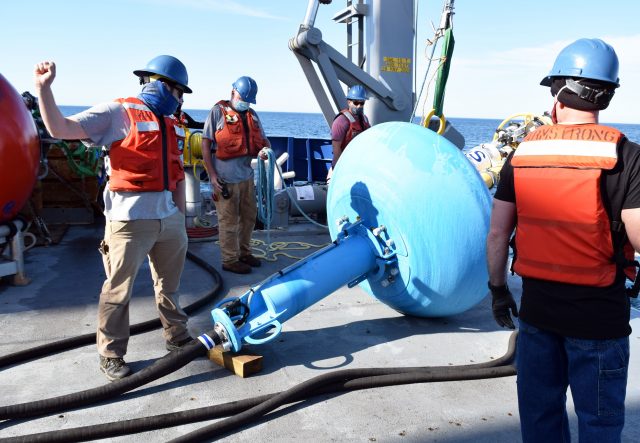
WHOI technician Chris Basque (far left) runs the deck while Bos’n Pete Liarikos and WHOI technician Nico Llanos (behind the buoy) assist in deploying the OSPM profiling mooring at Pioneer Array. Photo: © Woods Hole Oceanographic Institution, Rebecca Travis
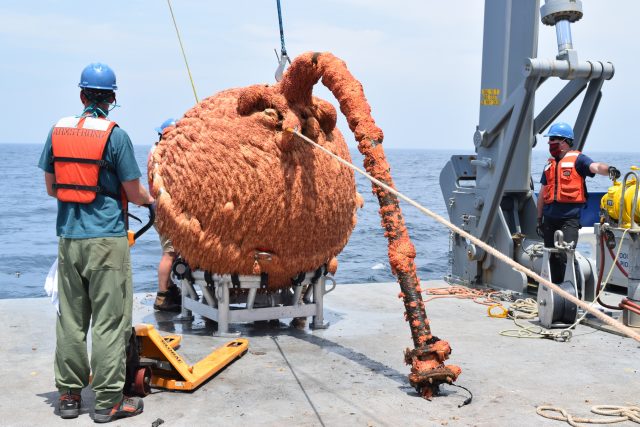
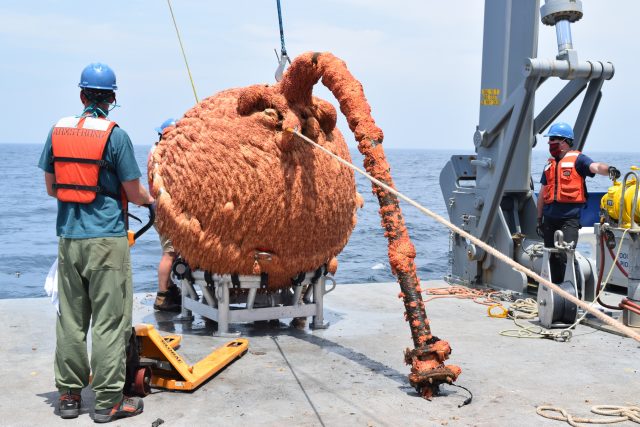
While this may look like Snuffleupagus on the back deck of the R/V Neil Armstrong, it is actually a profiler buoyancy sphere recovered on the Pioneer 14 cruise. The sphere is covered with marine growth after spending eight months in the water. Photo: © Woods Hole Oceanographic Institution, Rebecca Travis
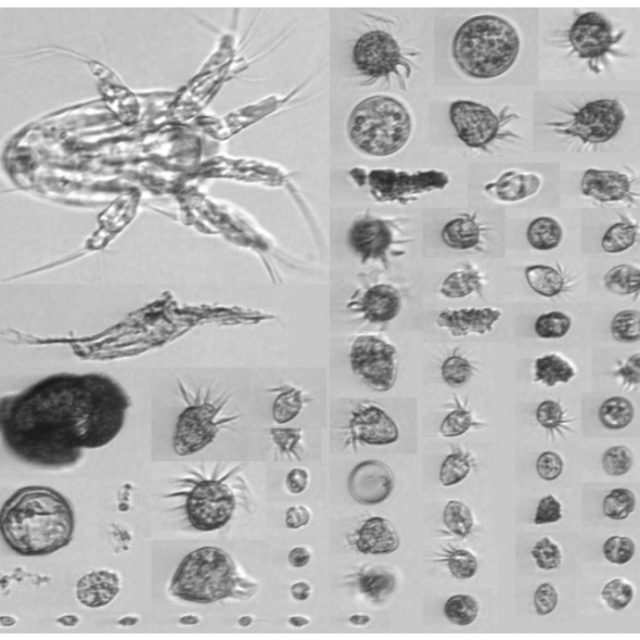
The Northeast U.S. Shelf Long-Term Ecological Research (NES-LTER) team, whose members would have been onboard under normal circumstances, remained onshore due to COVID-19 restrictions. But through an innovative use of data telemetry, Wood Hole Oceanographic Institution’s Shipboard Scientific Services Group made it possible for the NES-LTER team to receive data and images of phytoplankton and microzooplankton in near-real-time along the cruise track. Photo: NES-LTER
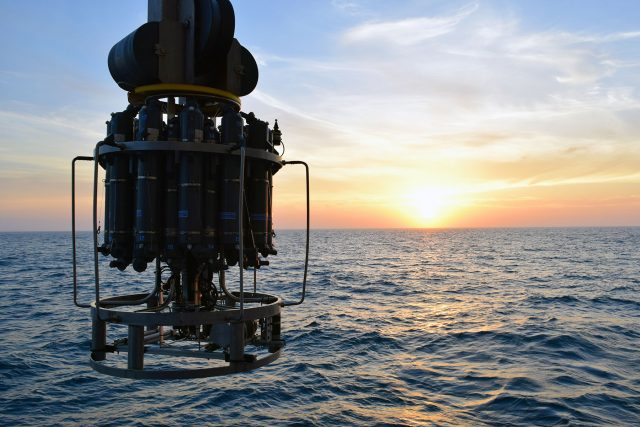
One of the rewards of working at sea is the peacefulness and beauty at the end of a long day aboard the R/V Neil Armstrong. Here the Pioneer 14 team got its just rewards as they lowered a CTD rosette frame into the Atlantic at sunset. Photo: © Woods Hole Oceanographic Institution, Rebecca Travis
Read MoreReady-to-use Educational Datasets Available
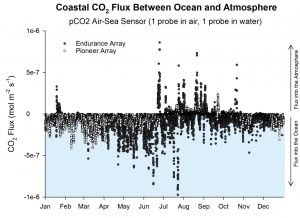
A new website of curated OOI datasets, called Data Nuggets, has launched. It contains valuable resources ready for integration into educational activities. The nuggets explore various concepts common in upper-level high school and introductory college courses and are designed and packaged to be readily accessible to educators to integrate into their existing curricula. Datasets were selected based on their quality and alignment with a broader OOI Science Theme.
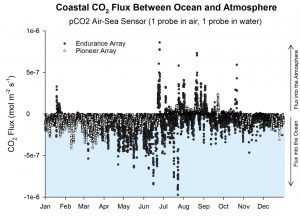 The nuggets were created as part of the National Science Foundation-funded OOI Synthesis & Education project, Ocean Data Lab, conducted by Rutgers University and led by the Consortium for Ocean Leadership.
For now, four data nuggets are available:
- 2015 Axial Seamount Eruption
- Seasonal Phytoplankton Blooms at High Latitudes
- Flux of CO2 Between Ocean and Atmosphere
- Seasonal Mixing of the Irminger Sea Water Column
The material provided in each nugget ranges from a description of scientific relevance to high resolution graphs to how use Python to pull and use OOI data in the classroom. The nuggets are designed to support educators as they design their own activities using OOI data.
More nuggets will be continually added so check the website often.
Read More
COVID-prevention, Quarantine, and Collaboration: Endurance Array 13 is Ready to Go
After two weeks of quarantine at home where possible, Airbnbs, and deserted family vacation homes, the 12-member Endurance Array team will head to Newport, Oregon on July 1 to board the R/V Thomas G. Thompson. As part of COVID-19 precautions, all of the needed equipment to service the Endurance Array will have been transported to the pier by non-seagoing staff prior to their arrival. The seagoing staff will simply arrive at the dock, load the ship, and then go to sea.
Under normal circumstances, the array is serviced – that is moorings are recovered and new ones deployed to ensure that the collection and transmission of ocean data continues seamlessly – twice a year. The regularly scheduled expedition this spring was canceled due to the coronavirus epidemic, so the cruise this summer will combine the work of the spring and fall expeditions.
“We are pleased to be able to get to the arrays this summer and to work aboard the R/V Thomas G. Thompson. This ship is large enough to give us all enough space to adequately social distance while onboard,” said Ed Dever, project scientist and principal investigator for the Endurance Array project. The ship will sail from its homeport in Seattle to meet the Endurance Array team in Newport, Oregon.
“With COVID-19 keeping some researchers on land, people are more interested than ever in the data that we collect remotely using the OOI. It’s important to have this opportunity to recover and replace the equipment at our Oregon and Washington lines,” Dever added.
The expedition will involve replacing seven moorings at six locations and the deployment of four gliders and four coastal surface piercing profilers. The team also will be measuring salinity, temperature, density, oxygen, and chlorophyll as a function of depth, during CTD casts before and after mooring recoveries. These onsite real-time data are publicly shared, as are all data continuously collected by the arrays throughout the year.
This expedition will involve three legs, traveling back and forth between different locations in the array and Newport to unload and pick up the huge coastal moorings. (Estimated weight of ~ 11 tons/per mooring). In total, the team will travel an estimated 1000 nautical miles during the expedition.
Dever’s OOI colleague Jon Fram at Oregon State University will be the chief scientist on this expedition. He remarked, “COVID-prevention has significantly changed operations onshore as well as while we are aboard the Thompson. Even for the seemingly simple task of ensuring that everyone had adequate masks for the duration, we tried out six different mask styles to find one that would be comfortable enough for everyone to wear for the duration of the journey. We also had to figure out how to achieve appropriate social distancing while onboard, which will change our normal operations.”
The Endurance Array team usually invites graduate students along on these expeditions to provide extra sets of hands, while offering mentoring opportunities and shipboard experiences for future potential marine scientists. During this summer expedition, only one graduate student will be onboard, who has previous experience on similar cruises.
Collaborative non-OOI scientific experiments, however, will take place. The Endurance Array team will gather the data rather than the non-OOI scientists involved, who would normally be onboard. Three different non-OOI experiments will occur. The first involves Linsey Haram of the Smithsonian, who collects fouling communities that grow on panels attached to OOI buoys. Ashley Burkett of Oklahoma State University is involved in the next, which entails collecting settling organisms on devices attached to the Seafloor Multi-Function Nodes (MFN) at the base of some surface moorings and act both as an anchor as well as a platform to affix instruments. The third, proposed by Taylor Chapple of Oregon State University, involves testing deployment of tagged fish acoustic monitors on the Near-Surface Instrument Frame (NSIF), a cage containing subsurface oceanographic instruments attached to multiple data concentrator logger computers.
Added Dever, “These three experiments are great examples of how scientists can become involved in the OOI and access the data they need. They demonstrate how scientists can have access to ocean data without ever having set foot aboard a ship.”
After the Endurance Team’s expedition, the Regional Cabled Array team will board the R/V Thomas G. Thompson on 30 July to begin a month-long expedition to service the RCA array, which provides power and equipment to a multitude of data gathering ocean equipment on the ocean floor.
Read MoreShipboard Data Transmission to Onshore Partners in Real-time
A team from Woods Hole Oceanographic Institution (WHOI) was onboard the R/V Neil Armstrong at the Pioneer Array, about 75 nautical miles south of Martha’s Vineyard in the Atlantic, deploying equipment and collecting data. Due to COVID-19 restrictions, the number of the science party onboard was limited. These limits prevented participation by the Northeast U.S. Shelf Long-Term Ecological Research (NES-LTER) team, whose members would have been onboard under normal circumstances.
But through an innovative use of onboard technology, WHOI’s Shipboard Scientific Services Group made it possible for the NES-LTER team to receive data and images of phytoplankton and microzooplankton in near-real-time along the cruise track. The data were collected by Imaging FlowCytobots (IFCBs), which provide long term, high-resolution measurements of phytoplankton abundance and their cell properties. The data can be viewed here.
Said WHOI researcher Taylor Crockford from her research laboratory on land, who beta-tested the data transmission with the WHOI onboard team, “In this challenging time of the Coronavirus, we are thankful for this opportunity to continue long-term research into the productivity and food web on the Northeast U.S. Shelf while the cruise was underway.”
The Ocean Observatories Initiative is funded by the National Science Foundation.
Read MoreTeam Headed to Pioneer Array
After ten weeks of preparation, two weeks of isolation, documentation of negative COVID-19 tests, temperatures taken, and personal protective gear in place, nine science team members from Woods Hole Oceanographic Institution (WHOI) will depart on the R/V Neil Armstrong from Woods Hole, MA on Sunday 7 June 2020 for an 11-day expedition to service the Pioneer Array, a collection of ocean observing equipment off the New England coast, about 75 nautical miles south of Martha’s Vineyard.
The Pioneer mission is the first science expedition to leave Woods Hole following a “pause” in research expeditions imposed in March by UNOLS (University-National Oceanographic Laboratory System). UNOLS coordinates the U.S. academic research fleet ship schedules and has established guidelines for COVID prevention and mitigation aboard these ships. The journey aboard the R/V Neil Armstrong is the second UNOLS science expedition to leave port with new stringent COVID-prevention protocols in place.
“We’ve worked extremely hard to implement measures that will help ensure the safety and health of our scientific party and crew members aboard the R/V Neil Armstrong,” said Al Plueddemann, chief scientist for the Pioneer Array expedition and a research scientist at WHOI. “It’s been an extensive planning and re-planning effort as our procedures had to adapt to changing circumstances.”
“We’ve had to reduce our scientific team significantly to ensure there is enough social distancing room aboard the ship, and condense the work into one cruise leg instead of two, which forced us to scale back the scientific mission, as well. But with the extensive precautionary measures in place, we are able to provide much needed service to the array, while also ensuring the cruise is sufficiently low risk to all personnel involved.”
The Pioneer Array is a collection of long-term oceanographic observing equipment that provides continuous ocean measurements over a period of years. The data collected are sent via satellite to a network server on shore for use by scientists, educators, and others. The data are available for everyone to use in as near real-time as possible. These long time-series data are helping to advance ocean research, understanding of ocean processes, and the changing ocean. The equipment requires regular maintenance to ensure that it can continually collect and disseminate biological, physical, and chemical ocean observations for the the oceanographic community and others who have come to rely on it. The Pioneer Array is one of five ocean observing arrays collecting real-time ocean data as part of the National Science Foundation funded Ocean Observatories Initiative.
Extensive precautionary measures were necessary to enable the ship and its passengers to conduct the science mission safely during the COVID-19 pandemic.
“Preparations began with trying to figure out the appropriate length and circumstances under which the scientific party and crew members could quarantine prior to heading out to sea, then evolved into gaining access to COVID-19 testing and labs to process the results, determining how to house the scientific party while in quarantine and onboard the vessel, and defining social distancing and protective gear that would be needed while at sea,” said Derek Buffitt, program manager for the Coastal Global Scale Node arrays, which includes the Pioneer Array.
Once such decisions were made, other practical considerations were tackled, such as how to:
- store used personal protective gear while at sea for onshore disposal,
- arrange bunks to minimize shared space,
- feed passengers and maintain social distances in shared common spaces,
- maintain the operational safety of the smaller science party,
- prioritize the scientific objectives to ensure the most effective use of the ship time, and
- respond if someone presented COVID-19 symptoms while at sea.
“The Pioneer expedition departure on Sunday will represent the successful culmination of preparations for the new normal of conducting research at sea during a pandemic,” added Plueddemann.
Read More