Archive for February 2022
Distributed Acoustic Sensing Lays Groundwork for Earthquake, Tsunami Warnings, and More
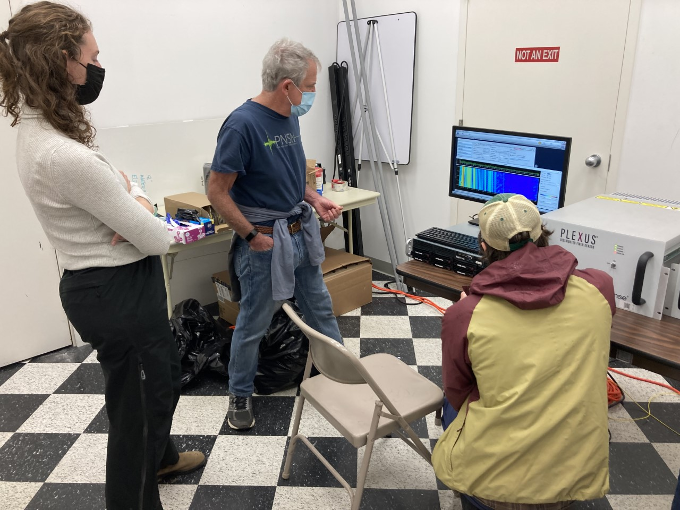
Researchers using the OOI Regional Cabled Array are at the forefront of testing Distributed Acoustic Sensing (DAS) along the seafloor through funding from the National Science Foundation. Ocean-bottom DAS using submarine fiber optic cables promises to advance what we know about marine geology, offshore earthquakes, ocean currents, ocean waves, sediment transport, marine mammals, and a host of other activities that now can be measured by this revolutionary technique.
Taking advantage of a rare temporary shutdown of RCA’s submarine fiber optic cables during a shore station maintenance period, University of Washington Researcher William Wilcock and California Institute of Technology (Caltech) Graduate Student in Geophysics Ethan Williams were part of a team of scientists who installed DAS interrogators on RCA’s “dark cables” to test and collect data for a community experiment. The experiment was designed to determine the potential of submarine DAS to observe seismic, oceanographic, acoustic and geodetic processes. Each interrogator transmitted laser pulses down the fiber optic cable from RCA’s shore station and across the offshore Cascadia Margin and recorded the echoes that came back. This backscatter remains constant until some movement on the bottom or in the water column perturbs the fibers in the cable, changing the pattern of backscattered light. By rapidly probing the cable hundreds of times per second, DAS allows researchers to monitor what’s happening in the cable environment.
“Using DAS, the fiber optic cable acts, in effect, like a line of seismometers that can measure the stretching and contracting of the ground, “explained Wilcock. “It’s an amazing technology, similar to going out in the field and putting a seismic instrument every 10 meters for a stretch of 100 kilometers. So it’s just astounding in terms of what it can potentially measure,” said Wilcock.
The DAS system also has the capability of measuring other oceanographic signals. “It turns out that ocean bottom acoustic sensing on these fiber optic cables is as sensitive to the water layer above as it is to the solid Earth below. This sensitivity provides all sorts of really interesting signals that you would normally observe using an ocean bottom pressure sensor. DAS is opening up the door for lots of interesting research opportunities,” said Williams, who has been working with DAS systems for years under the supervision of Zhongwen Zhan at Caltech, one of the world’s foremost experts in the field.
Among the many potential ways DAS data might be used include advancing earthquake and tsunami early warning systems, and understanding wave and current action, sediment transport, and ocean-generated seismic noise, as well as providing biological information. In Wilcock’s case, he’s excited about using DAS to gain access to fin whale calls that were picked up by this DAS experiment.
The National Science Foundation funded this experiment in the hopes of developing protocols that can support the use of DAS for science and hazards mitigation in the Northeast Pacific while meeting national security requirements. The U.S. Navy conducted a preliminary review of the data and subsequently released the data for public use. The data are being stored on RCA servers at the University of Washington. Researchers will have ftp access to the data at this link. But because the full data set is 26 terabytes, researchers can also email ooicable@uw.edu to arrange to provide disks that will be returned with data they are interested in.
Four days of continuous measurements in this dynamic offshore environment also offer a potential treasure trove of data. Graduate student Williams is turning his attention to exploring these datasets and calibrating them against conventional measurements to better understand what some of the potential applications may be. “I’m very excited about the potential DAS brings to understanding what’s happening on the seafloor. Having, in essence, so many seismometers on the ocean floor means that we can apply all sorts of array-based processing so we’re not only averaging in time, we’re combining information in space. And this allows a lot of really innovative things that we weren’t able to do before.”
“But the real value of these datasets comes from being an open dataset. It will be a great facilitator for learning with the potential to expand general knowledge about how to use DAS in the marine geology and marine geophysics world, which is great,” Williams added.
Both Wilcock and Williams were excited about the potential for DAS to open up understanding of the processes involved in this deep-sea world. They both mentioned a dream of having DAS sensors integrated into future SMART cable technology to expand DAS use on land and in the sea.
Read More
WHOI’s Jim Edson to Replace John Trowbridge as OOI’s Principal Investigator
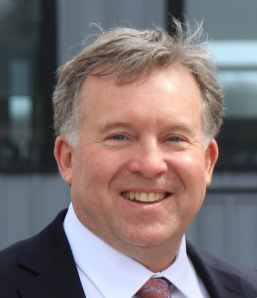
The National Science Foundation has approved the appointment of Dr. James B. Edson as the new Principal Investigator (PI) of the Ocean Observatories Initiative (OOI) Program Management Office (PMO). Edson will assume his responsibilities on March 1, taking over for Dr. John Trowbridge, who announced his intention to leave for a new position in January and has led the PMO from October 2018, when the program management office was moved to the Woods Hole Oceanographic Institution (WHOI) from the Consortium for Ocean Leadership (COL) in Washington, D.C.
“John’s done an exceptional job leading OOI and leaves very big shoes to fill, and we are delighted to have Jim assume the reins and are confident in his ability to lead OOI through the leadership transition and beyond” said Rick Murray, WHOI Deputy Director and Vice President for Science and Engineering, who led the search for Trowbridge’s replacement. “Jim has a phenomenal depth of knowledge about OOI’s early years, having served [with Trowbridge] on the ORION Science & Technology Advisory Committee during the OOI planning stages and as a member and chair of the OOI Program Advisory Committee from 2008-2013. Plus, Jim brings a wealth of experience running large government programs and academic departments. We share his excitement in leading OOI.”
Edson was an Assistant through Associate Scientist with tenure in the Department of Applied Ocean Physics and Engineering at WHOI from 1991 to 2004. He also served as a rotator at the Office of Naval Research from 1998-1999. His research interests include boundary-layer meteorology, with a focus on surface-layer turbulence, air-sea interaction and flux parameterizations. During this period, Edson was Chief Scientist for the Office of Naval Research Coupled Boundary Layers and Air-Sea Transfer (CBLAST) Defense Research Initiative, and Principal Investigator for the Construction and Management of the Martha’s Vineyard Coastal Observatory and its Air-Sea Interaction Tower at WHOI. Edson was Professor and Head of Marine Sciences at the University of Connecticut (UConn) from 2005 to 2017, where he led UConn’s successful effort to join the University Corporation for Atmospheric Research, served as UConn’s member representative for the COL, and oversaw the upgrade and stretch of the R/V Connecticut. He rejoined WHOI in 2018 as a Senior Scientist.
Edson is a fellow of the American Meteorological Society and member of the American Geophysical Union. He has written more than 80 scientific articles and has contributed to 18 scientific books. Edson received a PhD in meteorology from the Pennsylvania State University.
Edson assumes the leadership of an organization that is in excellent shape due to Trowbridge’s leadership. Among many innovations during his tenure, Trowbridge oversaw the development and launch of a new data delivery system, Data Explorer, and the transition of the cyberinfrastructure network to a new state-of-the-art data center at Oregon State University. Despite challenges imposed by costs to upgrade cyberinfrastructure, a flat budget, and Covid-19, Trowbridge ensured that the program accomplished the full scope of marine operations while staying within budget. Trowbridge enabled a highly motivated and capable team, established productive relationships within the Program and with NSF and the Ocean Observatories Initiative Facilities Board, and led a robust community engagement effort.
To ensure a smooth transition, Trowbridge will end his service as the OOI PI on March 1, but will continue half-time to support Edson during a four-month transition period. On June 30, Edson will begin his tenure as the full-time OOI PI.
The Ocean Observatories Initiative is a long-term infrastructure project funded by the National Science Foundation to gather physical, chemical, and biological data from the ocean, atmosphere, and seafloor and to deliver that data on demand and in near real-time online. The program includes moored instrument arrays and autonomous underwater vehicles deployed at critical locations in the coastal and open ocean worldwide. Data from the observatories help researchers address questions across short and long time periods, small and large spatial scales, and from the ocean surface to the seafloor. OOI is managed by the Woods Hole Oceanographic Institution (WHOI) and implemented by WHOI, the University of Washington, and Oregon State University.
Read MoreAxial Seamount Continues to Reveal Its Secrets
Adapted and condensed by OOI from Chadwick et al., 2022, doi:/10.1029/2021GC010153.
Axial Seamount is the longest monitored mid-ocean ridge volcano, providing new insights into the relationships among magma supply, uplift-deflation behavior, and seismicity leading to and follow eruptions. Results are as summarized here.
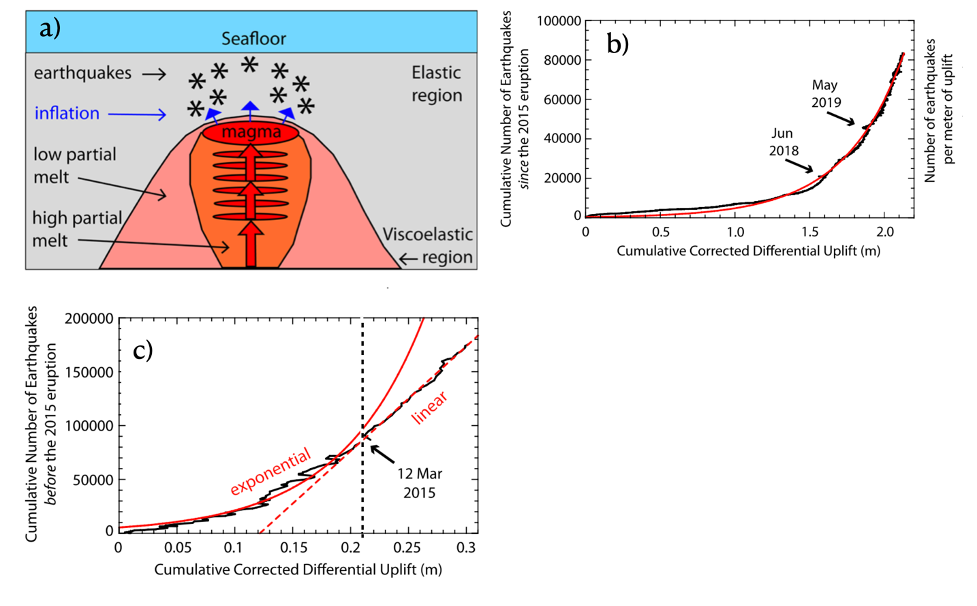
[media-caption path="/wp-content/uploads/2022/02/Axial.png" link="#"]a) Cross section cartoon showing shallow magma chamber beneath Axial fed by a series of stacked sills. Upward migrating of melt through the sills results increases pressure in the shallow chamber causing uplift and associated earthquakes. b) Exponential increase in earthquakes per meter of uplift since the 2015 eruption. c) Earthquakes per meter of uplift before March 12, 2015 follow an exponential increase, while post this day earthquakes follow a linear trend leading up to the April 24, 2015 eruption. (After Chadwick et al., 2022; Figures 6 and 13).[/media-caption]The magma supply rate has changed significantly over periods of months to years. Since the 2015 eruption, the summit of the volcano has been inflating at a decreasing rate. This re-inflation was punctuated by eight discrete short-term deflation events occurring over 1-3 weeks, approximately every 4-6 months from August 2016 to May 2019. These deflation events were coincident with an abrupt decrease in seismic activity, which did not pick up until reinflation resumed. In contrast, the long-term monitoring indicates that there was a surge in magma supply between 2011 and 2015, resulting in the two eruptions closely spaced in time.
Although the summit of the volcano has inflated 85%-90% of its pre 2015 eruption level, the geodetic and seismic monitoring suggests that the magma supply rate has been waning since 2015, pushing the forecast for the next eruption out 4-9 years. The data since 2015 also show that the deformation and seismic activity are tightly coupled, showing an exponential increase in seismic activity per unit of uplift. A significant conclusion from this study is that the transition from an exponential to linear increase in seismic activity to total uplift may indicate impending crustal failure between the shallow magma chamber and the seafloor. In concert, these results may lead to more refined forecasting of future eruptions of this highly active volcano and the testing of hypotheses concerning the short-term deflation events.
__________________________________________________________
Chadwick, W.W., Jr., W.S.D. Wilcock, S.L. Nooner, J.W Beeson, A.M. Sawyer, and T.-K. Lau (2022) Geodetic monitoring at Axial Seamount since its 2015 eruption reveals a waning magma supply and tightly linked rates of deformation and seismicity. Geochemistry, Geophysics, Geosystems, 23, e2021GC01053.
Read MoreOOI at Ocean Sciences Meeting 2022
The following is a compilation of OOI-related presentations at this year’s Ocean Sciences Meeting. OOI sponsored a virtual booth at OSM this year. Content and presenters are highlighted in the blue boxes below.
If we have missed any OOI-related sessions, please contact dtrewcrist@whoi.edu and we will be glad to add them.
[feature]
OOI Virtual Booth Sessions
Please register at the links below. Attendance at the Ocean Sciences Meeting is not required for OOI virtual booth sessions.
Monday 28 Feb 2022
Update on Moving the Pioneer Array to the Southern Mid-Atlantic Bight: Lisa Clough, National Science Foundation and Al Plueddemann and Derek Buffitt, Woods Hole Oceanographic Institution
[embed]https://vimeo.com/683052826[/embed]Tuesday 1 March 2022
OOI and Extreme Events: Ke Chen, Woods Hole Oceanographic Institution and Hillary Scannell, Lamont-Doherty Earth Observatory will discuss marine heat waves. Ed Dever, Oregon State University will present on extreme high PCO2 events in the Pacific.
[embed]https://vimeo.com/683823106[/embed]Wednesday 2 March 2022
OOI Data and the Carbon System: Wendi Ruef, University of Washington, Chris Wingard, Oregon State University, and Andrew Reed of Woods Hole Oceanographic Institution will share practical ways researchers can work with and integrate PCO2 and pH data into their research.
[embed]https://vimeo.com/683983211[/embed]Thursday 3 March 2022
Lightning Talks Redux: In case you missed the lightning talks at the OOIFB Town Hall on Friday, 25 February, this is another chance to hear presenters give quick and lively talks about their research and how they are using OOI data to answer scientific questions.
[embed]https://vimeo.com/684418256[/embed]Friday 4 March 2022
OOI Data in the Classroom: Janice McDonnell and Sage Lichtenwalner, Rutgers Center for Ocean Observing Leadership, presented on the OOI Data Lab Manual created by Ocean Data Labs. Cheryl Greengrove, University of Washington, shared innovative ways she is using OOI data to inspire undergraduate students. Elizabeth (Lisa) Rom, National Science Foundation, addressed funding opportunities for OOI education and research initiatives, and Dax Soule, City University of New York, shared how Project EDDIE can be integrated into the classroom.
[embed]https://vimeo.com/685549506[/embed][/feature]
[feature]
OOI at OSM
Friday February 25 2022
noon-1 pm Eastern
TH08 The Ocean Observatories Initiative Facility Board (OOIFB) Town Hall
Lead organizer: Annette DeSilva, University of Rhode Island (desilva@uri.edu)
Tuesday 1 March 2022
9-11 pm Eastern
pH and pCO2 Time Series from the Ocean Observatories Initiative Endurance Array
Presenter: Ed Dever, Oregon State University (Edward.Dever@oregonstate.edu)
Wednesday 2 March 2022
10:30 am Eastern
Six Year Time-Series of Particulate Organic Carbon Flux in the Subpolar North Atlantic from Ocean Observatories Initiative Bio-Optical Data
Presenter: Jose Cuevas, Boston College (cuevasjo@bc.edu)
Thursday 3 March 2022
11:30-12:30 pm Eastern
Mesoscale and Submesoscale Shelf-Ocean Exchanges Initialize an Advective Marine Heatwave
Presenter: Ke Chen, Woods Hole Oceanographic Institution (kchen@whoi.edu)
5:20 pm Eastern
Influence of Biological and Physical Processes on Carbon Uptake over Annual Cycles in the Irminger Sea
Presenter: Kristen Fogaren, Boston College (kfogaren@bc.edu)
Friday 4 March 2022
11:35 am Eastern
Constraining the mixed layer carbon budget in the Irminger Sea using autonomous mooring observations
Presenter: Meg Yoder, Boston College (yoderma@bc.edu)
12:30-1:30 pm Eastern
Categorizing wind events that cause the fall stratification breakdown on the New England Shelf
Presenter: Lucas Lobert, Woods Hole Oceanographic Institution (Llobert@whoi.edu)
3:35 pm Eastern
Robust climatologies of subsurface ocean conditions on the continental shelf and slope along the Newport Hydrographic Line, Oregon, USA, during 1997–2021
Presenter: Melanie Fewings, Oregon State University (melanie.fewings@oregonstate.edu)
5-6 pm Eastern
On the Vertical Structure of Deep Ocean Subinertial Variability
Presenter: John Toole, Woods Hole Oceanographic Institution (jtoole@whoi.edu)
5-6 pm Eastern
OT06 Ocean Observatory Science – Connecting Processes from Events to Climate 01
Lead Organizer: Richard Dewey, (rdewey@uvic.ca)
5:00 pm Quality control and validation of OOI carbon system measurements in the Irminger Sea
Presenter: Andrew Reed, Woods Hole Oceanographic Institution (areed@whoi.edu)
5:05 pm Making available more than two decades of mooring and ship-based observations from the Newport Hydrographic Line
Presenter: Craig Risien, Oregon State University (craig.risien@oregonstate.edu)
5:10 pm A doorway to data: Accessing and exploring OOI data using the InteractiveOceans portal
Presenter: Michael Vardaro, University of Washington (mvardaro@uw.edu)
5:15 pm Basin-scale climate forcing of carbon flux to the deep ocean
Presenter: Maureen Conte, Bermuda Institute of Ocean Sciences (mconte@mbl.edu)
5:20 pm A first look at megabenthic community responses to seasonal change using the new Holyrood Underwater Observatory in Conception Bay, NL
Presenter: Rylan Command, Memorial University of Newfoundland (rylan.command@mi.mun.ca)
5:25 pm Ocean Networks Canada’s fifteen years of observatory science
Presenter: Richard Dewey, University of Victoria (rdewey@uvic.ca)
6-7 pm Eastern
OT06 Ocean Observatory Science – Connecting Processes from Events to Climate 02
Lead Organizer: Richard Dewey, (rdewey@uvic.ca)
6:00 pm A purpose-built integrated ocean observatory captures physical mechanisms driving spatial and inter-annual variability within an Antarctic coastal canyon
Presenter: Josh Kohut, Rutgers University (kohut@marine.rutgers.edu)
6:05 pm Estimating gross primary production from Diel measurements of oxygen and pH from underwater gliders
Presenter: Stephen Huie, California State University Monterey Bay (shuie@csumb.edu))
6:10 pm OOI protocols, workflows, and user tools provide high-quality, research-ready oceanographic data
Presenter: Wendi Ruef, University of Washington (wruef@uw.edu)
6:15 pm Event detection using QARTOD quality control flags: Examples from OOI Argentine Basin and Irminger Sea Arrays
Presenter: Andrew Reed, Woods Hole Oceanographic Institution (areed@whoi.edu)
6:20 pm An all-weather sea surface wind speed product from microwave radiometers
Presenter: Suleiman Alsweiss, Global Science & Technology Inc. (suleiman.alsweiss@noaa.gov)
6:25 pm Improvements and new applications of high-frequency radar for coastal ocean observing systems
Presenter: Libe Washburn, University of California, Santa Barbara (libe.washburn@ucsb.edu)
[/feature]
Read MoreObservations of Cross-Shelf Nitrate Fluxes over the Oregon Continental Shelf
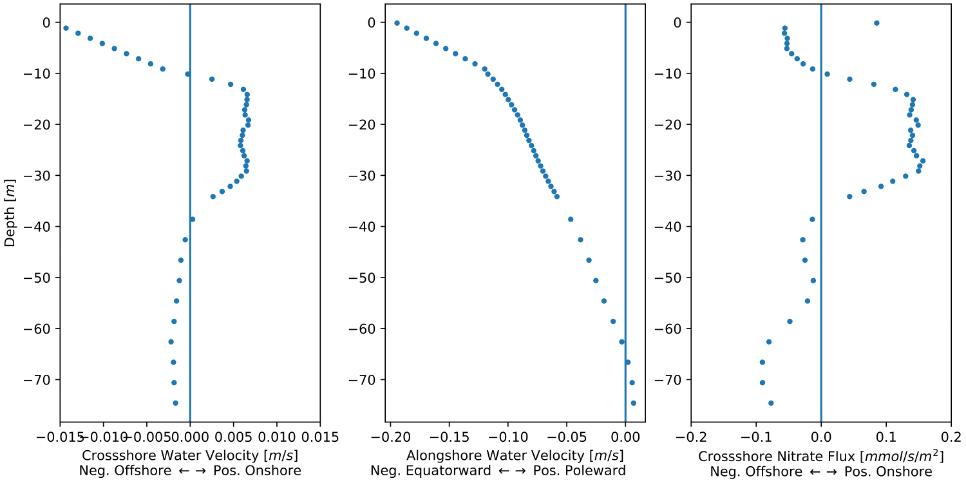
Extracted from OOI Quarterly Report, 2022.
The US Pacific Northwest coastal ecosystems are primarily limited in growth from nitrate supply. The nitrate supply that drives the highly productive marine growth in this region is primarily a result of wind driven coastal upwelling. This work seeks to investigate cross-shelf nitrate fluxes over the continental shelf off the coast of Oregon following the installation of new nitrate and Acoustic Doppler current profilers (ADCPs) in the Ocean Observatories Initiative Coastal Endurance Array.
[media-caption path="/wp-content/uploads/2022/02/Endurance.png" link="#"]Figure 24. A velocity and nitrate profile from the shelf site at the Newport line. Data used was from the 2019 summer, approximately mid-June to early October (deployments 13, 14, and 15). The net nitrate flux found at that site over this time period, found by vertically integrating the values above, is roughly 1.16 mmol Nitrate/second/meter coastline. [/media-caption]
The primary onshore flow of nitrate-rich water over the continental shelf is found to originate at the middle depths, consistent with previous research in the region. However, the upwelling and cross-shelf nitrate fluxes on the continental shelf are found to be in poor agreement with common upwelling indices, e.g., coastal upwelling transport index (CUTI) and biologically effective upwelling transport index (BEUTI). Several factors for this disagreement are proposed, including the focus of the indices on dynamics farther offshore of the continental shelf. Observed coastal wind stress, calculated on a weekly rolling average, is found to be a potential alternative for predicting nearshore nitrate concentrations. Farther offshore at the mid-shelf, only a weak correlation between observed wind stress and observed surface transport is found, suggesting the need for additional dynamics to fully explain the observed surface transport and nitrate fluxes. Correctly modelling the nitrate supply for coastal ecosystems is essential for predicting phytoplankton blooms that are vital to the production of fisheries on the coast. Thus, understanding these limitations is of great importance for ocean-driven coastal economies.
Written by Andrew Scherer, California State University, Monterey Bay and Cleveland State University and Thomas Connolly, Moss Landing Marine Laboratories, San José State University
Andrew Scherer is an undergraduate physics student at Cleveland State University. In summer 2021, he performed this research with Prof. Tom Connolly (MLML, SJSU) as part of a National Science Foundation Research Experience for Undergraduates program and presented it at the Eastern Pacific Ocean Conference Stanford Sierra Center, Fallen Leaf Lake, California 26-29 Sep 2021.
Read MoreApplications Open for June Northeast Pacific OOIFB Workshop
The Ocean Observatories Initiative Facility Board (OOIFB) will host a workshop focusing on current and future science that can be addressed using data from OOI’s infrastructure in the Northeast Pacific and other regional observatory arrays. The workshop will be held at the OSU Portland Center in Portland, OR on June 7-9, 2022. This workshop was scheduled to be held in 2020, but was postponed due to the COVID-19 pandemic. The OOIFB is hopeful that in June 2022 members of OOI’s community can safely come together for a productive workshop. A hybrid model with in-person along with options for virtual participation is planned.
The workshop is aimed at researchers who are using or are considering using OOI data; resource managers from national, state, and tribal agencies; and educators at all levels interested in using data from the OOI’s Regional Cabled, Coastal Endurance, and Global Station Papa Arrays.
The workshop will inform the research community of the available data and science opportunities offered by the OOI and other observatory arrays located in the Northeast Pacific. An overview of OOI data products, user interfaces, and system features will be provided along with hands-on demonstrations using data access tools. OOI Program Team members and NSF representatives will be on hand to answer questions and provide information on OOI operations.
The workshop will provide a forum to facilitate science collaborations, identify strategies for engaging future users of OOI, and build cross-network collaborations. Community-building and expanding broader impacts will be discussed. Workshop participants will have the opportunity to provide feedback on their experiences in working with the OOI systems and data.
To apply for the workshop, please complete the on-line application form that is available on the workshop web page. Please indicate how you plan to participate in the workshop (in person or virtual) when completing the form. Travel support is available, but limited. Broad representation from institutional, geographic, and disciplinary groups is desired and will be considered in participant selection. The deadline for applications is March 20, 2022.
Additional details about the workshop and agenda are available here.