Archive for September 2024
Irminger Sea Wind Speed Validation
The Irminger Sea in the North Atlantic is a stormy, windy place. Consequently, it is an area of interest for studying the flux balance of heat, momentum, and biogeochemically important gasses such as CO2. The Ocean Observatories Initiative (OOI) deploys meteorological instruments in the Irminger Sea, as part of the OOI Global Irminger Sea Array, to collect in-situ observations in this relatively undersampled region. The goal is to deliver high-quality, long-term observations to the ocean science community to study these, and many more, questions of interest.
Validating these measurements is an important part of delivering quality data to the ocean science community. This summer, rising senior at California State University – Monterey Bay Aaron Wickware took on the challenge of validating OOI wind measurements in the Irminger Sea. Aaron was a Woods Hole Partnership in Education Program (PEP) scholar. PEP is a program designed primarily for college juniors and seniors from underrepresented groups who want to spend a summer gaining practical experience in marine and environmental science. The program consists of an accredited course in global climate change and a ten-week research project.
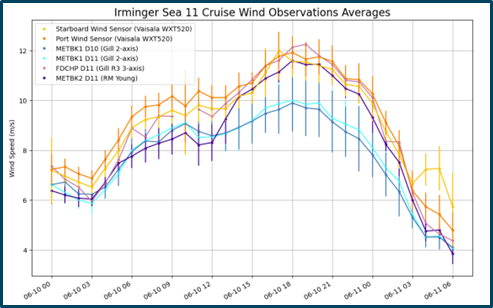
At Aaron’s disposal were six different sensors: a Gill Windobserver II two-axis sonic anemometer, R.M. Young Wind Monitor propeller-driven anemometer, and a Gill R3 three-axis sonic anemometer integrated into the direct flux covariance instrument (FDCHP) on the recently deployed Irminger Sea surface mooring; a Gill Windobserver II on the surface mooring to be recovered; and the two Vaisala sonic anemometers located on the ship’s mast. Aaron downloaded all the data, identified the overlapping time periods, calculated the wind speeds from the u-and-v-vector components, adjusted the speeds to a common-height using a community standard bulk flux algorithm (COARE 3.5), and took the 1-hour averages. His resulting comparison demonstrated that the two Gill two-axis sonic anemometers under-reported wind at speeds greater than 8 m/s. His workflow and analysis code are accessible on his GitHub page at https://github.com/Aaron-Wickware/ooicgsn-wind-validation.
Aaron’s results are part of a broader OOI Data Team investigation into the accuracy of buoy-based sonic anemometer wind measurements. This work is being followed up by similar sensor cross-comparisons at other mooring arrays. The results will be incorporated into a report to facilitate the use of data from the OOI-deployed buoy-based anemometers.
[caption id="attachment_34892" align="alignnone" width="493"] Figure 1. Comparison of hourly-averaged wind speeds with standard deviations from the six available wind sensors all operating at the same time at the OOI Global Irminger Sea Array.[/caption]
Read More Connecting Science and Community: Key Insights from the OOIFB Pioneer MAB Workshop
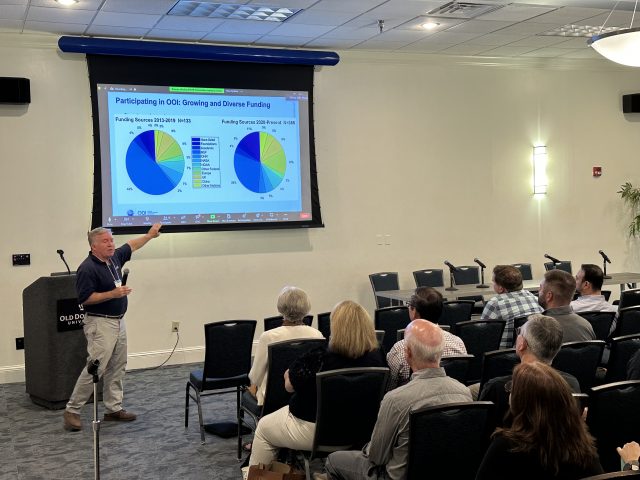
The Coastal Pioneer Southern Mid-Atlantic Bight (MAB) Array Community Workshop, held from September 10-12, 2024, at Old Dominion University, brought together a diverse group of scientists, educators, and stakeholders to explore the potential of the Pioneer MAB Array in advancing oceanographic research in the region. Funded by the U.S. National Science Foundation (NSF) and dedicated to the memory of Dr. Larry Atkinson, the event organized by the Ocean Observatories Initiative Facilities Board (OOIFB), aimed to highlight the array’s capabilities, evaluate regional research progress, and promote collaboration within the ocean research community.
Workshop Focus and Objectives
The workshop offered an in-depth exploration of the Pioneer MAB Array, showcasing its measurement capabilities and ability to improve our understanding of the Southern Mid-Atlantic Bight’s complex oceanographic processes. Participants reviewed past research, discussed data access, and assessed current knowledge and gaps in the region, guided by insights from local stakeholders to align research priorities with community needs.
Day 1: Setting the Stage for Collaborative Research
The first day began with a dedication to Dr. Larry Atkinson, whose career laid the groundwork for many oceanographic initiatives in the region. The morning sessions featured an overview of NSF funding opportunities, encouraging participants to propose innovative research projects using OOI data.
The OOI presentations showcased the successes of past research and outlined the proposal process for adding instruments to the array. These discussions set the stage for deeper dives into key science themes, such as the dynamics of shelf-slope exchange, biogeochemical cycling, and the impact of extreme events like hurricanes, winter storms and freshwater outflows.
The afternoon was dedicated to breakout sessions, where participants engaged in discussions on specific science themes. These sessions allowed for the exploration of collaborative research ideas and the identification of potential projects that could leverage the capabilities of the Pioneer MAB Array.
Day 2: Harnessing Data for Research and Innovation
The second day focused on data access and utilization, with hands-on demonstrations of the latest OOI data tools. Participants were introduced to the OOI Data Explorer and other data access methods that facilitate the retrieval and analysis of complex oceanographic data. These sessions also highlighted the program’s approach to data quality assurance and control, ensuring that researchers have access to reliable and accurate information.
Breakout sessions offered practical experience with data access through various platforms including Jupyter notebooks. These tools enable researchers to leverage the rich datasets provided by the Pioneer MAB Array for a wide range of projects, from studying physical oceanography and biogeochemistry to investigating ecosystem dynamics and the effects of extreme weather events.
The day concluded with a panel discussion on the use of modeling in interdisciplinary projects, providing insights into how data can be integrated into complex models to better understand ocean processes.
Day 3: Expanding Broader Impacts and Future Directions
The final day of the workshop shifted focus to the broader impacts of using OOI data in educational and community contexts. Panel discussions explored innovative ways to integrate OOI data into K-12 and higher education curriculums, as well as engaging citizen scientists and the fishing community in data collection and its many uses. These sessions highlighted the potential for data-driven outreach and education programs to inspire the next generation of oceanographers and to raise public awareness of ocean science.
Key Takeaways
The workshop highlighted the Pioneer MAB Array’s potential to advance our understanding of the Southern Mid-Atlantic Bight and emphasized the importance of accessible data for researchers, educators, and citizen scientists. It effectively fostered collaboration within the scientific community, paving the way for new research initiatives that will propel scientific progress in the region for years to come.
[caption id="attachment_34869" align="alignnone" width="640"]
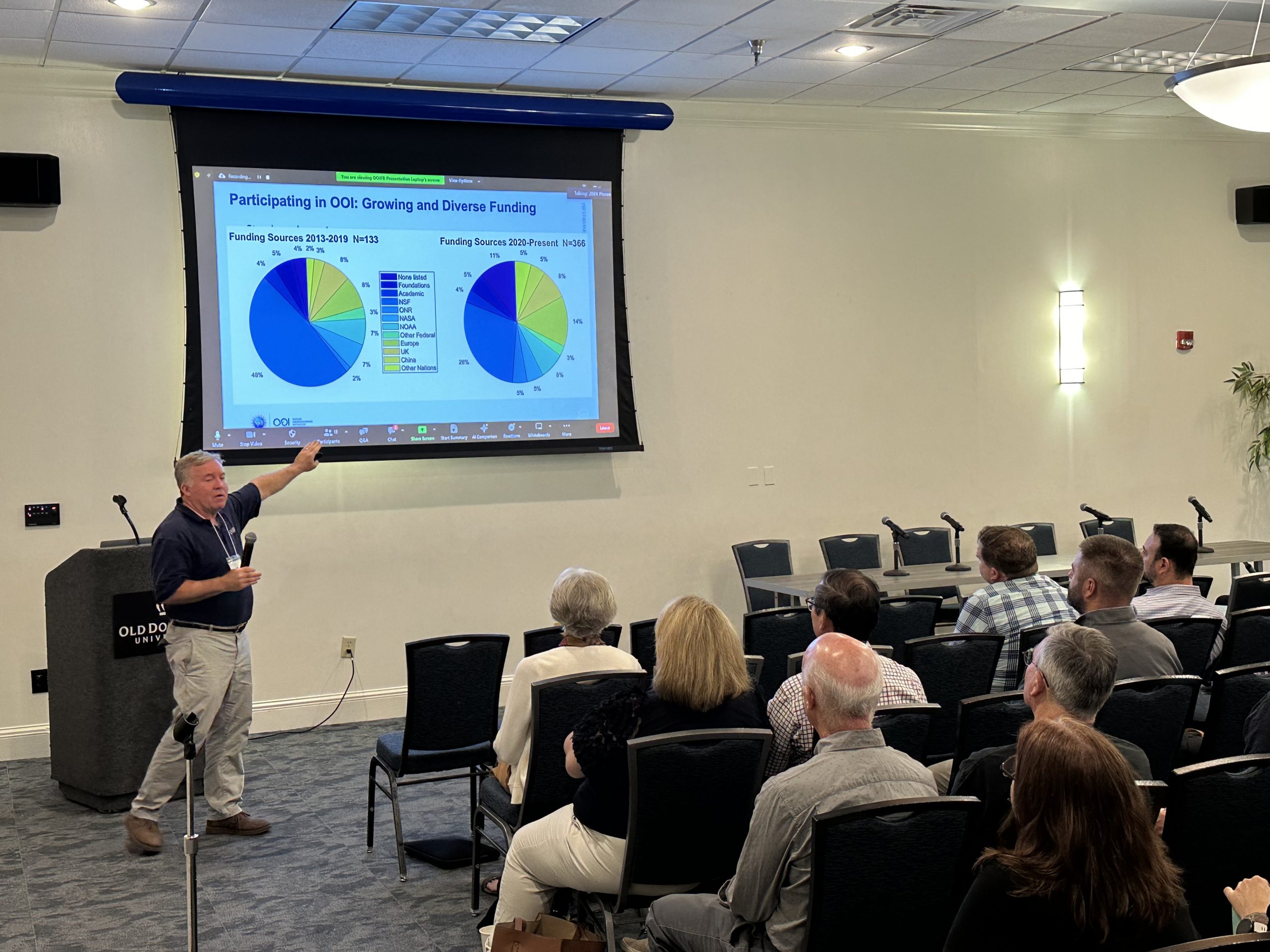 OOI Principal Investigator, James Edson[/caption]
[caption id="attachment_34866" align="alignnone" width="640"]
OOI Principal Investigator, James Edson[/caption]
[caption id="attachment_34866" align="alignnone" width="640"]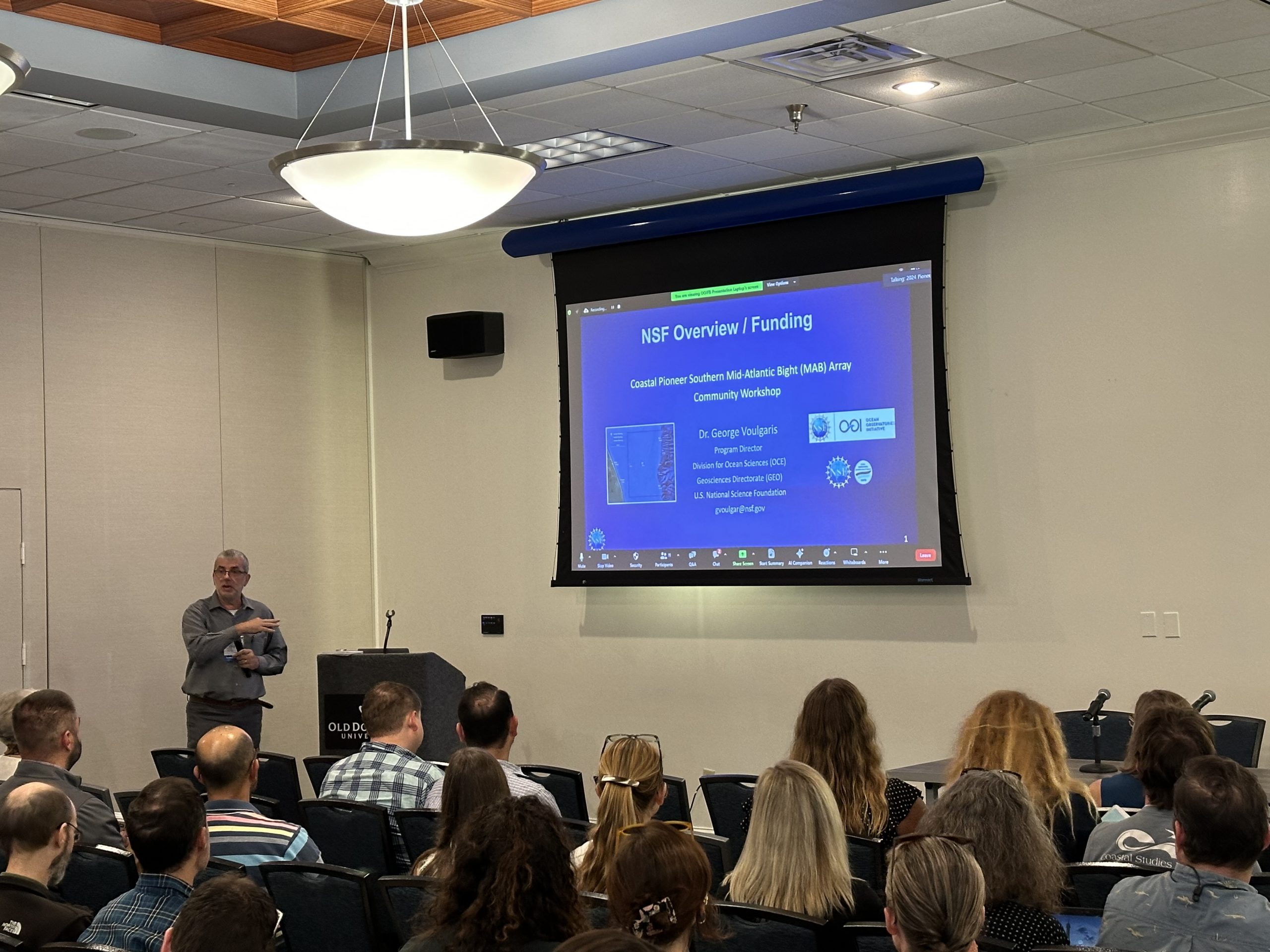 George Voulgaris, NSF OOI Program Director[/caption]
Read More
George Voulgaris, NSF OOI Program Director[/caption]
Read More URI Receives $3.2 Million NSF Award to Support OOI

University of Rhode Island Receives $3.2 Million NSF Award to Support Ocean Observatories Initiative.
Read MoreDeep-Sea Biodiversity: VIAME and OOI JupyterHub Accelerate Research
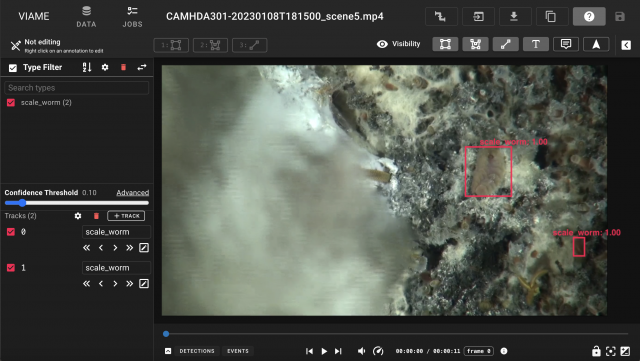
Off the coast of Oregon, the Axial Seamount on the Juan de Fuca Ridge hosts the ASHES vent field, a site rich in hydrothermal activity and diverse marine life. Principal Investigators, Dax Soule and Karen Bemis, and their teams are leveraging footage from past expeditions, captured by the OOI CamHD video archive, to study species diversity and abundance in this extreme environment.
With hundreds of terabytes of video data available, manual analysis is impractical. To address this, master’s student Julia Sandke and a team of undergraduate researchers are utilizing VIAME (Video and Image Analytics for a Marine Environment), a tool that helps build machine learning datasets by automating the annotation and classification of vent organisms. The goal is to use these datasets to train models that can autonomously analyze species diversity and abundance.
The integration of VIAME’s directories into the OOI JupyterHub environment, along with the addition of Nvidia L40S GPUs, has been a pivotal advancement. Previously, the team faced long delays using the shared VIAME web interface. Now, with dedicated resources in JupyterHub and the enhanced power of GPUs, they can significantly speed up machine learning processes, such as video training and data analysis, which once took days to complete.
This new computational power allows the team to begin unlocking the wealth of data in the CamHD archive, delving deeper into the species diversity around these vents. The long-term goal of the project is to use computer vision and machine learning to develop models that can track species abundance and predict key changes in the ecosystem. For example, these models could forecast where target species may appear after volcanic eruptions at Axial Seamount, providing researchers crucial insights into the shifting biological landscape of hydrothermal vent environments.
[caption id="attachment_34847" align="alignnone" width="640"]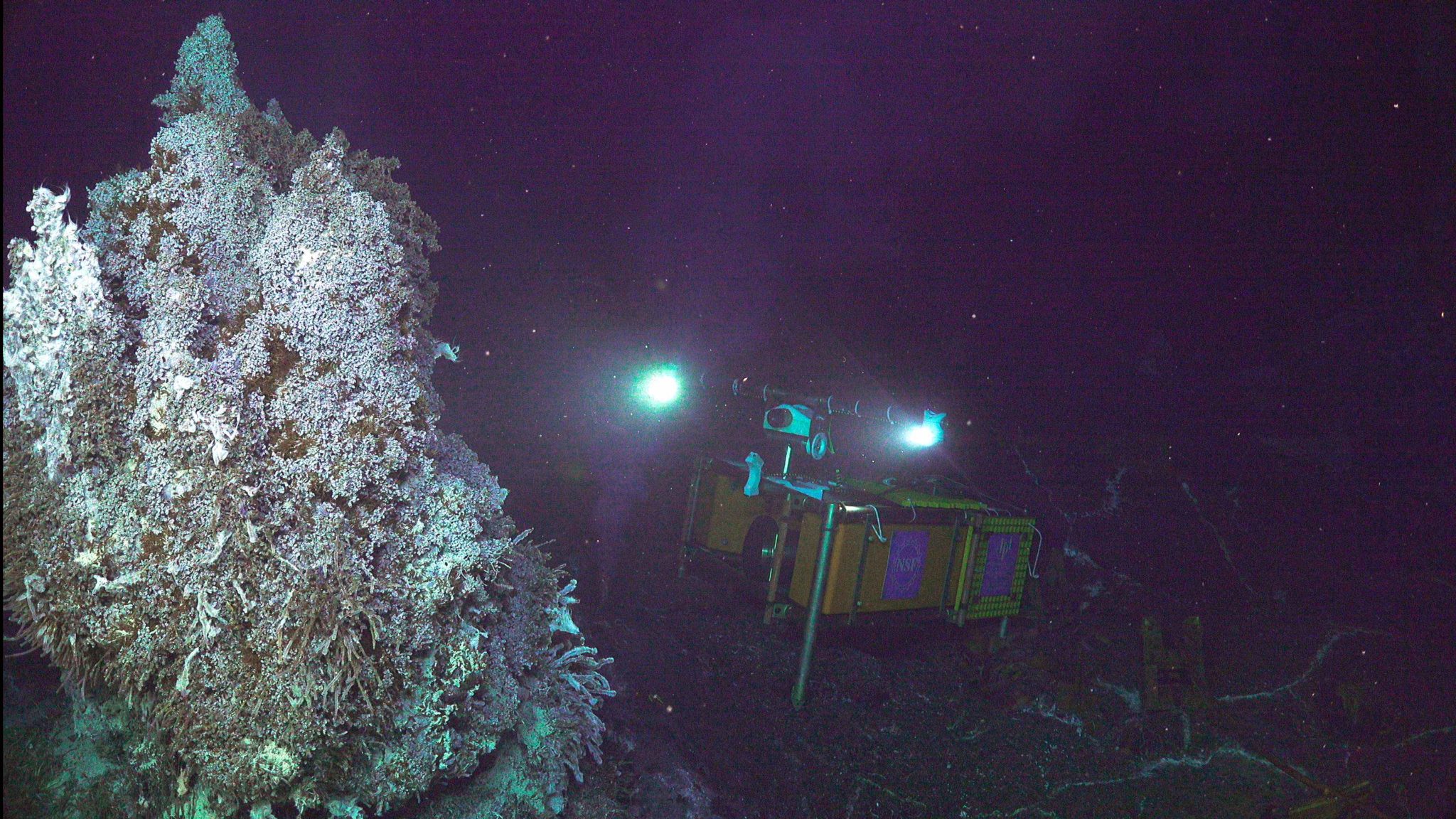 Credit: UW/NSF-OOI/WHOI; J2-1613. V24[/caption]
Read More
Credit: UW/NSF-OOI/WHOI; J2-1613. V24[/caption]
Read More Data Systems Committee – Call for Applications
The Data Systems Committee (DSC) of the Ocean Observatories Initiative Facility Board (OOIFB) was established to help ensure timely and reliable access to high-quality U.S. National Science Foundation (NSF) Ocean Observatories Initiative (OOI) data. The Committee evaluates and recommends improvements to the data services policies and practices of the NSF OOI Facility that will lead to more efficient and effective scientific use of NSF OOI data. The DSC is now soliciting applications to fill one open position. This 3-year appointment will begin October 2024. The selected individual will be eligible to serve a second 3-year term, if fitting.
The DSC holds at least one in-person meeting per year and one web conference each month. Some objectives of the DSC include:
- Keeping abreast of the current state of the NSF OOI cyberinfrastructure and data services with the goal of helping to promote maximum scientific use of NSF OOI data. These efforts will be informed by the FAIR Guiding Principles for scientific data management and stewardship, such that data are: a) Findable, b) Accessible, c) Interoperable, and d) Reusable.
- Encouraging the use of best practices, standards, and naming conventions established by the oceanographic community.
- Engaging with the user community to gauge user needs in regard to NSF OOI data systems, and to facilitate the promotion of a positive user experience.
- Staying current on potential new modes of data service and access, data analysis methodologies, and related technologies that facilitate the use of NSF OOI data.
- Engaging with the NSF OOI Program team regarding the priorities and plans of the NSF OOI cyberinfrastructure groups.
- Making recommendations for data products, usage metrics, and improving the user experience on the OOI Data Explorer, as well as other data service systems employed by the NSF OOI.
Scientists with interests and/or experience using scientific observing systems such as the NSF OOI, as well as those with experience in successfully delivering data from large-scale multi-sensor observing systems to scientific users are encouraged to apply. Interested applicants should submit a letter of interest and accompanying CV to Holly Morin, at the OOIFB Administrative Support Office (holly@ooifb.org), no later than September 17, 2024. The statement of interest should highlight the applicant’s experience with OOI data services and/or with other similar data services. Applicants might also include their experiences with OOI data services and/or a vision for how these might evolve in the future. All applications will be considered. Applications will be reviewed by the DSC members who will give due consideration to the qualifications of applicants, as well as to maintenance of gender, career level, disciplinary, and regional balance on the Committee. For more information about the DSC and its activities, please visit the OOIFB website: http://ooifb.org or contact Jim Potemra, DSC Chair (jimp@hawaii.edu).
Read More