Posts Tagged ‘AGU’
AGU 2026 Annual Meeting
AGU’s annual meeting, the largest gathering of Earth and space scientists, convenes 25,000+ attendees from 100+ countries to share research, connect, collaborate, and inspire one another.
Discover “Where Science Connects” at AGU26. Share your research with the global Earth and space science community.
Read MoreAGU 2026: AI and Machine Learning for Sustained Ocean Observing: Progress and the Road Ahead
Long-term, large-scale ocean observing systems, including the Ocean Observatories Initiative (OOI), Ocean Networks Canada (ONC), Argo, GO-BGC, and IOOS networks, among others, generate high-density, multi-stream datasets at a volume and complexity that increasingly exceed the capacity of traditional analysis approaches. Advances in artificial intelligence (AI) and machine learning (ML) offer powerful tools for rapidily processing these data at scale and reveal patterns and scientific insights that would otherwise remain undetected. We invite contributions highlighting observatory science enhanced by AI and ML, including but not limited to: seismic and acoustic event detection; computer vision applications; integration with modeling and data assimilation workflows; quality assurance, quality control, and anomaly detection; autonomous platform control, data reduction and adaptive sampling; and cross-platform data synthesis. Work addressing model interpretability, training data limitations, and reproducibility is especially encouraged. Contributions are welcome across disciplines, including physical oceanography, biogeochemistry, marine ecology, and solid Earth science.
Submit and Abstract for this Session
Primary Convener:
- Katharine Bigham
- University of Washington Seattle Campus
Conveners:
- Ben Biffard
- Ocean Networks Canada, University of Victoria
- Martin Scherwath
- University of Victoria
Student/Early Career Convener:
- Ada Carter
- University of Washington Seattle Campus
AGU 2026: Long-Term Ocean Observatories as Drivers of Sensor and Data Science Innovation
Over the past two decades, growing recognition of shifting baselines, spatial variability, and the value of long-duration ocean observations has driven expansion of long-term mobile and stationary ocean observatories, including ARGO, ONC, OOI, and more. These observatories have produced essential time-series data in ecologically and economically critical, and often understudied, marine environments. They also catalyzed major innovations in engineering and data science, including development of robust hardware that can withstand years on the seafloor and survive severe surface conditions, methods to mitigate drift and biofouling over extended deployments, software and machine learning algorithms designed to handle the high volume and frequency of real-time data streams, and procedures to ensure long-term storage, quality control, processing, and delivery of enormous quantities of diverse instrument data. This session highlights advances in ocean observing technology and data processing tools, emphasizing best practices and the sometimes unanticipated scientific and operational benefits of long-term ocean observatories.
Submit an Abstract to this Session
Primary Convener:
- Michael Vardaro
- University of Washington Seattle Campus
Conveners:
- Wendi Ruef
- University of Washington Seattle Campus
- Edward Paul Dever
- Oregon State University
Ocean Observatories Initiative at the 2024 AGU Conference
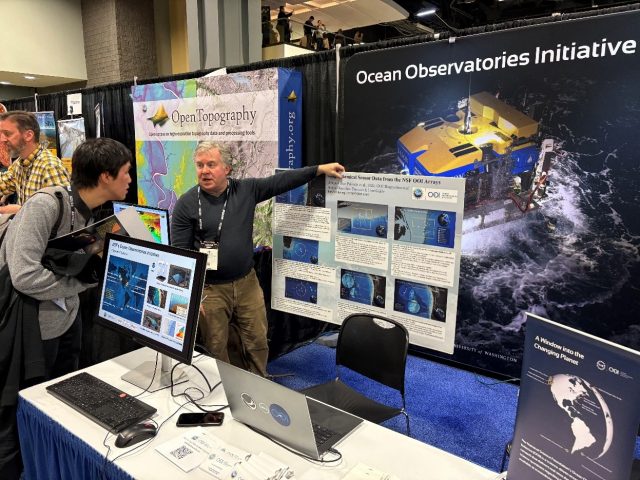
The Ocean Observatories Initiative (OOI) participated in the 2024 American Geophysical Union (AGU) Fall Meeting in Washington, D.C. This premier event served as a global platform for thousands of scientists and researchers to share breakthroughs and foster collaborations in Earth and space sciences. OOI took part in presentations, interactive discussions, and participation in the Ocean Observatories Initiative Facilities Board (OOIFB) Town Hall.
OOIFB Town Hall
A key event at AGU was the OOIFB Town Hall held on December 10th. This in-person session provided an opportunity for the community to engage directly with OOI representatives, NSF and NOAA program leaders, and the OOIFB. The event featured:
- Updates from OOI’s Principal Investigator (PI), Jim Edson who shared the latest developments from the Program Management Office (PMO) and the Marine Implementing Organizations (MIOs).
- Interactive Panel Discussion: A panel of experts, including representatives from OOI’s Endurance Array, Mid-Atlantic Bight Array (MAB), Regional Cabled Array (RCA), and PMO discussed opportunities and challenges for observatory-based research.
Participants heard from PI’s about the proposal process and discussed opportunities for adding new instruments to the infrastructure. The session emphasized the importance of community input and encouraged feedback to inform OOI’s future directions.
The panel members included:
- Jim Edson (OOI/WHOI)
- Al Plueddemann (OOI/WHOI)
- Ed Dever (OOI/OSU)
- Mike Vardaro (OOI/UW)
- George Voulgaris (NSF)
- Kaity Goldsmith (NOAA)
Researchers, educators, and scientists using or considering OOI data were encouraged to share their insights, helping to shape future OOI research and initiatives. Examples involved the use of existing OOI data and the addition of new sensors by external PIs for specific research projects. Other opportunities to use OOI infrastructure was discussed including the use of available space on our Operations and Maintenance cruise. Making better use of individual observing systems by combining measurement capabilies (e.g., between NSF/OOI and NOAA) was discussed as an action item.
Engaging at the OOI Booth
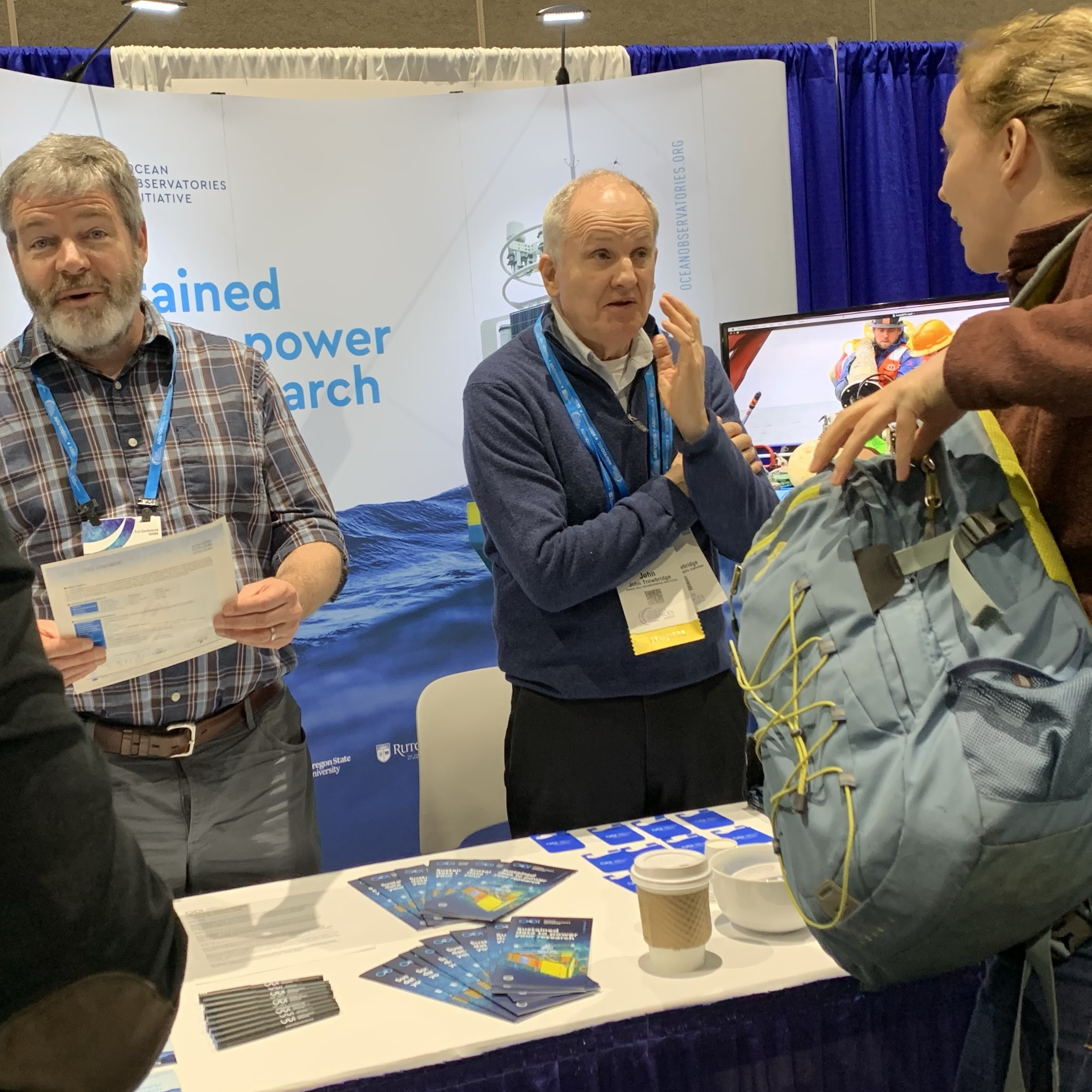
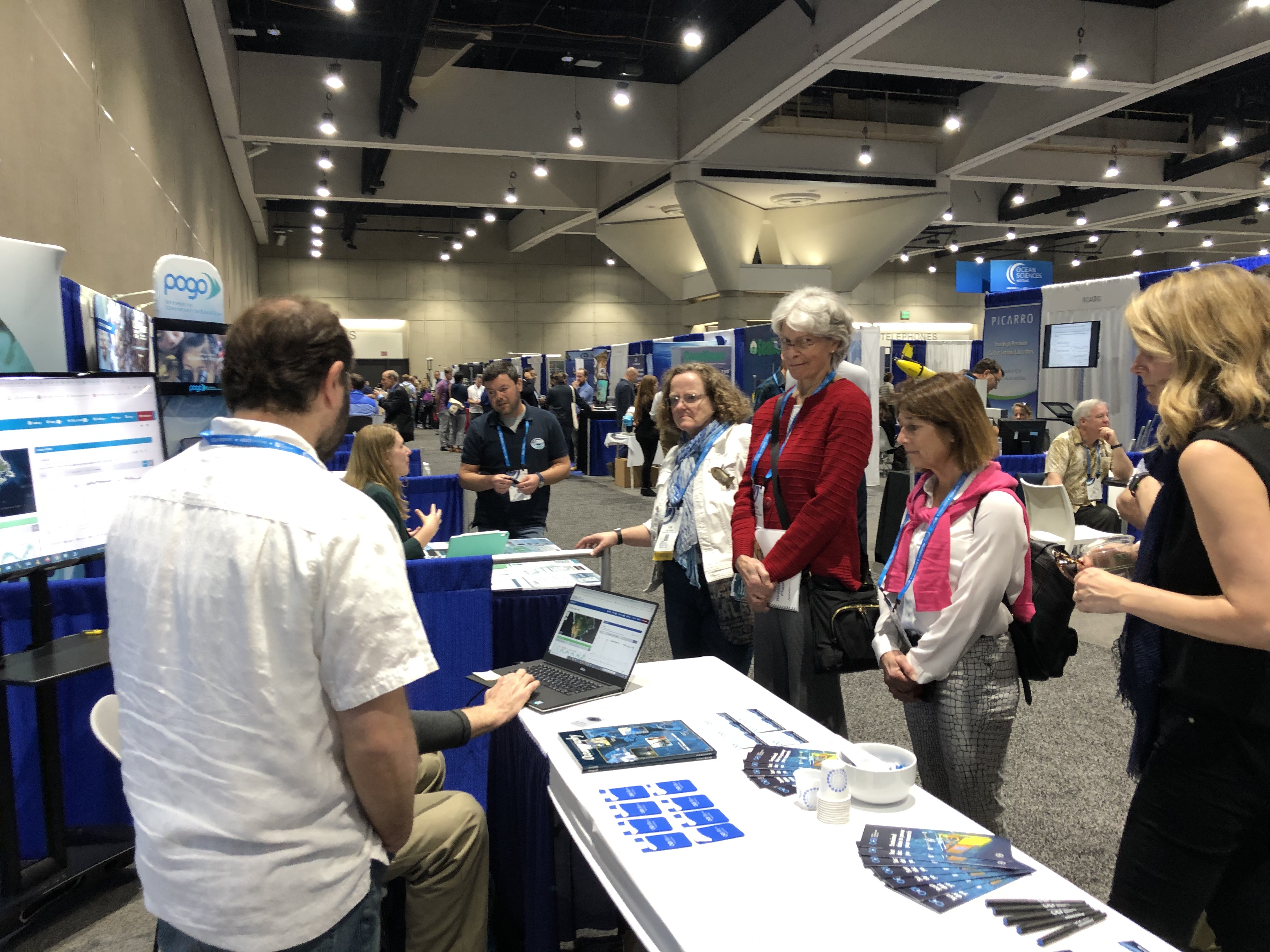
The OOI exhibit booth was a hub of activity throughout the conference. Attendees explored live demonstrations of OOI’s data tools, learned about recent updates to infrastructure, and connected with OOI representatives to discuss potential collaborations. The booth provided an accessible entry point for researchers new to OOI data and offered experienced users an opportunity to delve deeper into its capabilities.
Looking Ahead
Through discussions, booth interactions, and participation in the OOIFB Town Hall, OOI demonstrated its commitment to innovation and collaboration. Looking forward, OOI remains dedicated to fostering an engaged community of researchers. The feedback and ideas gathered during AGU will help shape OOI’s next steps, ensuring its data and infrastructure continue to meet the needs of the scientific community.
For more information on OOI’s resources, presentations, and opportunities for collaboration, visit our website or follow us on social media.
[caption id="attachment_35482" align="alignnone" width="640"]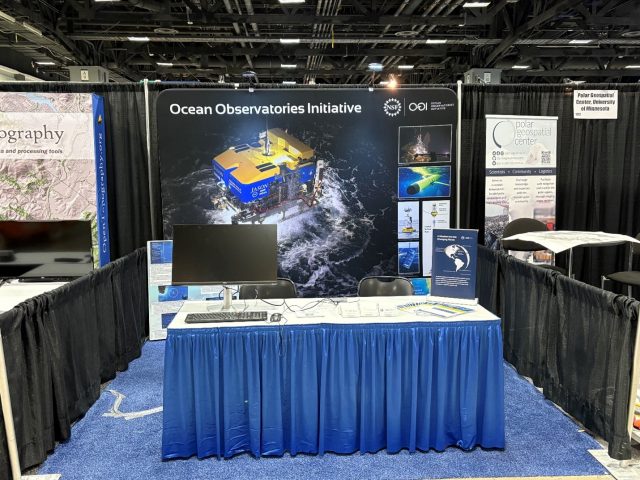 OOI at AGU[/caption]
[caption id="attachment_35483" align="alignnone" width="640"] Jim Edson, OOI’s Principal Investigator[/caption]
[caption id="attachment_35484" align="alignnone" width="640"]
OOI at AGU[/caption]
[caption id="attachment_35483" align="alignnone" width="640"] Jim Edson, OOI’s Principal Investigator[/caption]
[caption id="attachment_35484" align="alignnone" width="640"]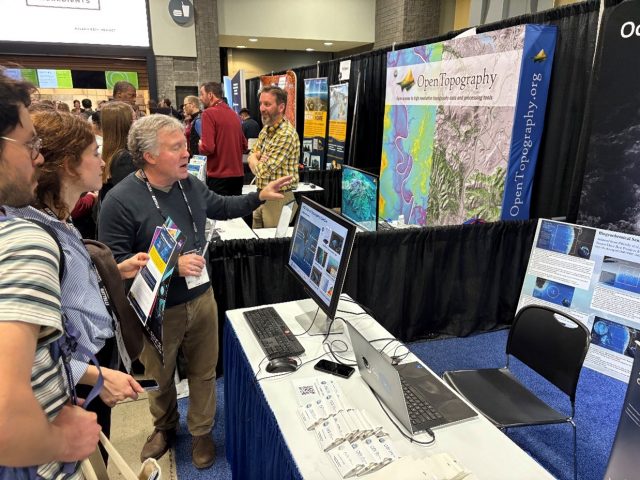 Jim Edson, OOI’s Principal Investigator[/caption]
Read More
Jim Edson, OOI’s Principal Investigator[/caption]
Read More AGU 2023 Fall Meeting
Abstract Deadline for AGU Fall Meeting
Call for Lightning Talks at OOIFB Town Hall
The Ocean Observatories Initiative Facilities Board (OOIFB) will host a Town Hall at the 2022 Fall AGU Meeting on December 12th from 6:30 pm to 7:30 pm Central Time. The Town Hall will be offered in-person, as well as virtually. The community will have the opportunity to hear the latest information about the OOI Facility Board activities, OOI facility, Pioneer Array relocation plans, and learn about research using OOI data.
The Town Hall will also include a series of lightning presentations where scientists are invited to present one slide in one minute explaining how they have used (or plan to use) freely available observatory data in their respective research. This is your opportunity to highlight your experience with OOI. We hope you will consider presenting a slide in the lightning session.
Time during the Town Hall is limited and we expect to be able to schedule about six lightning talks during the Town Hall. However, all submitted lightning talks will have the opportunity to be presented during the Fall AGU Meeting. The OOIFB has teamed with the OOI booth exhibitor to offer a time slot during the meeting to highlight all of the lightning talks.
Sign-up now to present a lightning talk – If you are using (or plan to use) OOI data and wish to present a lightning talk during the Town Hall, please please apply using the: LIGHTNING TALK FORM by November 21st. From the applications submitted, we will work to select six lightning talks for the Town Hall that can highlight the exciting research that is being done across the entire OOI Facility.
Funding Available for AGU Fall Meeting Registration Fee – Please note, all participants and presenters during the OOIFB Town Hall must be registered for the 2022 AGU Fall Meeting. Funding is available to offset the registration fees for students and early career scientists (ECS) who are presenting a lightning talk. Funding is limited and the first 8 student/ECS applications will be considered for reimbursement. The Lightning Talk application form includes space for requesting registration fee reimbursement.
The workshop is aimed at researchers who are using or are considering using OOI data and/or adding instrumentation to OOI infrastructure and educators at all levels interested in using data from the OOI’s Arrays. We hope to see you at the OOIFB Town Hall!
Event: OOI Facility Board Town Hall
When: Monday, December 12, 2022 from 6:30 pm to 7:30 pm Central Time
Lightning Talks: Apply online here: The form will be open until November 21st.
Where: In person at McCormick Place, Room S106a or Virtual Participation.
The Town Hall agenda and additional details are available here.
Read MoreOOI’S AGU Virtual Booth Schedule
OOI is hosting a virtual booth at AGU this year. All events are free and open to those wanting to attend, including those not attending AGU. Register for each event by clicking on the link in the event’s title. We hope to see you virtually at AGU this year! For those attending in person, do check out these OOI-related presentations.
OOI’s Virtual Booth Schedule |
||||
| DATE | TIME | EVENT | DESCRIPTION | PRESENTERS |
| Monday 13-Dec | 3-4 pm CT/4-5 pm ET | MOVING THE PIONEER ARRAY TO THE SOUTHERN MID-ATLANTIC BIGHT | Status of plans, permitting, and projected timeline for relocating the Pioneer Array | Lisa Clough (NSF) Moderator, Al Plueddemann (WHOI), Derek Buffitt (WHOI) |
| Tuesday 14-Dec | 1-2 pm CT/2-3 pm ET | INTRODUCING OOI’S NEW DATA CENTER: CREATIVE WAYS TO USE DATA | How cutting edge techniques to analyze and visualize data are being integrated into research and education | Anthony Koppers (OSU) Moderator, OOI’s New Data Center, Don Setiawan (UW) Interactive Oceans, Wu-Jung Lee (UW) EchoPype, Chris Wingard (OSU) Jupyter Notebooks |
| Tuesday 14-Dec | 3-4 pm CT/4-5 pm ET | OOI AND OSNAP IN THE NORTH ATLANTIC | What we are learning about the changing nature of the North Atlantic | Al Plueddemann (WHOI) Moderator, Nora Fried (NIOZ), Nick Foukal (WHOI), Yao Fu (Georgia Tech), Isabela Le Bras (WHOI) |
| Wednesday 15-Dec | 1-3 pm CT/2-4 pm ET | OOIFB’s DATA SYSTEMS COMMITTEE: USING OOI DATA IN THE CLOUD WITH PANGEO | Be prepared to do science in real time during this hands-on interactive session in the cloud. Participants will need a GitHub account to fully participate. If you don’t have one, it’s a simple process. Once you have a GitHub account, you can experience using real data to resolve a real science question during this workshop. | Tim Crone (LDEO) |
| Wednesday 15-Dec | 3-4 pm CT/4-5 pm ET | WHAT’S NEW IN THE UNDERSEA WORLD OF EARTHQUAKES AND VOLCANOES? | Lead authors of high-impact papers present their findings on Axial Seamount using OOI and other data (i.e. 3D seismics) for an integrated view into this highly active volcano, what their next steps are, how OOI data will play a role, and ideally what tools they would like to have answer their questions. | Deb Kelley (UW) Moderator, Suzanne Carbotte (LDEO), William Chadwick (OSU), William Wilcock (UW) |
| Thursday 16-Dec | 3-4 pm CT/4-5 pm ET | OOIFB LIGHTNING TALKS REDUX | For those who miss the lightning talk presentations during OOIFB’s Town Hall, this is another opportunity to see, hear, and question Lightning Talk presenters | Ed Dever (OSU) Moderator, Lightning talk presenters |
| Friday 17-Dec | 11 am-noon CT/noon-1 pm ET | WHAT’S NEW WITH DATA EXPLORER? | A demonstration of how Data Explorer 1.2 can be used to address science questions using different data types | Jeff Glatstein (WHOI) Moderator, Stacey Buckelew (Axiom), Wendi Ruef, Mike Vardaro (UW), Andrew Reed (WHOI) |
OOI at AGU 2021
[media-caption path="/wp-content/uploads/2020/10/agufront2-scaled-e1603490292321.jpeg" link="#"]The AGU 2021 Fall Meeting is a combination of virtual and in person events. OOI will have a virtual booth with daily activities to join. [/media-caption]
AGU Fall Meeting 2021
The following is a compilation of OOI-related presentations at this year’s fall meeting. If we’ve missed any OOI-related sessions, please contact dtrewcrist@whoi.edu and we will be happy to add them. OOI will have a virtual booth at AGU this year. Interesting programming is being finalized and will be added to this listing once confirmed. Share your AGU news at #AGU2021.
Monday, 13 December 2021
09:07-09:12, Convention Center, Room 223 (Note: all times are in Central time)
OS11A-02 – Overflow Water Pathways in the North Atlantic: New Observations from the OSNAP Program
Susan Lozier, Georgia Institute of Technology, Amy S Bower and Heather H Furey, Woods Hole Oceanographic Institution, Kimberley Drouin, Duke University, Xiaobiao X, Florida State University, and Sijia Zou, Woods Hole Oceanographic Institution.
Tuesday, 14 December 2021
11:15-12:15, Convention Center, Room 395-396
Ocean Observatories Initiative Facilities Board Town Hall
17:00-1900
Posters, Convention Center Poster Hall D-F
B25E-1522 – Synergistic Data Source Approach to Studying Keystone Marine Predators.Elizabeth Ferguson, Ocean Science Analytics. See the poster live.
G25A-0340 – Drift Corrected Pressure Time Series at Axial Seamount, July 2018 to November 2021 – A Progress Report
Glenn S Sasagawa, University of California San Diego and Mark A Zumberge, University of California San Diego.
PP25C-0927 – OOI infrastructure and Experimental Deployments: Preliminary insights from SEA3s deployed from 6 months to 1 year in the North Pacific
Ashley M Burkett, Oklahoma State University and Sarah Keenan, South Dakota School of Mines and Technology.
Wednesday, 15 December 2021
17:00-1900
Posters, Convention Center Poster Hall D-F
V35A – Focused Observations of Ridge Near-Axis Remote and in Situ Investigations: Magmatic, Volcanic, Hydrothermal, and Biological Processes V Poster
Michael R Perfit, Timothy M Shank, Woods Hole Oceanographic Institution, Jeffrey Karson, Syracuse University, Deborah Kelly, University of Washington, and Kenneth Howard Rubin, University of Hawaii.
Thursday, 16 December 2021
13:45-15:00, Convention Center, el.Lightning Theater VII
V43B – Focused Observations of Ridge Near-Axis Remote and in Situ Investigations: Magmatic, Volcanic, Hydrothermal, and Biological Processes IV eLightning
Michael R Perfit, University of Florida, Timothy M Shank, Woods Hole Oceanographic Institution, Jeffrey Karson, Syracuse University, Deborah Kelly, University of Washington, and Darin M Schwartz, Boise State University.
14:18-14:21, Convention Center, el.Lightning Theater VII
V43B-07 – Spatial distribution of diffuse discharge at ASHES vent field, Axial Seamount, captured by acoustic imaging
Guangyu Xu, University of Washington, Karen G Bemis, Rutgers, The State University of New Jersey, Darrell Jackson, University of Washington, and Anatoliy N. Ivakin, University of Washington.
V43B-08 – Systematic Shift in Plume Bending Direction at Grotto Vent, Main Endeavour Field, Juan de Fuca Implies Systematic Change in Venting Output along the Endeavour Segment
Karen G Bemis, Rutgers, The State University of New Jersey
17:00-1900
Posters, Convention Center Poster Hall D-F
V45B-0137 – Monitoring at Axial Seamount since its 2015 eruption reveals tightly linked rates of deformation and seismicity
William W. Chadwick Jr, Oregon State University, Scott L Nooner, University of North Carolina at Wilmington, William S D Wilcock, University of Washington, and Jeff W Beeson, Oregon State University.
V45B-0138 – Deformation Models for the 2015-Eruption and Post-Eruption Inflation at Axial Seamount from Repeat AUV Bathymetry
William Hefner, University of North Carolina at Chapel Hill, Scott L Nooner, University of North Carolina at Wilmington, William W. Chadwick Jr., Oregon State University, David W Caress and Jennifer Brophy Paduan, Monterey Bay Aquarium Research Institute, and Delwayne R Bohnenstiehl, North Carolina State University.
V45B-0139 – Annual and long-term seismic velocity variations at Axial Seamount observed with seismic ambient noise
Michelle Lee, Columbia University, Yen Joe Tan, Chinese University of Hong Kong, Maya Tolstoy, Lamont-Doherty Earth Observatory of Columbia University, Felix Waldhauser, Lamont-Doherty Earth Observatory of Columbia University, and William S D Wilcock, Lamont-Doherty Earth Observatory of Columbia University.
Read More
Recordings of OOI Events at AGU
Just in case you missed some of the events at OOI’s virtual booth at AGU, we’ve compiled some recordings and information so you can watch as your schedule allows:
[embed]http://https://youtu.be/Wuc-Be-IFVA[/embed] [embed]https://www.youtube.com/watch?v=WuEXjlXl-HM&t=5s[/embed] [embed]https://www.youtube.com/watch?v=bWqvOzyYirE[/embed]