Archive for June 2022
BGC Workshop Cooks Up a Recipe for Collaborative Research
Thirty-six researchers from 19 institutions from five countries converged on the Woods Hole Oceanographic Institution for three days (June 16-18) to participate in a workshop designed to enhance the use of data from biogeochemical (BGC) sensors on Ocean Observatories Initiative arrays. A product of the workshop will be the “OOI Biogeochemical Sensor Best Practices and User Guide” designed to standardize the use of BGC sensor measurements and promote best practices in their research application.
In summer 2021 the NSF-funded OOI Biogeochemical Sensor Data Working Group was established to develop guidelines and best practices for using OOI biogeochemical sensor data to broaden users and applications of these data, and build community capacity to produce analysis-ready data products. The Working Group convened regular virtual meetings beginning with a three-day virtual workshop in July 2021. Members developed a draft best practices guide with explicit recommendations for end users working with data from four sensor sub-groups: dissolved oxygen, inorganic carbon parameters, bio-optics, and nitrate. The five chapters of the best practices guide cover background on the OOI arrays and the biogeochemical sensors deployed on them, data QA/QC and data access, and each of the four sensor sub-groups listed above.
Current and prospective OOI biogeochemical sensor data users gathered together with the Working Group members at the June workshop to review and discuss the best practices guide and to explore scientific questions that can be explored with these data. The discussions were lively and productive. Small breakout groups discussed scientific research ideas using OOI biogeochemical sensor data, with the hope that these discussions would kickstart research collaborations, and help inform a planned follow-on peer-reviewed publication (e.g. a Frontiers in Ocean Observing article) to present the exciting science that OOI biogeochemical data and the best practices guide will enable. The second goal of the workshop was to solicit the revisions and edits needed to finalize the best practices guide in advance of dissemination to the wider community through Ocean Best Practices.
The workshop was a huge success. Said participant Michael Vardaro from the University of Washington and a member of the OOI Regional Cabled Array Data Team, “It was a great workshop. I hope we and NSF can inspire other interested early career scientists to organize more workshops like this. They ask hard questions, which ultimately will make the program better!”
Over the past year Sophie Clayton, Old Dominion University, Hilary Palevsky, Boston College, and Heather Benway, Woods Hole Oceanographic Institution have facilitated the Biogeochemical Working Sensor Data Group meetings and preparation of the best practices guide.
“We’ve spent the past year working with a great group of early career and experienced researchers on developing best practices for maximizing the use of biogeochemical data from OOI sensors, “ said Sophie Clayton.
“The workshop gave us all a great opportunity to meet in person and discuss a wide range of exciting research ideas that the OOI BGC data will enable. We were also so pleased to connect and see how much new progress we made in just three days thanks to being all in the same place together,” added Hilary Palevsky.
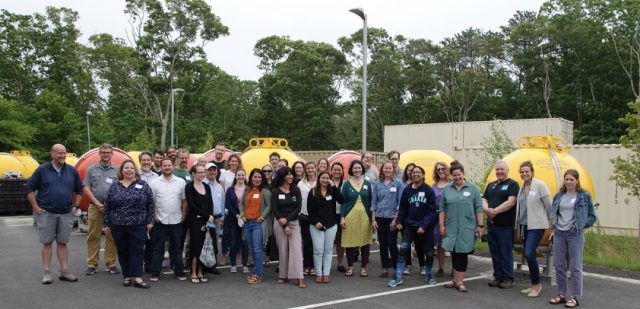
[media-caption path="/wp-content/uploads/2022/06/BGC-Workhshop.jpeg" link="#"]Participants at the end of a three-day Biogeochemical Sensor Workshop held at Woods Hole Oceanographic Institution June 17-19, 2022. Photo: Mai Maheigan ©WHOI.[/media-caption]The working group members are: Annie Bourbonnais, (University of South Carolina), Susan Hartman (National Oceanography Centre), Hilde Oliver (WHOI), Kristen Fogaren (Boston College), Merrie Beth Neely, (Global Science and Technology – embedded contractor at NOAA), Filipa Carvalho (National Oceanography Centre), Andrew Reed (OOI – CGSN), Isabela Le Bras (WHOI), Alison Chase (University of Washington – Applied Physics Laboratory), Cara Manning (University of Connecticut), Rob Fatland (University of Washington), Ellen Briggs (University of Hawaii at Manoa), Christina Schallenberg (University of Tasmania), Ian Walsh (Freelance Researcher), Jennifer Batryn (WHOI), Christopher Wingard (Ocean Observatories Initiative Endurance Array), Jonathan Fram (Oregon State University (OOI)), Roman Battisti (University of Washington/NOAA PMEL), Dariia Aamanchuk (Dalhousie University), Jennie Rheuban (WHOI), Rachel Eveleth (Oberlin College) and Joseph Needoba (Oregon Health & Science University).
The additional participants who reviewed the draft Best Practices and User Guide and attended the workshop are: Kohen Bauer (Ocean Networks Canada – University of Victoria), Baoshan Chen (Stony Brook University), Jose Cuevas (Boston College), Susana Flecha (Spanish National Research Council), Micah Horwith (Washington State Department of Ecology), Melissa Melendez (University of Hawaii at Manoa), Tyler Menz (Stony Brook University), Al Plueddemann (WHOI/OOI), Sara Rivero-Calle (University of Georgia), Nick Roden (Norwegian Institute for Water Research), Pablo Nicolás Trucco-Pignata (University of Southampton – National Oceanography Centre), Michael Vardaro (University of Washington, OOI), and Meg Yoder Boston College.
Read MoreRecap of Successful NE Pacific Workshop
The Ocean Observatories Initiative Facility (OOIFB) hosted a well-attended three-day workshop (June 7-9), followed by an optional Q&A data workshop on June 10. The workshop explored research opportunities using OOI data and its infrastructure to advance understanding of ocean processes in the NE Pacific. More than 100 people attended the workshop, 70 in-person, in the first such event in two years, and 30 virtual participants.
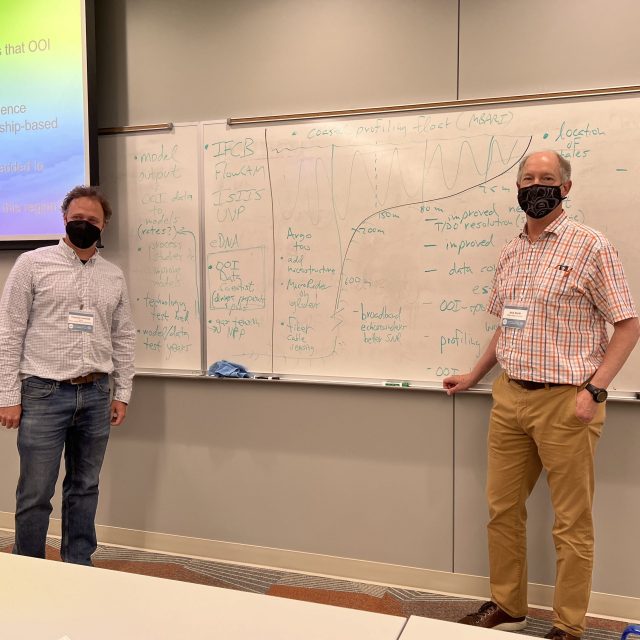
[media-caption path="/wp-content/uploads/2022/06/20220607_105055-2-scaled.jpg" link="#"]The workshop consisted of a mix of plenaries, breakout groups, posters, and many informal, productive discussions about how to maximize use of OOI data. Photo: Abby Ernest-Beck, URI.[/media-caption]
“Not only was it exciting to be with colleagues after all of this time,” said Kendra Daly, chair of the OOIFB, “the number of new ideas discussed on how to expand use of OOI data and extend partnerships with other observatories in the region was truly invigorating. The workshop laid the groundwork for new ways in which to use OOI data to explore research questions relevant to the NE Pacific.”
The three-day event alternated between plenaries on topics such as the “Warm Blob,” preparing for the next eruption at Axial Seamount, and how OOI data are used in modeling efforts and in the classroom. Lively breakout group sessions covered topics ranging from how to access OOI data, to major scientific questions, to research aimed at specific geographic regions, to potential broader impact initiatives.
The workshop was funded by the National Science Foundation.
For those who missed the workshop, all presentations and posters are available online here. Recordings of the workshop will be available online in the coming weeks.
Read MoreMonth-long Expedition to Refresh Irminger Sea Array
In late June, a team of 15 scientists and engineers headed to the Irminger Sea, a region with high wind and large surface waves in the North Atlantic. This remote ocean region is one of the few places on Earth with deep-water formation that feeds the large-scale thermohaline circulation.
[media-caption path="/wp-content/uploads/2022/06/IMG_5251.jpg" link="#"]The R/V Neil Armstrong is loaded with Irminger Sea gear, ready to depart fo a month-long expedition to recover and deploy OOI’s Global Irminger Sea Array. Photo: Sheri N. White©WHOI.[/media-caption]
The Irminger Sea 9 expedition is taking place on the R/V Neil Armstrong, operated by the Woods Hole Oceanographic Institution (WHOI). After an eight-day transit to the mooring array site off the tip of Greenland, the team will recover and deploy four moorings and three gliders over the next two and a half weeks. They will conduct CTD (conductivity, temperature, and depth) casts at the deployment/recovery sites and carry out shipboard sampling for field validation of the platforms and sensors that will remain in the water for the next year.
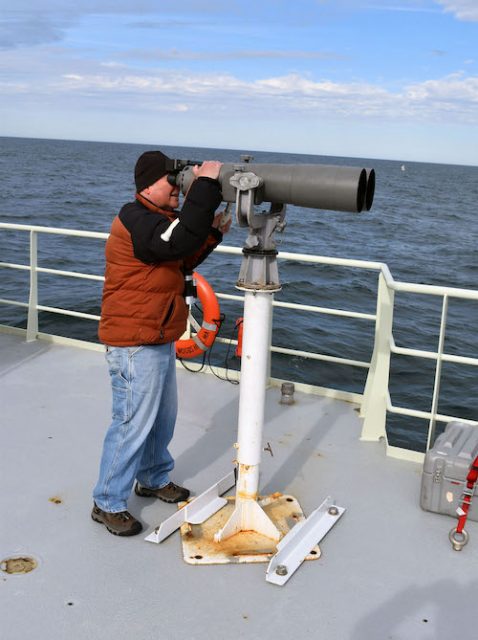
In addition to the Ocean Observatories Initiative’s (OOI) operations, a team from OSNAP (Overturning in the Subpolar North Atlantic Program) also will be onboard to recover and deploy four moorings, conduct CTD casts and water sampling at the mooring sites, and conduct additional instrument field validation tests to ensure the quality of the data collected. A participant from the National Oceanic and Atmospheric Administration will also be on board using Big Eyes binoculars mounted on a forward deck to make observations of marine mammals during the transit and in the Irminger Sea.
[media-caption path="/wp-content/uploads/2022/06/big_eyes.jpg" link="#"]Large, deck-mounted binoculars known as “big eyes” are used for marine mammal observations. NOAA Research Wildlife Biologist Peter Duley will be onboard the R/V Neil Armstrong watching for marine life in the Irminger Sea. Photo: Al Plueddemann ©WHOI.[/media-caption]
“Measurements in this remote ocean region are critical to increasing understanding of changes occurring in the ocean,” said Al Plueddemann, head of the OOI Coastal and Global Scale Nodes, which operates the OOI Global Irminger Sea Array. “It’s great to have a collaborative effort with OSNAP in this important area and an opportunity to learn more about marine life during this month-long expedition.”
Read MoreTrina Litchendorf: A Wealth of Sea-going and Engineering Experience
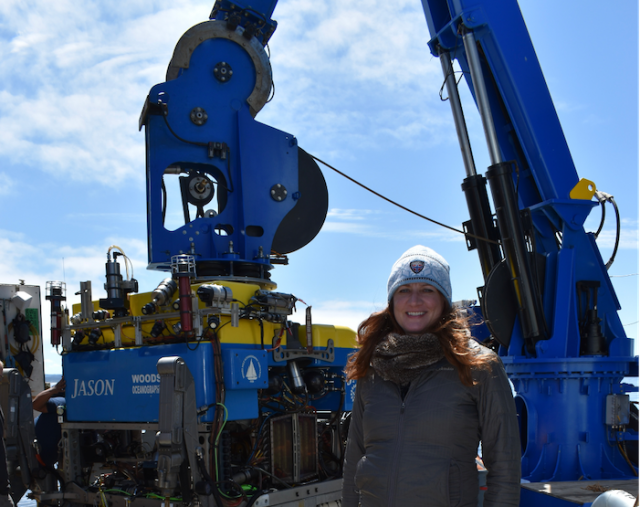
Trina Litchendorf is a highly experienced member of the Regional Cabled Array (RCA) team with a wealth of sea-going and engineering experience. She’s been with the Applied Physics Laboratory (APL) at the University of Washington (UW) since 2001. She started there as an intern through a NASA sponsorship, and stayed on while getting a degree in chemical oceanography at the UW. After graduation, she remained at APL, where she has been involved in keeping ocean observing instrumentation operational ever since. She has been working specifically on RCA instruments since 2013. She was onboard for the first deployment of cabled array instrumentation in 2014, and has served as a key part of every annual expedition since.
[media-caption path="/wp-content/uploads/2022/06/Trina-1.png" link="#"]Trina Litchendorf in front of the ROVJason. Credit: University of Washington.[/media-caption]
Trina’s duties at APL and for the RCA vary by the season. During the spring and early summer, she is actively engaged in testing and building RCA components so that they are ready for the annual Operations and Maintenance cruise. These cruises usually take place in August when undergraduate students join RCA team members at sea as part of the VISIONS at-sea experiential learning program to recover and deploy the infrastructure and instruments that the cable powers.
Each instrument undergoes three rounds of testing. The first is in the winter after the recovered instruments have been refurbished. Each is put through a rigorous round of testing, with a 12-page document of things to check. These procedures cover everything from checking for ground faults to prevent instruments from shorting out in saltwater, to placing them in a large salt water tank to simulate deployment conditions to ensure they work under such conditions. The instruments are also put through a pressure test to simulate seafloor conditions, followed by full functionality testing.
The second and third tests happen directly before the annual cruise and prior to deployment. “The second test is an integration test in the lab. We attach the instruments on the platforms on which they will be deployed to make sure that we can communicate with them and operate them through the platform. Once this test is complete, we are ready for the third, which happens onboard the ship during the annual expedition.” Onboard, she conducts a final test, connecting to the platform again to make sure all the instruments are working before anything goes into the water. She also is ready with spare and replacement parts should anything go awry during this final test.
During the expedition, Trina also directs remotely operated vehicle (ROV) dives, which serves as the eyes, ears, and hands of the underwater operation. She sits in the “hot seat” next to the ROV pilot where she directs activities on the seafloor and in the water column. The pilot manipulates the ROV to execute myriad complex operations she directs. Every platform is a little different so it is necessary to follow a prescribed dive plan to make sure every task is completed in the order in which it is supposed to happen. The complexity of these dives makes for some long days. “Typical dives run anywhere from 3-12 hours or more, and I usually end up pulling one or two 24-hour days while I’m at sea.”
“We have to get all of our gear on the seafloor plugged in and operational and last year’s gear up and off the seafloor,” Trina explained. “We have so much equipment that there’s not enough deck space for all of it, so we break the cruises up into multiple legs to load the next batch of equipment and offload the recovered gear. As a result, these cruises last anywhere from five to six or more weeks.” She’s currently getting ready to depart on VISIONS 22 in August, which because of its scope, is six weeks long and will be conducted in five legs.
Once recovered, another of her jobs is to photograph the platform and instruments’ condition, before helping with clean up, scraping of sea life that has colonized instruments and platforms, and removing a years-worth of additional biofouling.
[media-caption path="/wp-content/uploads/2022/06/students_20190622_171924_working.jpg.jpg" link="#"]Chris Williams, an undergraduate student at UW, helps to clean off a bioacoustics sonar package heavily covered with barnacles and anemones. Credit: UW/VISIONS’19/NSF/OOI.[/media-caption]
In the fall, after the cruise is over, Trina’s responsibilities turn to refurbishment and readying the instruments their next deployment. This, too, is a big job. There are close to 150 instruments deployed on more than 30 different types of platforms. The platforms range from junction boxes on the seafloor that serve as power sources for many instruments to benthic experimental packages with their own suite of instruments to shallow and deep-water profilers that move instruments up and down through the water column to sample at various depths. Her task is to ensure that recovered instruments are cleaned, taken apart, and refurbished. Most of the instruments are sent off to vendors for refurbishment and recalibration. The ultimate objective is to ensure that all of the instruments are working and that high quality data are being streamed from the RCA for community use.
The winter, into spring is spent testing and putting the platforms and instruments back together again in preparation for the upcoming cruise as the cycle begins again.
Trina’s favorite part of her job is her time at sea, particularly the time she spends in the control van with the ROV team. There she also runs the science camera, which gives her an inside look into a world few others have the opportunity to see. “I’m seeing things that most people only get to see on the Discovery Channel or National Geographic. It really is a great privilege to be part of that.”
And, she sees the cabled array as a vision realized. “I remember Dr. John Delaney telling us (during one of her undergraduate oceanography classes) about this idea he had to put a large cable in the water to power multiple seafloor sensors to study the ocean and that the whole paradigm of how oceanographic research was conducted was going to change. He saw it as moving from the old model of going out to sea on research vessels for just a few weeks at a time to collect data, to having a 24/7 365–day presence on the seafloor and throughout the water column streaming data in real time to scientists all over the world. And here I am now, actually doing this work and helping this science happen. It’s amazing,” she concluded.
Read More
OOI Designated as a UN Ocean Decade Endorsed Project
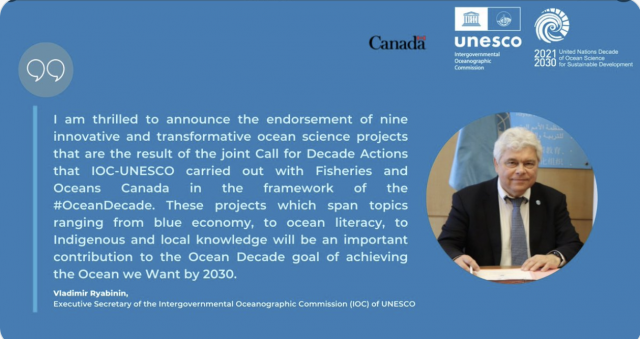
On June 8, 2022, World Oceans Day, the United Nations Educational, Scientific and Cultural Organization (UNESCO) designated the Ocean Observatories Initiative (OOI) as a UN Endorsed Action as part of the UN Decade of Ocean Science for Sustainable Development 2021-2030 (The Ocean Decade). Endorsed status presents opportunities for wider collaboration and enhanced ability to tackle grand challenges in better understanding the ocean. The announcement was timed to add to global celebrations of the UN World Oceans Day, which was organized this year around the theme “Revitalization: Collective Action for the Ocean.”
With the aim of achieving the Ocean Decade vision of “The science we need for the ocean we want,” the newly endorsed Decade Actions address priority issues worldwide, including marine pollution, management and restoration of marine ecosystems and the ocean-climate nexus—all with the goal of achieving a better understanding of the ocean system, and of delivering science-based solutions to inform decision-making from the international to the individual level.
“We are delighted that the importance of OOI’s data contributions to improving understanding of the changing ocean was recognized by the UN Decade. We very much look forward to broader opportunities to share our data with global colleagues,” said OOI Principal Investigator James B. Edson, lead of OOI’s Program Office at Woods Hole Oceanographic Institution (WHOI). WHOI operates OOI in partnership with the University of Washington and Oregon State University.
“The themes and objectives of the UN Decade of Ocean Science are tailor-made for scientists, engineers, and technicians who access OOI measurements to advance the state of our knowledge in ways that will ensure a long-term, sustainable path for society and a thriving, healthy ocean. For the coming decade and beyond, our goal is to make the ocean more accessible and to turn what we learn into meaningful, actionable information available to all,” added Edson.
Funded by the National Science Foundation, OOI was designed as a long-term project to collect ocean data for up to 25 years or more. This longevity makes it possible to measure and directly observe both short-lived episodic events and longer-term changes occurring in the ocean. Such data makes it possible to better understand ocean processes that support society and ecosystems and how the ocean is changing.
About the Ocean Decade
Proclaimed in 2017 by the United Nations General Assembly, the UN Decade of Ocean Science for Sustainable Development (2021-2030) (‘the Ocean Decade’) seeks to stimulate ocean science and knowledge generation to reverse the decline of the state of the ocean system and catalyze new opportunities for sustainable development of this massive marine ecosystem. The vision of the Ocean Decade is ‘the science we need for the ocean we want’. The Ocean Decade provides a convening framework for scientists and stakeholders from diverse sectors to develop the scientific knowledge and the partnerships needed to accelerate and harness advances in ocean science to achieve a better understanding of the ocean system, and deliver science-based solutions to achieve the 2030 Agenda. The UN General Assembly mandated UNESCO’s Intergovernmental Oceanographic Commission (IOC) to coordinate the preparations and implementation of the Decade.
About the IOC-UNESCO
The Intergovernmental Oceanographic Commission of UNESCO (IOC-UNESCO) promotes international cooperation in marine sciences to improve management of the ocean, coasts and marine resources. The IOC enables its 150 Member States to work together by coordinating programs in capacity development, ocean observations and services, ocean science and tsunami warning. The work of the IOC contributes to the mission of UNESCO to promote the advancement of science and its applications to develop knowledge and capacity, key to economic and social progress, the basis of peace and sustainable development.
OOI Hydrophone Data Helping ID Whale Calls
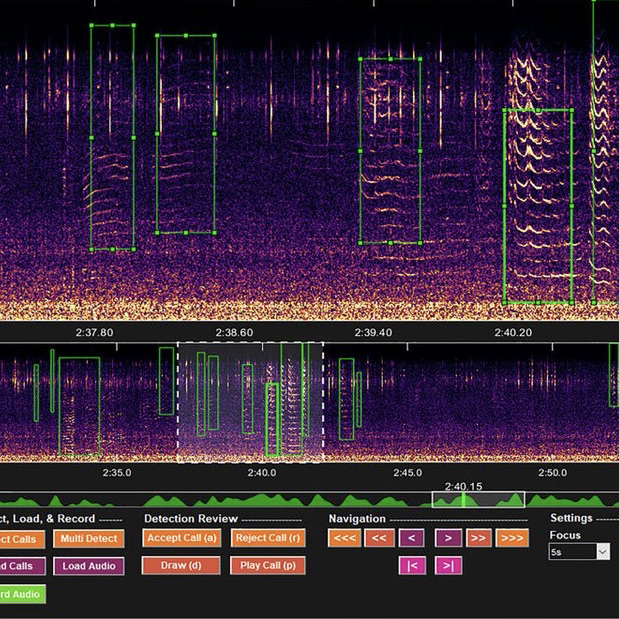
Elizabeth Ferguson of Ocean Science Analytics used OOI hydrophone data with DeepSqueak – a computer program designed to sort mice squeaks that is also finding whales in the deep.
She was interviewed about her work by Joe Palca on Morning Edition of NPR o n May 31, 2002. Listen to the report here.
Read More