Archive for August 2019
Anomalous Shallow Strong Currents Off the Oregon Margin
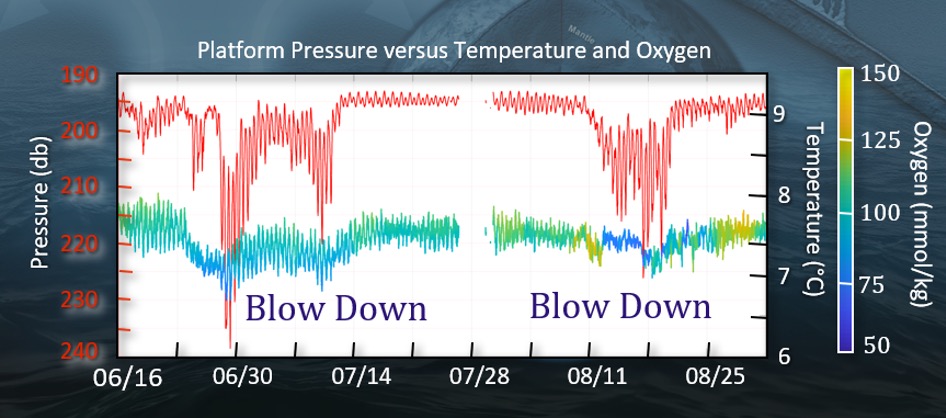
Blow down of the 200-meter Shallow Profiler Mooring Platform 2019
K. Roseburg and W. Ruef, Regional Cabled Array and P. MacCready, University of Washington, 20 August 2019
In June and August, 2019, the Slope Base Shallow Profiler Mooring was impacted by two substantial “blow down” events: these were the first observances of blow downs since the moorings were installed in 2014. The largest of these events, which occurred near the end of July and which lasted over two weeks, resulted in a deepening of the 12 ft across, 7,000 lb. platform nearly 50 m and migration of the platform ~ 150 m to the west. Results from pressure, ADCP, temperature and oxygen data pulled from CI using M2M, indicate that as the currents strengthened, the float was depressed into ~ 0.25-0.50°C cooler water with slightly decreased oxygen concentrations. An evaluation of the eddy kinetic energy calculated from the ADCP data, does not support eddy-driven water mass transport. The lower oxygen concentrations could reflect lower amounts of photosynthesis as the platforms are pushed deeper into the water column. We do not know of other documented blow down events such as these in the PNW.
Read MoreRegional Cabled Array 2019 Expedition Sets Records
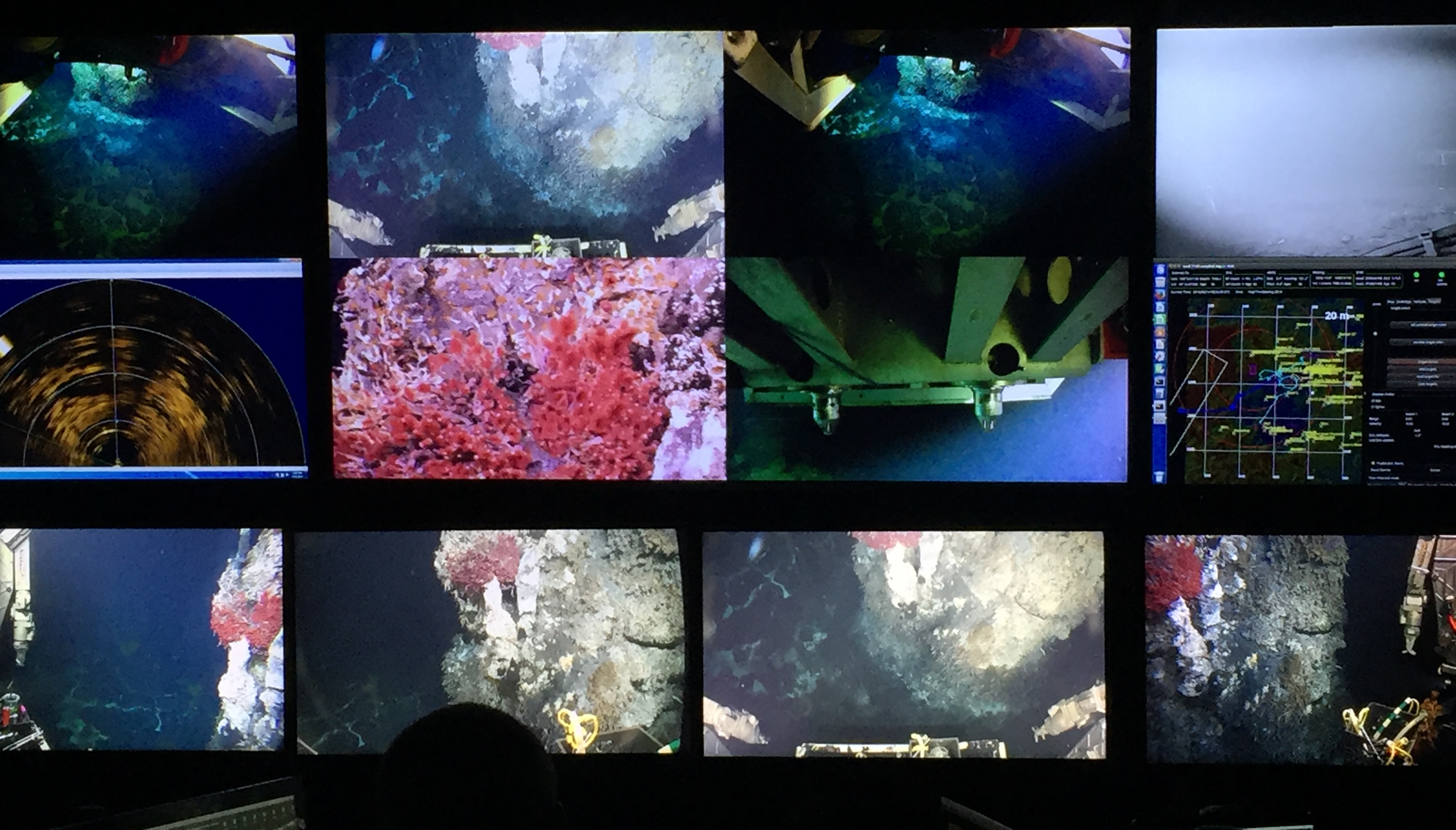
This summer’s Regional Cabled Array (RCA) 44-day expedition (May 30-July 12, 2019) onboard the R/V Atlantis was highly successful with the completion of all tasks scheduled for this annual maintenance and operations cruise. One hundred forty-nine out of 151 RCA Core and PI instruments are operational, all three instrumented Deep Profiler vehicles and instrumented Science Pods on the Shallow Profiler Moorings are conducting daily traverses through the water column, and 113 RCA instruments were installed. It was wonderful to once again see the beautiful life inhabiting the hydrothermal vents at Axial Seamount, amazing aggregations of cod curious about our work at the Oregon Offshore site, and to witness the profound changes that have taken place again at the methane seeps at Southern Hydrate Ridge.
During the 53 days of staging and demobing for the cruise over the four legs 166 tons of RCA equipment were transported to/from Seattle, WA and Newport, OR. Onboard staffing included 52 personnel with 13 students, six non-OOI PI’s-technicians from four institutions and one member from industry. In addition, Susan Casey, a New York Times bestselling author (i.e. The WAVE, the Devils Teeth, and Voices of the Ocean) participated on Leg 4. As part of the NSF Oceans Month, a 1-hour “Science in the Deep” Facebook live interactive broadcast was conducted, including live streaming of imagery from Jason working at Southern Hydrate Ridge and a period for questions and answers. There were 58 Jason Dives, with a record setting 20 dives in five days including deep dives to 2600 m and 2900 m water depths. The vehicle worked extremely well with turn-arounds commonly less than one hour.
Another big success for this summer occurred during nine days of at-sea operations dedicated to turning and installation of cabled and uncabled instrumentation and field work provided to externally-funded researchers. This work included the:
- Installation of an NSF-funded new high resolution, self-calibrating pressures sensor at Central Caldera, Axial Seamount (W. Wilcock, University of Washington).
- The recovery, repair and reinstallation of the NSF-funded COVIS multibeam sonar for hydrothermal plume imaging at the ASHES hydrothermal field, as well as installation of a thermistor array (K. Bemis, Rutgers University); Bemis also conducted a several hour thermal and video survey of the field.
- The turning of an NSF-funded CTD at the ASHES hydrothermal field, Axial Seamount (W. Chadwick, Oregon State University). Note Chadwick received a new NSF award to expand the CTD network to monitor the release of subsurface brines associated with eruptions at Axial as observed during the 2015 eruption (see Xu et al., 2018).
- The recovery of an ONR-funded uncabled Benthic Observatory Platform (BOP) from the Oregon Offshore site and installation of another BOP at a seep site at Southern Hydrate Ridge (C. Reimers-Oregon State University and P. Girguis-Harvard University) and associated sediment sampling; and
- The recovery, repair, and reinstallation of a University of Bremen-Germany-funded cabled overview multibeam sonar for imaging of all methane plumes at Southern Hydrate Ridge (G. Bohrmann and Y. Marcon -University of Bremen) – the range of this sonar is now extended from 200 m to 700 m. A new 4K video-still camera was also installed near Einsteins’ Grotto.
The RCA engineering and science team is enjoying being on land after conducting round the clock operations to insure that the facility work was completed on schedule. Folks are enjoying the Seattle sun and the Cascades and Olympic mountains during the summer blue-skied days. Soon however, our thoughts, will be turning to refurbishment and planning for next years cruise. The team is looking forward to working with the VISIONS19 students on their projects this upcoming academic year; we are excited to see the stories they tell with new eyes focusing on the oceans, the RCA, and OOI.
Read More