News
Nature Climate Change Article Highlights OOI Irminger Sea Data

Increased risk of a shutdown of ocean convection posed by warm North Atlantic summers
Marilena Oltmanns*, Johannes Karstensen and Jürgen Fischer
Abstract: A shutdown of ocean convection in the subpolar North Atlantic, triggered by enhanced melting over Greenland, is regarded as a potential transition point into a fundamentally different climate regime1,2,3. Noting that a key uncertainty for future convection resides in the relative importance of melting in summer and atmospheric forcing in winter, we investigate the extent to which summer conditions constrain convection with a comprehensive dataset, including hydrographic records that are over a decade in length from the convection regions. We find that warm and fresh summers, characterized by increased sea surface temperatures, freshwater concentrations and melting, are accompanied by reduced heat and buoyancy losses in winter, which entail a longer persistence of the freshwater near the surface and contribute to delaying convection. By shortening the time span for the convective freshwater export, the identified seasonal dynamics introduce a potentially critical threshold that is crossed when substantial amounts of freshwater from one summer are carried over into the next and accumulate. Warm and fresh summers in the Irminger Sea are followed by particularly short convection periods. We estimate that in the winter 2010–2011, after the warmest and freshest Irminger Sea summer on our record, ~40% of the surface freshwater was retained.
[button class="block" link="https://www.nature.com/articles/s41558-018-0105-1"]Full Article found can be on Nature Magazine Website[/button] [button class="block" link="/array/global-irminger-sea/"]More details on the OOI Irminger Sea Array design and data products[/button] [feature]Do you have a recent publication using OOI data? Let us know!
Simply send a note to the HelpDesk with the digital object identifier (DOI) of your publication.[/feature]
Read More
Oceanography Magazine OOI Special Issue Now Available
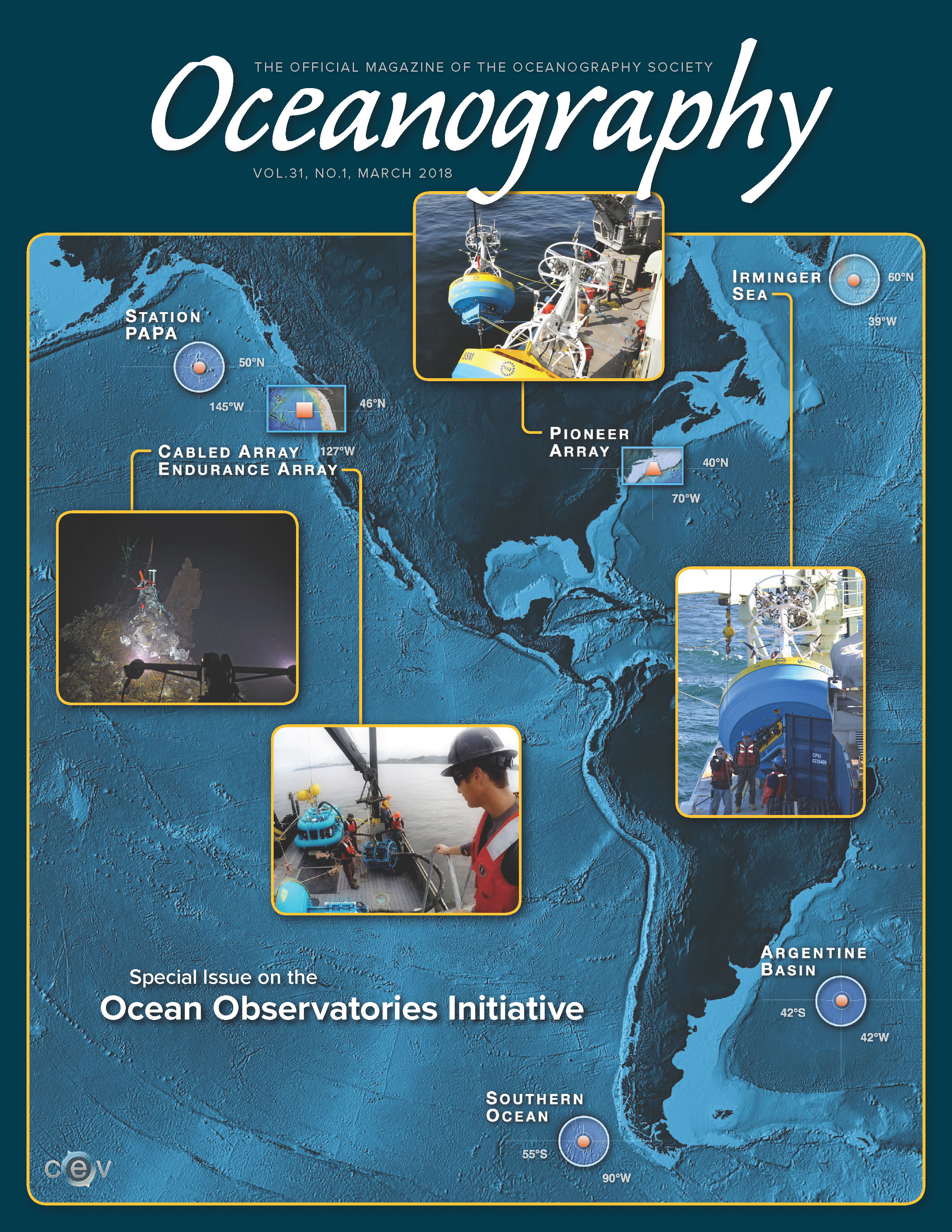
The March 2018 Special Issue of Oceanography Magazine (Volume 31, Issue 1) focusing on the Ocean Observatories Initiative is now available online!
Read More2018 OOI Data Workshops – Apply Now

The OOI is hosting several workshops for early-career scientists (PhD candidates, postdocs and pre-tenure faculty up to 7 years post-PhD) interested in learning more about the OOI and how to use data from the program in their work.
Read MoreOSM ’18 – OOI Related Talks & Posters
Members of the OOI Team and User Community will be sharing their research in posters and presentations throughout the conference. Talks and posters by the OOI Team are listed by date and time.
Read MoreOOI Special Session at OSM 2018
Join OOI scientists and colleagues from other ocean observatories as they discuss the latest in ocean observatory science at the Ocean Sciences Meeting in Portland, Oregon next month.
Read MoreOOIFB Ocean Sciences Meeting Town Hall
There will be an important Town Hall at the upcoming Ocean Sciences meeting in Portland, OR, hosted by the Ocean Observatories Initiative Facility Board (OOIFB) of the National Science Foundation (NSF).
Read MoreOOIFB Administrative Support Office Solicitation
The NSF is accepting proposals for the Ocean Observatories Initiative Facility Board (OOIFB) Administrative Support Office.
Read MoreMachine to Machine Interface Resources and Community Tools
The OOI is pleased to announce the release of the OOI Machine-to-Machine (M2M) interface for data download.
The M2M interface provides programmatic access to OOI data and metadata via a RESTful Application Programming Interface (API). It allows authenticated users to request small amounts of data via synchronous JSON requests, request larger amounts of data in NetCDF or CSV format in order to download multiple data streams or data from multiple platforms, or set up recurring downloads to procedurally update an existing dataset. Additional commands allow for searches of the asset management system to find deployment, calibration, quality control (QC) parameters, annotations, and other information, both in bulk and for specific instruments or platforms.
Full documentation of the M2M system is underway, but there are several existing “Community Tools” resources to assist in getting started using the API. Step by step instructions and sample code are now available on the OOI Website. In addition, the OOI Data Evaluation Team will be holding instructional webinars and posting additional guides and video tutorials in the Knowledge Base in the coming months.
For additional help using the interface, if you encounter errors, or if you have suggestions, please contact the HelpDesk.
Read MoreRFQ for OOI Location and Equipment Placement Maps

COL seeks a Contractor for graphic design services to design a suite of aesthetically consistent base maps and technical schematics for the project (further described in Section C and Attachment #1 (Statement of Work).
Read MoreWEBINAR: Dec. 1, 2017 Cabled Array Staff Consultation
Friday, December 1, 2017 at 10 AM PST/1 PM EST
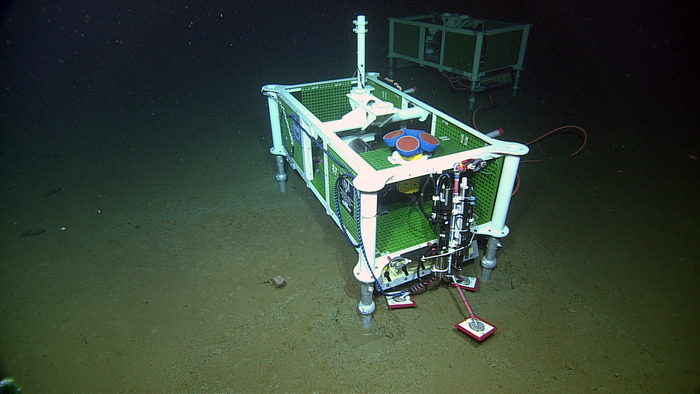
Cabled Array staff will provide an overview of the Cabled Array infrastructure currently deployed as well as engineering specifics including connectors, communication capabilities, testing procedures, and general timeline. The goal of the webinar is to provide researchers interested in adding instrumentation-infrastructure onto the Cabled Array the information required to submit an NSF proposal, which includes a letter from the Cabled Array team on technical feasibility. Awards have been made for addition of infrastructure onto the Cabled Array from NSF, ONR, and International collaborators.
[button link="https://docs.google.com/forms/d/e/1FAIpQLSemcNMpnYk1ekcZRHopOVnsETEVyTBGgf_PtqtVxisCipkgvg/viewform?usp=sf_link" bg_color="#00a9dd" window="yes"]Register Here[/button]
Please RSVP by Nov. 30