Posts Tagged ‘Distributed Acoustic Sensing’
Multi-Span Fiber Sensing Expands Reach of OOI Regional Cabled Array
From November 2025 through January 2026, scientists from the University of Washington (UW) and Nokia Bell Labs carried out a successful demonstration of a novel multi-span distributed acoustic sensing (DAS) system on the U.S. National Science Foundation (NSF) Ocean Observatories Initiative (OOI) Regional Cabled Array (RCA).
The UW investigators William Wilcock, Brad Lipovsky, Marine Denolle and Shima Abadi collaborated with Mikael Mazur, and Nicolas Fontaine at Nokia Bell Labs to test an exciting new approach that extends sensing across the full length of submarine fiber optic cables, far beyond previous limits.
“This experiment shows that we can transform existing subsea cables into powerful, large-scale sensing systems,” said William Wilcock, professor of Oceanography at the UW. “It’s a powerful new tool to observed ocean and Earth processes continuously over hundreds to thousands of kilometers.”
Extending Sensing Across the Full Cable
DAS works by measuring strain along a fiber using backscattered light, enabling detection of earthquakes, ocean waves, and marine mammals such as whales. Earlier NSF-funded RCA experiments were limited to the first cable segments, reaching about 65 km (north) and 95 km (south) offshore, due to signal loss at optical repeaters.
The Nokia Bell Labs system overcomes this barrier by using high-loss loopback couplers within the optical repeaters to extend sensing across the entire cable span. “We thought the most important function of subsea cables was transporting petabits per second of data across our oceans. In reality, it’s how we can turn these cables into an array of acoustic sensors spaced every 10 meters or so, spanning entire ocean basins,” said Nicolas Fontaine of Nokia Bell Labs.
The two RCA cables extend offshore from Pacific City, Oregon. The northern cable (~480 km) runs roughly perpendicular to shore and reaches Axial Seamount. The southern cable (~350 km) crosses the continental shelf, continues onto the Juan de Fuca Plate, and loops back toward shore off Newport Oregon.
“In the Pacific Northwest, much of the earthquake hazard is concentrated offshore, where there are still relatively few instruments,” said Zoe Krauss, a postdoctoral researcher at the UW. “This new multi-span DAS capability on the RCA could be a game changer for offshore earthquake monitoring and may ultimately improve earthquake early warning in the region.”
Deployment, Data & Access
The system was deployed on November 5, 2025, and operated continuously, alongside normal observatory functions, through January 28, 2026. Sampling rates and spatial resolution (~10–200 m) were varied throughout the test.
For comparison, a conventional DAS system from Alcatel Subsea Networks was also deployed on the first span of the southern cable.
Nonlinear optical effects and observatory signals introduced noise in portions of the data. To address this, researchers applied spatial masks starting December 2, preserving 165 km and 275 km of usable data on the northern and southern cables, respectively. Some noise and small timing offsets remain, and users are advised to interpret the data carefully as analysis continues.
Low sample rate (~8 Hz) data are now available:
For full experiment details, metadata, and documentation, visit the project page.
Datasets include 3.9 TB of Nokia multi-span DAS data from both cables and 1.2 TB of OptoDAS data from the southern cable, along with documentation and tools for access and analysis.
Looking Ahead
This experiment highlights the potential of using existing ocean infrastructure as a large-scale, distributed sensing network.
“The Regional Cabled Array was designed to support innovation, and this project is a great example of how we can expand its capabilities in new and exciting ways,” said Deb Kelley, Director of OOI’s Regional Cabled Array. “By leveraging existing infrastructure, we’re unlocking unprecedented new pathways for discovery across the ocean and seafloor.”
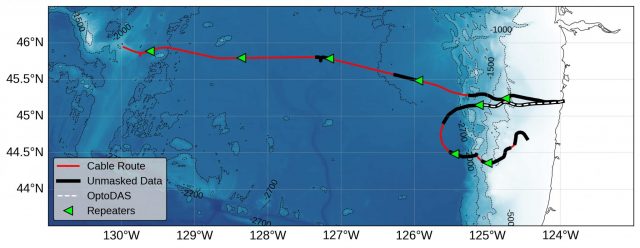
[caption id="attachment_37510" align="alignnone" width="2048"]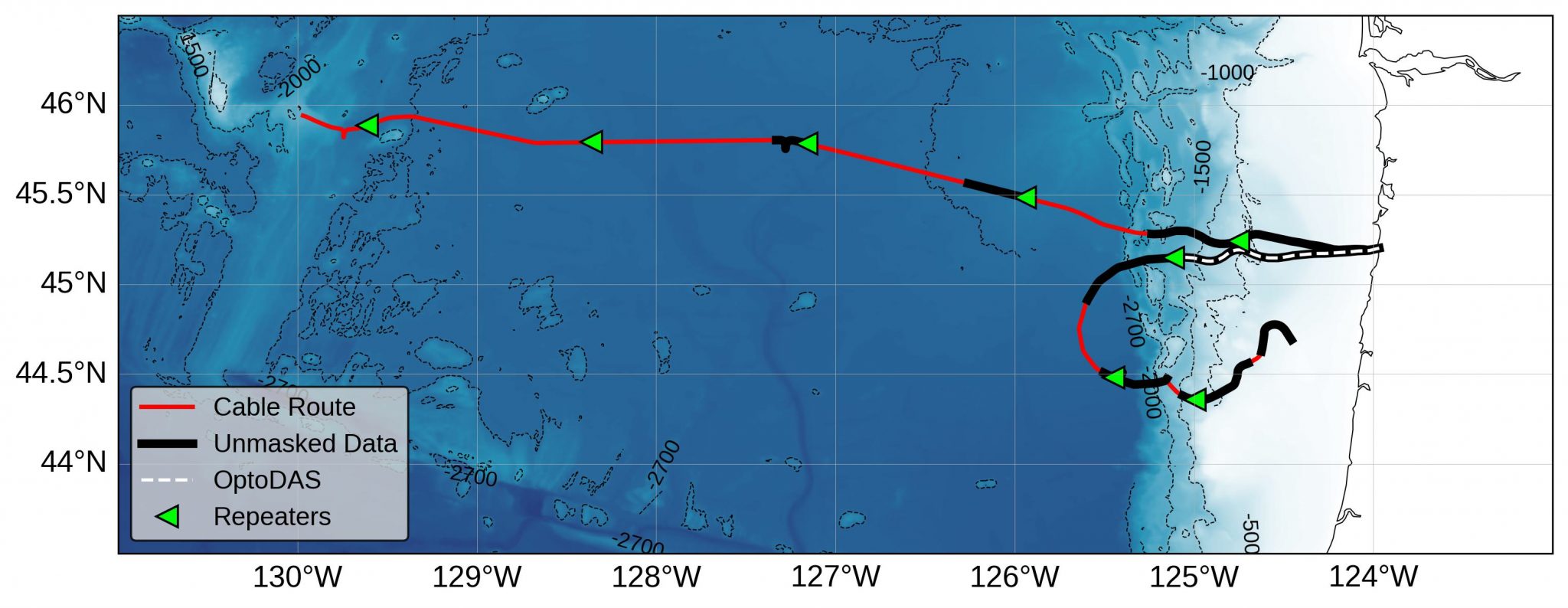 Location of the OOI RCA cables off the Oregon coast, shown in red. The portions of the cables that were successfully interrogated with the Nokia multi-span system during the experiment are shown in black. White dashed lines overlain on the first span of the South Cable show the portion of the cable interrogated with the OptoDAS system. The locations of the optical repeaters are shown in green. Credit: Z. Krauss, University of Washington.[/caption]
A manuscript describing the experiment and its results can be found as a preprint at ESS Open Archive.
Read More2025 OOIFB Summer School on Acoustics
From July 14-18, 2025, the U.S. National Science Founded funded OOI Facility Board (OOIFB) hosted an immersive summer school at the University of Washington in Seattle, bringing together early-career ocean scientists to explore the science and applications of underwater acoustics using Ocean Observatories Initiative (OOI) data.
Co-chaired by Dr. Wu-Jung Lee and Dr. Shima Abadi of the University of Washington, the program combined targeted lectures, hands-on tutorials, and real-world exercises to build participant expertise in accessing, processing, and interpreting both active and passive acoustic datasets including those from echosounders, hydrophones, and bioacoustic sonars available through the OOI network.
Over five days, participants gained:
- Core knowledge on underwater sound propagation and the main factors influencing it.
- Familiarity with the range of acoustic instruments deployed in the OOI network.
- Practical skills in navigating OOI data portals to access and download acoustic and complementary oceanographic datasets.
- Experience working with OOI datasets in JupyterHub, building Python skills and reinforcing coding as a core part of the program.
- Insights into scientific questions that can be addressed using OOI data.
- Connections with a community of researchers using OOI data in their work.
Participants
This year’s program welcomed 23 advanced graduate students, postdoctoral fellows, and early-career scientists from diverse research backgrounds. While geared toward those with an interest in underwater acoustics, the school was designed to be accessible, with no prior deep expertise required and high-level primers on underwater acoustics provided.
Looking Ahead
Archived materials, including the full agenda and select summer school resources, will be made available in the coming months for the broader research community.
The OOIFB Summer School on Acoustics exemplifies how targeted training can build a knowledge base in ocean acoustics research and broaden the use of OOI data in science and education.
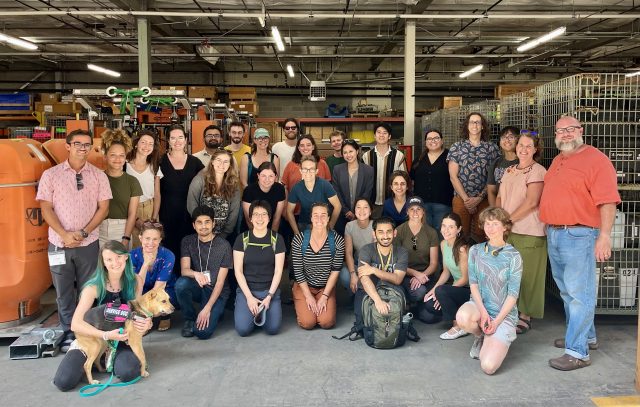
[caption id="attachment_36880" align="alignnone" width="2560"] The 2025 OOIFB Summer School on Acoustics cohort at the OOI-RCA Sand Point Facility.
 [/caption]
[caption id="attachment_36895" align="alignnone" width="2560"]
[/caption]
[caption id="attachment_36895" align="alignnone" width="2560"]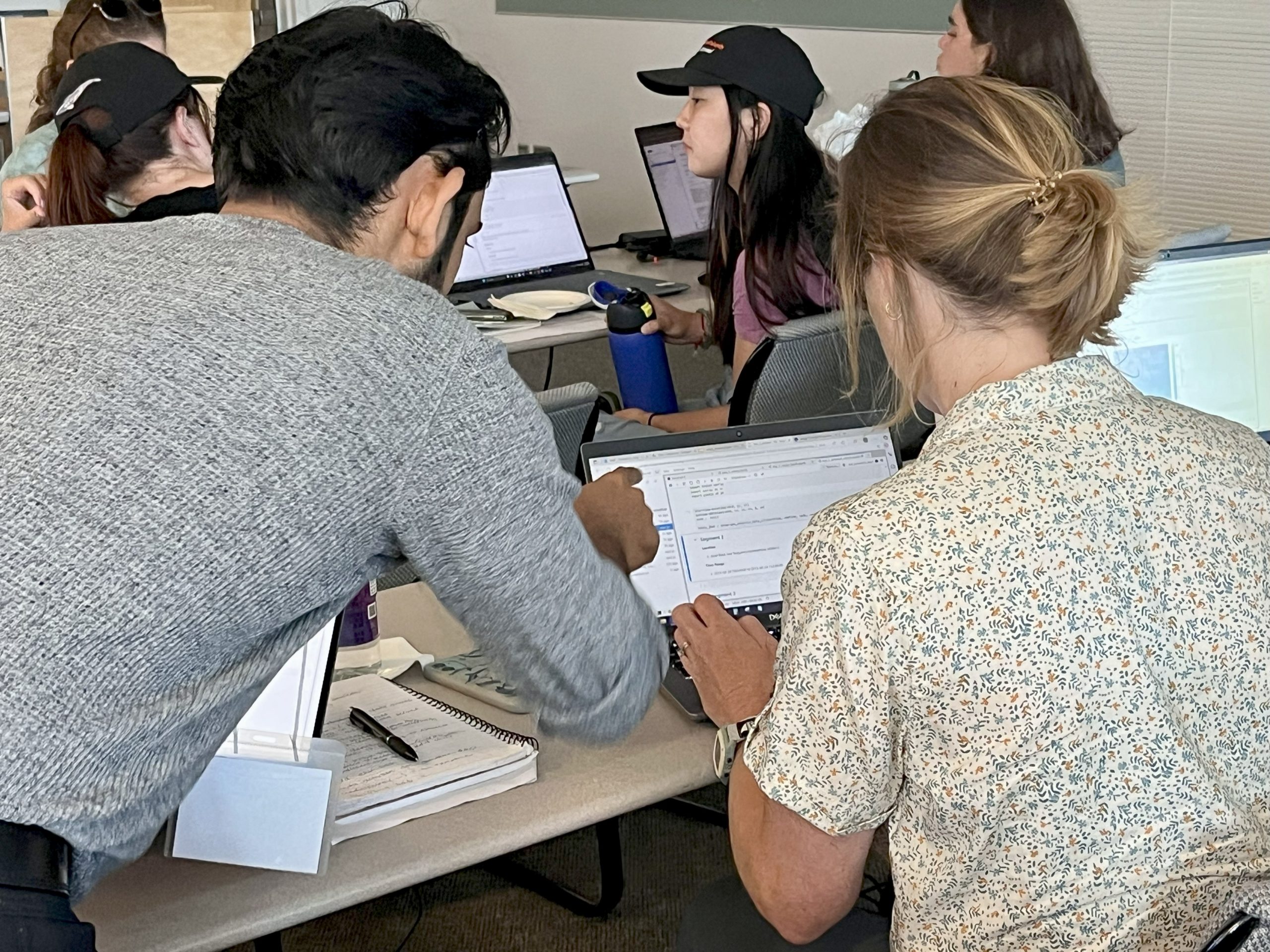 Students working through data exercises in the OOI JupyterHub environment. Credit: Holly Morin, OOIFB[/caption]
[caption id="attachment_36896" align="alignnone" width="2560"]
Students working through data exercises in the OOI JupyterHub environment. Credit: Holly Morin, OOIFB[/caption]
[caption id="attachment_36896" align="alignnone" width="2560"]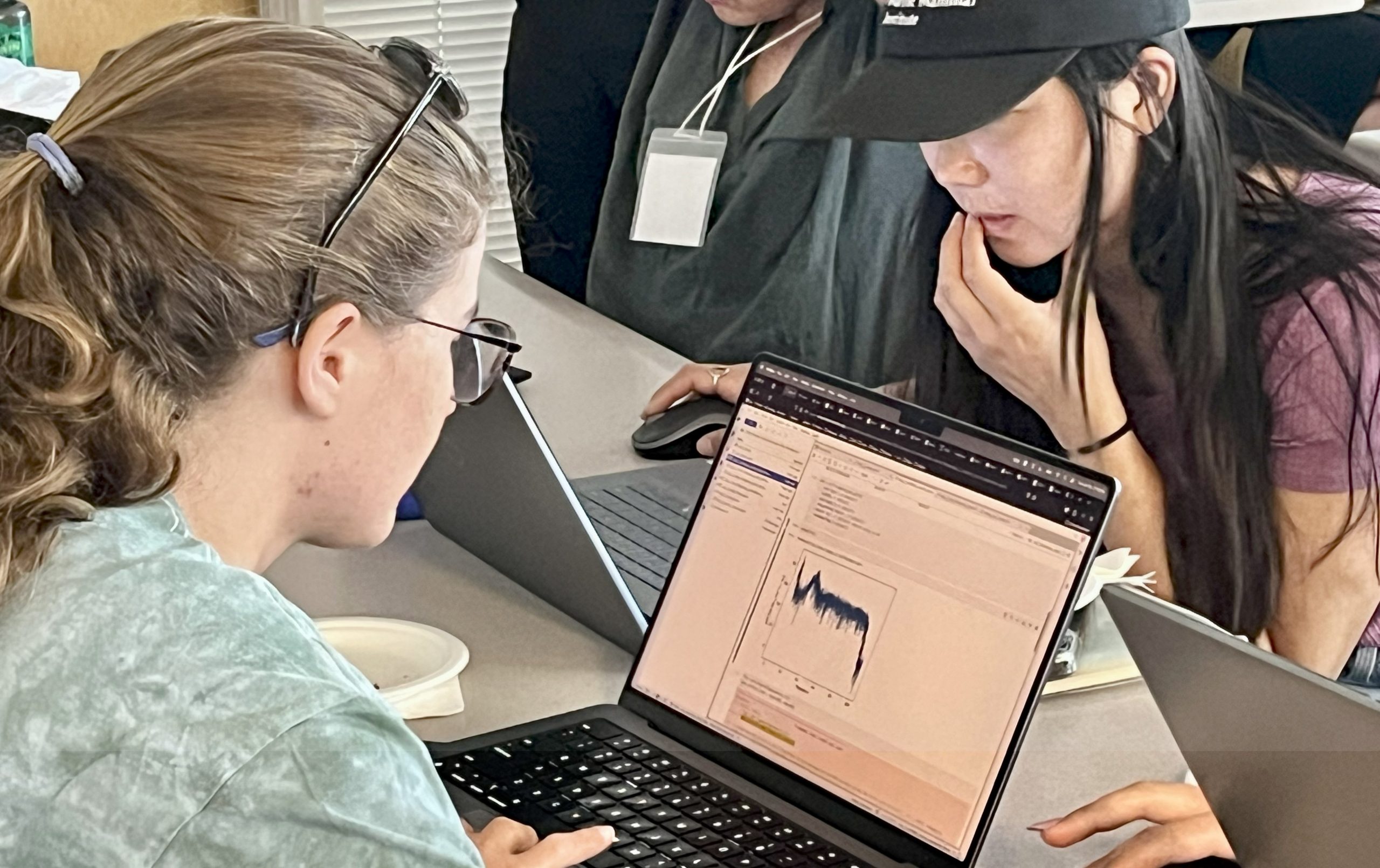 Students working through data exercises in the OOI JupyterHub environment. Credit: Holly Morin, OOIFB[/caption]
[caption id="attachment_36897" align="alignnone" width="2560"]
Students working through data exercises in the OOI JupyterHub environment. Credit: Holly Morin, OOIFB[/caption]
[caption id="attachment_36897" align="alignnone" width="2560"]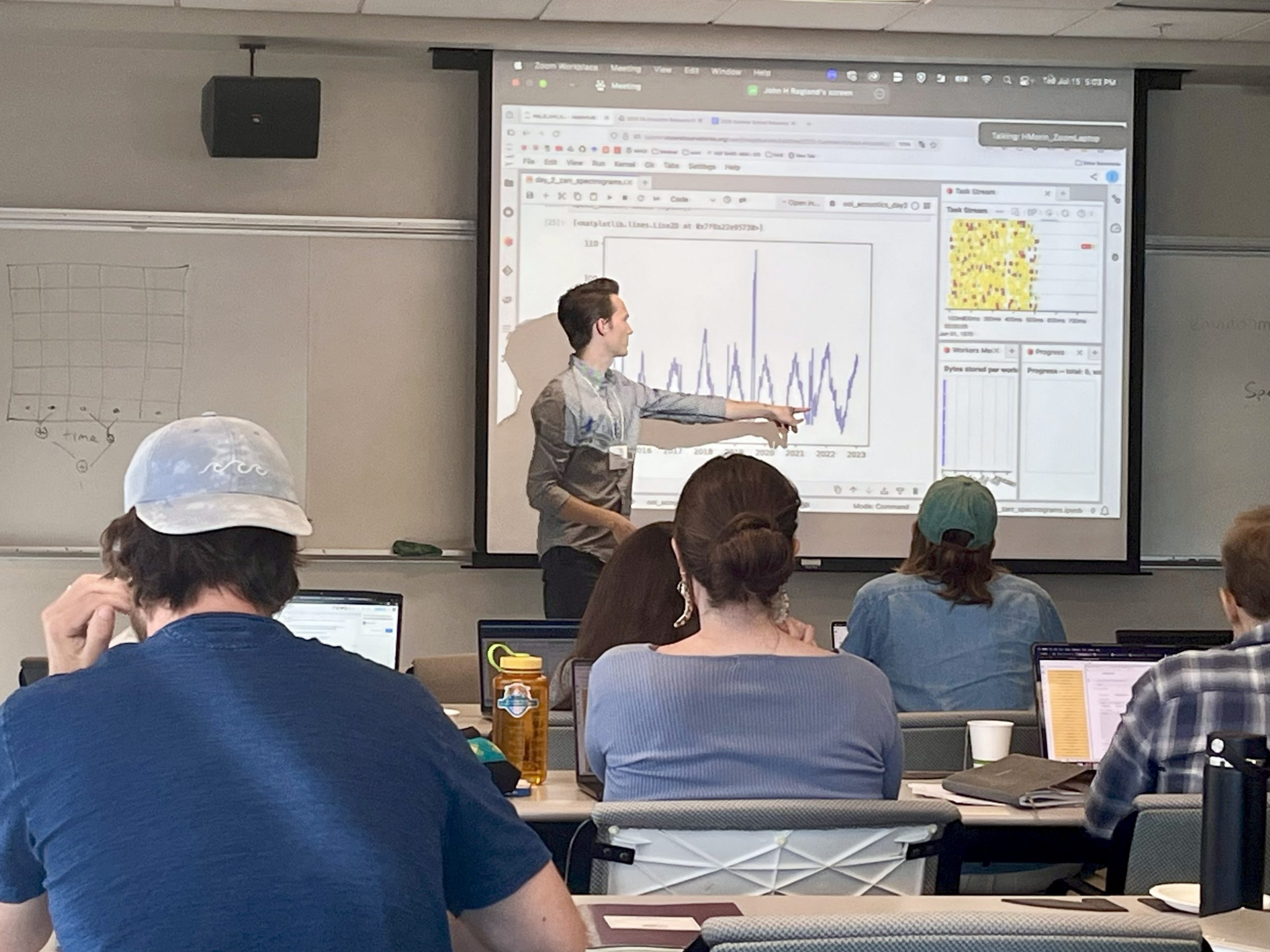 Dr. John Ragland works with participants to interpret outputs from a passive acoustic dataset. Credit: Holly Morin, OOIFB[/caption]
[caption id="attachment_36898" align="alignnone" width="2560"]
Dr. John Ragland works with participants to interpret outputs from a passive acoustic dataset. Credit: Holly Morin, OOIFB[/caption]
[caption id="attachment_36898" align="alignnone" width="2560"]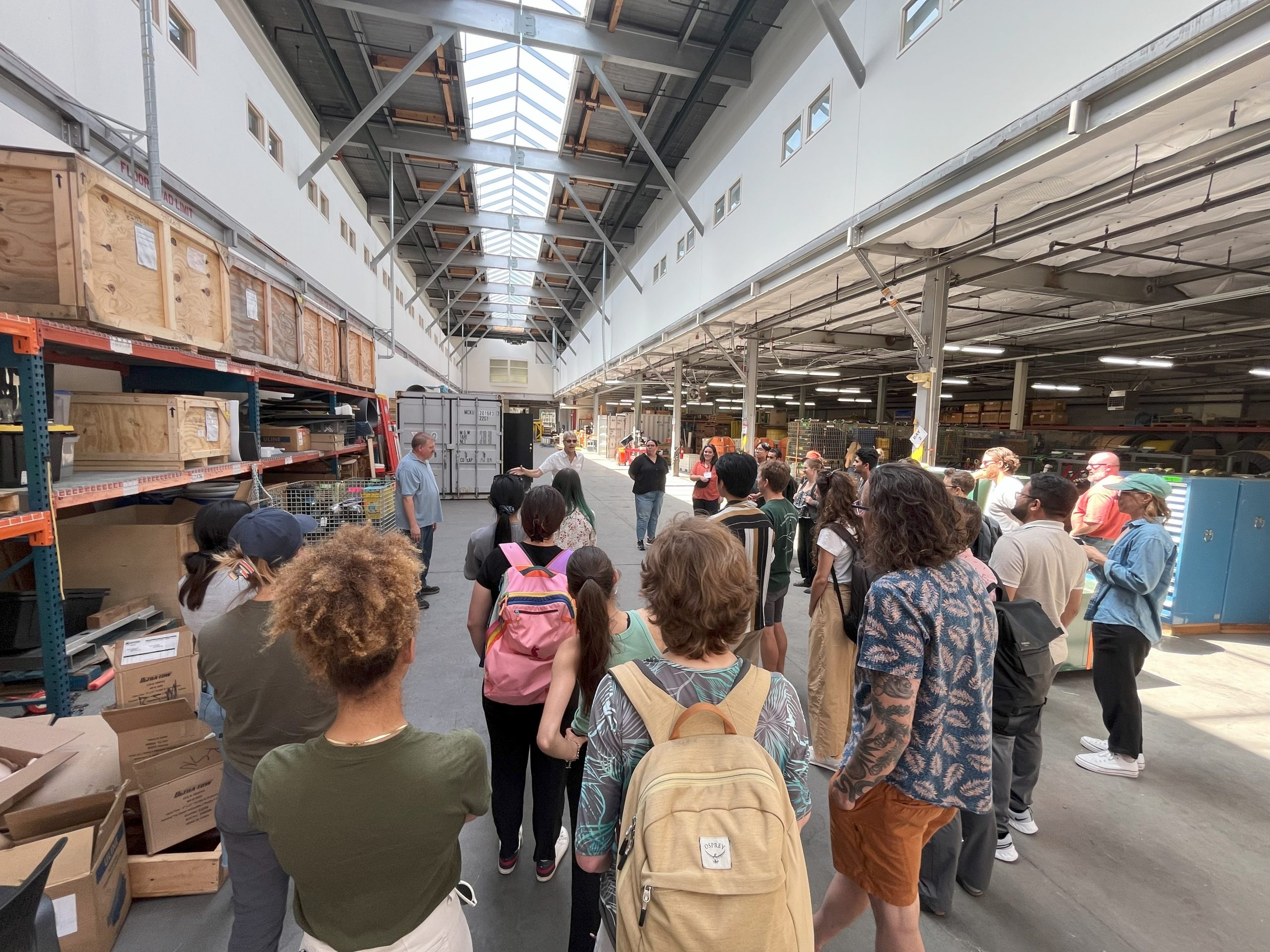 Participants tour the OOI-RCA Sand Point Facility. Credit: Holly Morin, OOIFB[/caption]


Distributed Acoustic Sensing Lays Groundwork for Earthquake, Tsunami Warnings, and More
Researchers using the OOI Regional Cabled Array are at the forefront of testing Distributed Acoustic Sensing (DAS) along the seafloor through funding from the National Science Foundation. Ocean-bottom DAS using submarine fiber optic cables promises to advance what we know about marine geology, offshore earthquakes, ocean currents, ocean waves, sediment transport, marine mammals, and a host of other activities that now can be measured by this revolutionary technique.
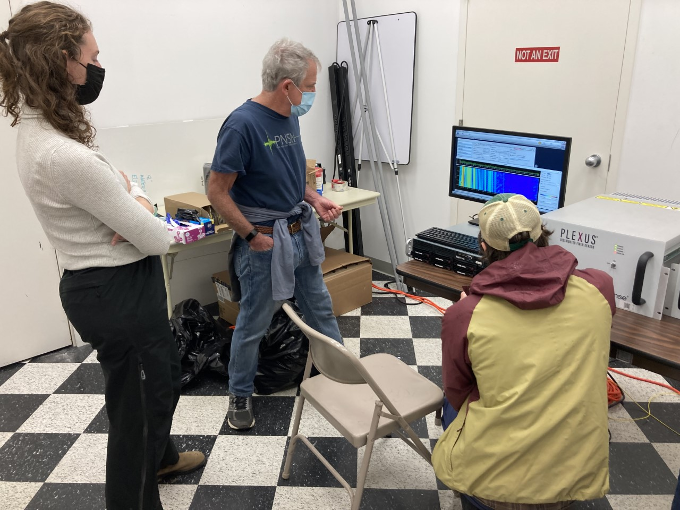
Taking advantage of a rare temporary shutdown of RCA’s submarine fiber optic cables during a shore station maintenance period, University of Washington Researcher William Wilcock and California Institute of Technology (Caltech) Graduate Student in Geophysics Ethan Williams were part of a team of scientists who installed DAS interrogators on RCA’s “dark cables” to test and collect data for a community experiment. The experiment was designed to determine the potential of submarine DAS to observe seismic, oceanographic, acoustic and geodetic processes. Each interrogator transmitted laser pulses down the fiber optic cable from RCA’s shore station and across the offshore Cascadia Margin and recorded the echoes that came back. This backscatter remains constant until some movement on the bottom or in the water column perturbs the fibers in the cable, changing the pattern of backscattered light. By rapidly probing the cable hundreds of times per second, DAS allows researchers to monitor what’s happening in the cable environment.
“Using DAS, the fiber optic cable acts, in effect, like a line of seismometers that can measure the stretching and contracting of the ground, “explained Wilcock. “It’s an amazing technology, similar to going out in the field and putting a seismic instrument every 10 meters for a stretch of 100 kilometers. So it’s just astounding in terms of what it can potentially measure,” said Wilcock.
The DAS system also has the capability of measuring other oceanographic signals. “It turns out that ocean bottom acoustic sensing on these fiber optic cables is as sensitive to the water layer above as it is to the solid Earth below. This sensitivity provides all sorts of really interesting signals that you would normally observe using an ocean bottom pressure sensor. DAS is opening up the door for lots of interesting research opportunities,” said Williams, who has been working with DAS systems for years under the supervision of Zhongwen Zhan at Caltech, one of the world’s foremost experts in the field.
Among the many potential ways DAS data might be used include advancing earthquake and tsunami early warning systems, and understanding wave and current action, sediment transport, and ocean-generated seismic noise, as well as providing biological information. In Wilcock’s case, he’s excited about using DAS to gain access to fin whale calls that were picked up by this DAS experiment.
The National Science Foundation funded this experiment in the hopes of developing protocols that can support the use of DAS for science and hazards mitigation in the Northeast Pacific while meeting national security requirements. The U.S. Navy conducted a preliminary review of the data and subsequently released the data for public use. The data are being stored on RCA servers at the University of Washington. Researchers will have ftp access to the data at this link. But because the full data set is 26 terabytes, researchers can also email ooicable@uw.edu to arrange to provide disks that will be returned with data they are interested in.
Four days of continuous measurements in this dynamic offshore environment also offer a potential treasure trove of data. Graduate student Williams is turning his attention to exploring these datasets and calibrating them against conventional measurements to better understand what some of the potential applications may be. “I’m very excited about the potential DAS brings to understanding what’s happening on the seafloor. Having, in essence, so many seismometers on the ocean floor means that we can apply all sorts of array-based processing so we’re not only averaging in time, we’re combining information in space. And this allows a lot of really innovative things that we weren’t able to do before.”
“But the real value of these datasets comes from being an open dataset. It will be a great facilitator for learning with the potential to expand general knowledge about how to use DAS in the marine geology and marine geophysics world, which is great,” Williams added.
Both Wilcock and Williams were excited about the potential for DAS to open up understanding of the processes involved in this deep-sea world. They both mentioned a dream of having DAS sensors integrated into future SMART cable technology to expand DAS use on land and in the sea.
Read More