
FDCHP
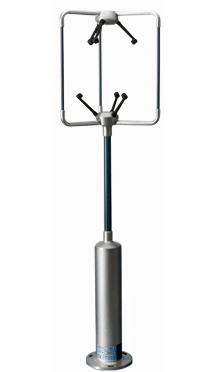
The Direct Covariance Flux sensor is an instrument package that collects vertical and horizontal wind components, air temperature and platform motion. These data are used to directly compute air-sea fluxes of momentum and buoyancy. The air-sea flux of momentum is the vertical transfer of horizontal momentum from the air to the ocean and is often referred to as the wind stress. The air-sea buoyancy flux is the vertical transfer of buoyancy associated with moist air and represents a mixture of sensible and latent heat exchange. Computation of the fluxes is accomplished using the motion-corrected direct covariance (MCDC) approach. This approach requires the system to measure the motion of the platform that can be used to compute the significant wave height and its direction. The system also provides the associated means and additional statistical measures of atmospheric turbulences and platform motion.
The system measures the horizontal and vertical wind components in the buoy reference frame using a 3-axis Gill Windmaster Pro (Model 1561-PK-020) sonic anemometer. The sonic anemometer also provides the speed of sound that is readily converted into sonic temperature, which closely approximates the virtual air temperature. The platform motion is characterized using a Microstrain (Model 3DM-GS5-25) Inertial Measurement Unit (IMU). This device integrates 3-axis linear accelerometers, 3-axis angular rate sensors (solid state gyros), and a 3-axis magnetometer. The data from the sonic anemometer and IMU are merged, time-stamped, and stored by a AA3355 1 Ghz ARM Cortex-A8 processor. The processor collects data for 20 minutes out of the hour and processes it during the 40 minute interval to generate the ancillary data telemetered to monitor system performance.
Read MoreFLOBN
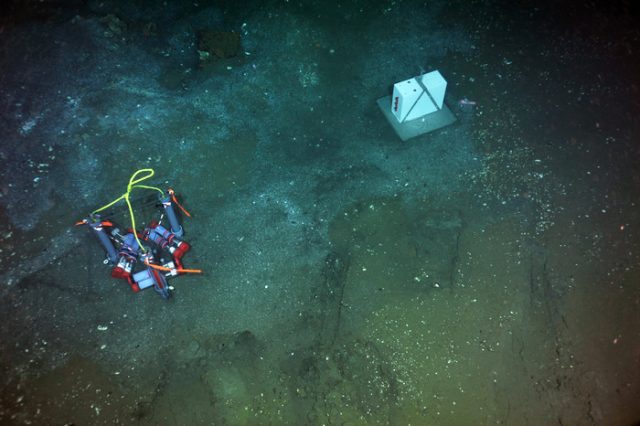
The Benthic Fluid Flow sampler measures fluid flow at the sediment-water interface by monitoring the dilution of a chemical tracer injected into fluids at the seabed and collected in small-bore, capillary tubing by osmotic pumps.
The “C” series of this instrument is a Chemical and Aqueous Transport (CAT) meter, and is deployed on or near methane seeps at the Southern Hydrate Ridge seabed. The recovered fluids are analyzed for chemical tracer and major ion concentrations, and flow rates are calculated.
The “M” series of this instrument is a Multiple Orifice Sampler and Quantitative Injection Tracer Observer (MOSQUITO), and is deployed on or near methane seeps at the Southern Hydrate Ridge seabed. The recovered fluids are analyzed for chemical tracer and major ion concentrations, and flow rates are calculated.
These instruments are deployed at methane seep sites at Hydrate Ridge, which is critical to determining the flux of methane, hydrogen sulfide, and other gases that are emitted into the overlying ocean. Methane is especially important because it is a greenhouse gas, and it and other gases support novel microbial communities that thrive in and on the seafloor at these sites, and in the overlying ocean.
(text and images courtesy of Interactive Oceans)
Read MoreHYDBB
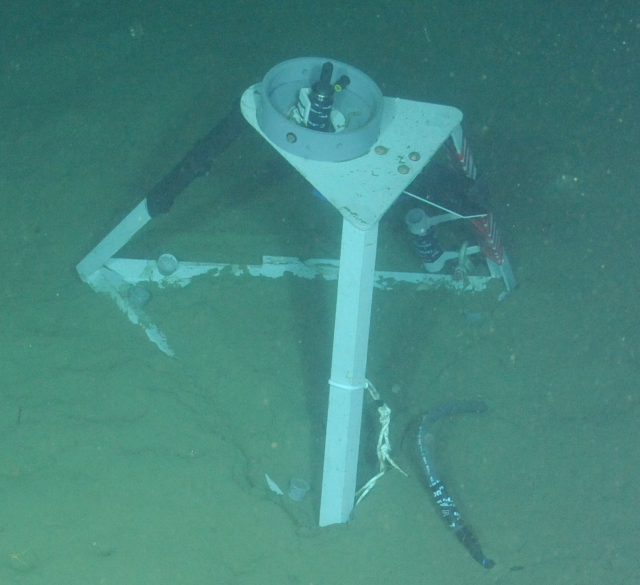
A digital Hydrophone is a passive acoustic sensor (an underwater microphone) that converts sound energy to electrical energy, with a binary stream output. The Broadband Acoustic Receiver (Hydrophone) listens for earthquakes, sea creatures, and human-generated noise in the ocean, and can hear and record everything from marine mammals in the water column to rain at the surface. The OOI requirements specified very broadband hydrophones with good noise floor characteristics and a wide dynamic range.
(text and images courtesy of Interactive Oceans)
Read MoreHYDLF
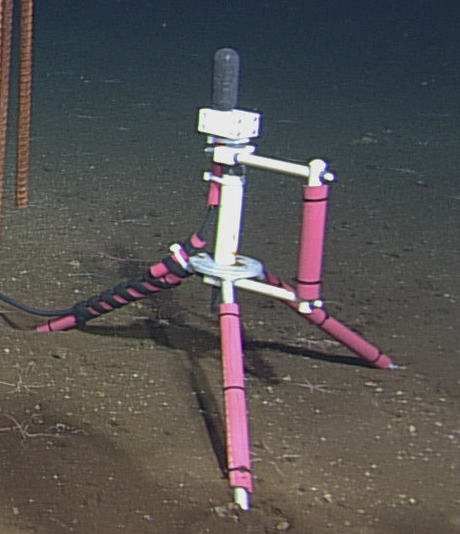
A Hydrophone is a passive acoustic sensor that listens for earthquakes, sea creatures, and human-generated noise in the ocean. The Low Frequency Acoustic Receiver (Hydrophone) measures acoustic signal of wind, rain, and seismic t-phases on the seafloor.
(text and images courtesy of Interactive Oceans)
Read MoreNUTNR
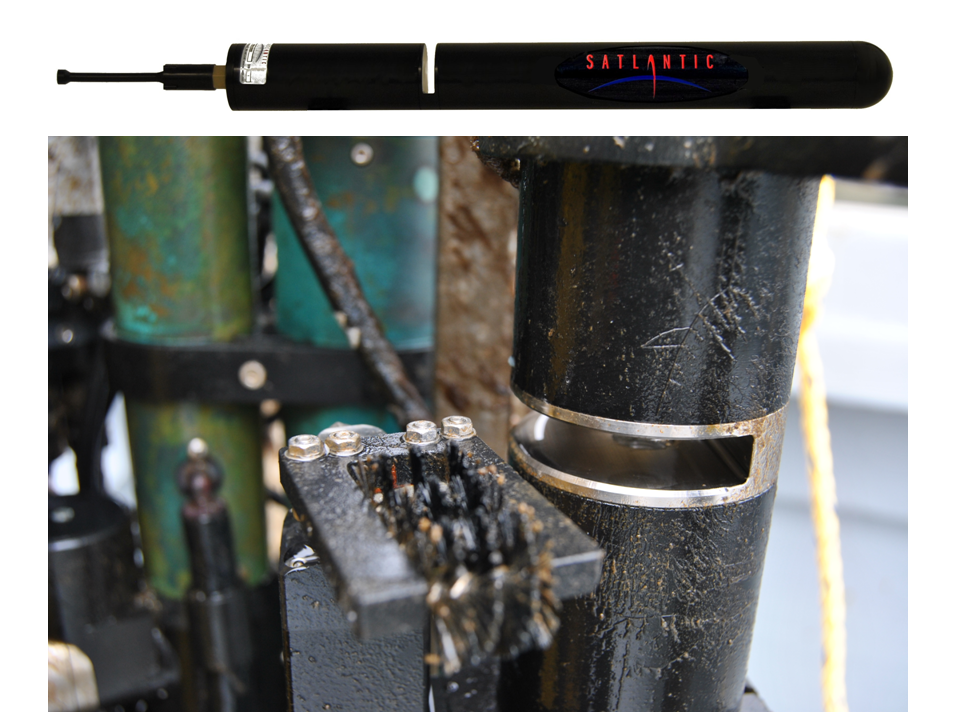
Nitrogen is an essential element for plant growth in the ocean, and the dominant labile inorganic form is nitrate. Nutrients typically have higher concentrations in the deep ocean; concentrations near the surface are often very low due to uptake by phytoplankton during photosynthesis. The nitrate vertical gradient may be very dynamic, responding to both physical and biological processes. The OOI Nitrate sensors optically measure the amount of nitrate (NO3-) dissolved in seawater by examining its absorption of ultraviolet (UV) light. The Sea-Bird SUNA V2 (Submersible Ultraviolet Nitrate Analyzer) is a chemical-free UV nitrate sensor based on the ISUS (In Situ Ultraviolet Spectroscopy) UV nitrate measurement technology developed at MBARI. These optical sensors provide fast response measurements, allowing for the sensor to be deployed on profilers, gliders, and AUVs.
Read MoreMETBK
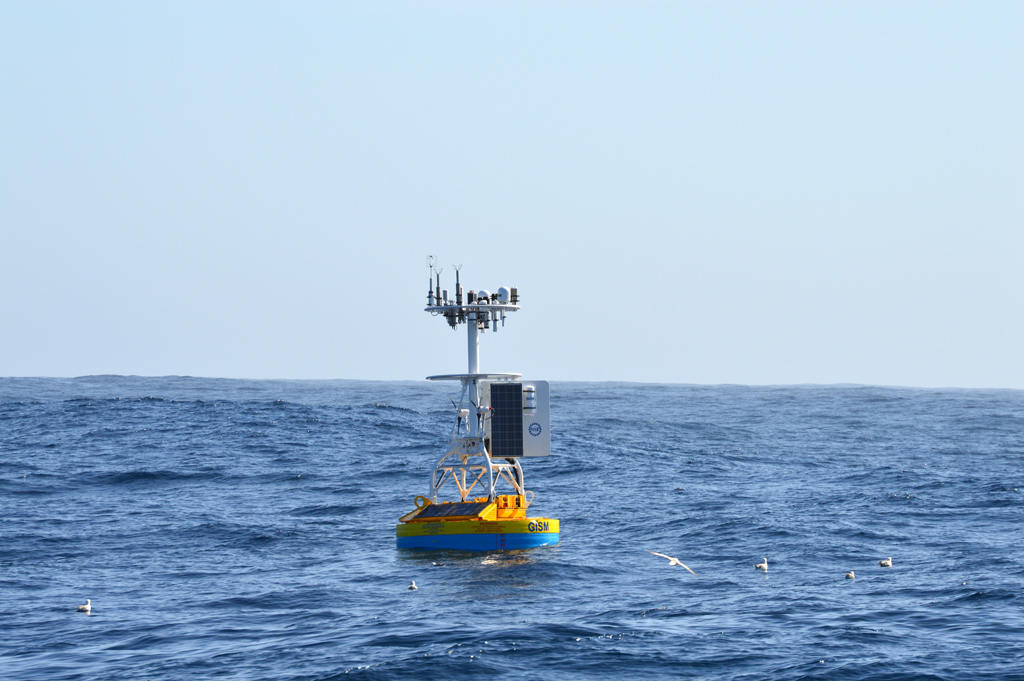
The Bulk Meteorology Instrument Package measures a variety of parameters that characterize weather conditions above the sea surface, including the data required to compute air-sea fluxes of heat, freshwater, and momentum. There are two data streams from this instrument: one for Level 1 (L1) surface meteorology data products (Relative Humidity, Air Temperature, Barometric Pressure, Mean Wind Velocity, Precipitation, Downwelling Shortwave Irradiance, Downwelling Longwave Irradiance, Sea Surface Conductivity, and Sea Surface Temperature), and one for Level 2 (L2) Bulk Flux products computed from the L1 data observations. The air-sea flux of heat is the sum of five separate heat fluxes: latent heat flux, sensible heat flux, net shortwave radiative heat flux, net longwave radiative heat flux, and rain heat flux. The air-sea flux of freshwater is the difference between rain and evaporation. The air-sea flux of momentum is the vertical transfer of horizontal momentum from the air to the ocean and is also called the wind stress.
Read More
CAMDS
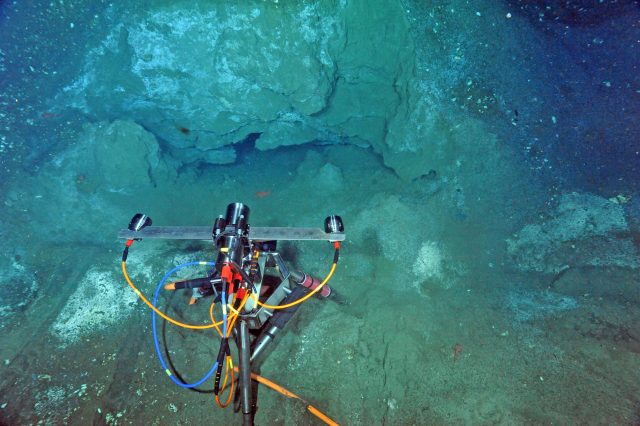
Imagery for OOI is collected to support a wide range of science questions, from geology to biology. Subjects of interest include changes in megafauna population density and activity, details of microbial mats, vent and seep flow rates and shape changes over time, and sedimentation processes. The cameras need the ability to image the sediment surface in sufficient detail to identify organisms (e.g., sea pens, fish, crustaceans, etc.), determine the presence/absence and changes in physical bedforms like ripples in the sediment, and identify biogenic features such as tracks and trails made by mobile fauna. Color images are required to assist with organism identification and to image phytodetritus flux to the seafloor.
Cameras that are attached to the electro-optical cable infrastructure (Endurance Oregon sites at 80 and 600 m depth, and on the Cabled Array) have the potential to increase the image capture rate during seismic activity, anoxic incidents, plankton blooms, or storm events to observe short-term changes in seafloor populations and features. Cameras deployed at sites without cabled infrastructure (Endurance Oregon 25 m and all Washington sites) have a reduced sampling rate and are equipped with onboard battery packs and increased data storage capacity to accommodate power and data communication constraints.
(text and images courtesy of Interactive Oceans)
Read MoreBOTPT
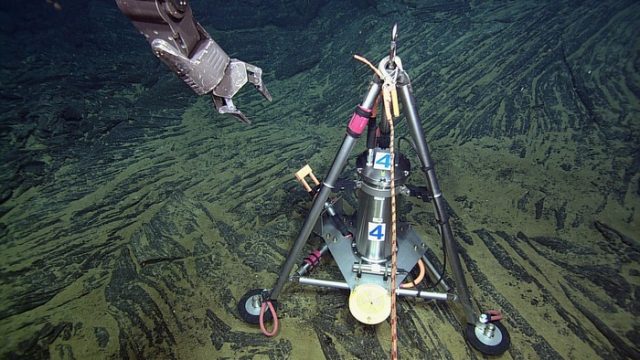
The Bottom Pressure and Tilt Meter (BOTPT) is a custom instrument developed by Bill Chadwick of NOAA PMEL. The BOTPT (aka Bottom Pressure Recorder or BPR) is designed to measure the inflation and deflation of the seafloor at the summit of Axial Volcano using a precision pressure sensor that enables detection of the seafloor’s rise and fall (“breathing”) as molten rock moves in and out of the underlying magma chamber. A very precise tilt meter that measures in micro-radians will record the tilting of the seafloor as it deforms in response to melt migration. Similar measurements are routinely made at terrestrial volcanoes, but these will be the first to be made in real-time at an active underwater volcano. Chadwick’s work has shown that the seafloor fell 2.4 m (7.9 feet) at the time of the eruption in April 2011. Three of these instruments are now installed at the summit of Axial Seamount at the Central Caldera (MJ03F), International District 2 (MJ03D), and Eastern Caldera (MJ03E) sites. They are connected to junction boxes that are now connected to Primary Node PN3B. All three instruments are now streaming data to shore. The pressure sensor is a Paroscientific Digiquartz pressure transducer, and the tilt meter is supplied by Applied Geomechanics (LILY).
(text and images courtesy of Interactive Oceans)
Read MoreRASFL
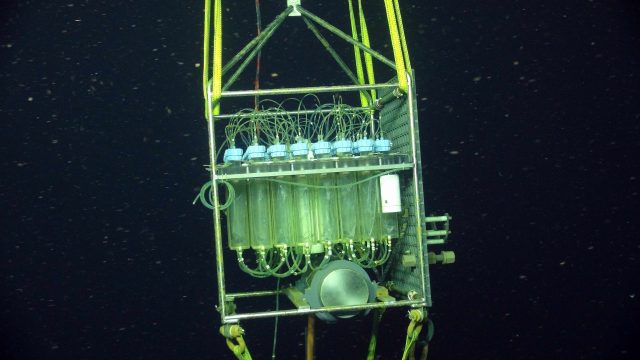
The Hydrothermal Vent Fluid Interactive Sampler collects and preserves fluid samples from hydrothermal vents and continuously measures vent fluid temperature. This instrument collects fluid samples from hydrothermal vents at the International District Vent Field on Axial Seamount. It is collocated with the Particulate DNA Sampler (PPSDN) and has an onboard temperature sensor (D1000) which continuously measures vent fluid temperatures. The sampler is able to be interactive, as its connection to the fiber optic cable allows two-way communication and power. Sample bottles can be triggered from shore in response to volcanic or tectonic events, or set to trigger at specified intervals. After instrument recovery, laboratory analyses provide chemical characterization of the hydrothermal fluid samples.
(text and images courtesy of Interactive Oceans)
Read MoreTHSPH

The Hydrothermal Vent Fluid In-situ Chemistry sensor measures the chemical composition of the mineral-rich fluid plumes that emanate from cracks on the seafloor, providing insight into the sub-surface structure and dynamics of these unique habitats. Specifically, it measures hydrothermal vent fluid temperature, hydrogen, hydrogen sulfide, and pH. The sensor wand design is a ceramic membrane electrode in conjunction with several reference electrodes, constructed with a titanium tube for long-term deployment applications. The instrument utilizes the power supply and bandwidth of the Cabled Array electro-optical cable to conduct continuous monitoring of the hot vent fluids.
(text and images courtesy of Interactive Oceans)
Read More