News
RCA’s Ninth Expedition: Best Laid Plans
Written by Deborah Kelley, PI of the Regional Cabled Array, September 17, 2023
The Regional Cabled Array, spanning the Cascadia Margin and Juan de Fuca tectonic plate and water depths of ~260 ft to 9500 ft, is an engineering marvel. It is the most advanced underwater observatory in the oceans comprised of >900 km of high power- and -bandwidth submarine fiber optic cables, a highly diverse suite of >150 instruments, and state-of-the-art moorings with instrumented profilers, which since 2014 have traversed >50 million meters of ocean water! The underwater substations and instruments are installed in some of the most extreme environments on Earth, including the most active submarine volcano off the Oregon-Washington coast ‘Axial Seamount’. Here, extension cables traverse glass covered lava flows and instruments are inserted into underwater, acidic hot springs, hot enough to rapidly dissolve aluminum and melt lead. Profiling science pods on moorings that traverse ocean depths from ~650 ft to 16 ft nine times a day, must be ‘smart’ enough to keep “their heads down” when storms, common in the waters of the NE Pacific Ocean, create waves reaching 30 feet in height or more. Yet, it is within these environments that the cabled observatory has thrived, largely due to its design, rigorous testing, and the hard work of the RCA Team, and Jason and Thompson crews during the annual operations and maintenance expeditions, such as the one nearing its end now: VISIONS’23.
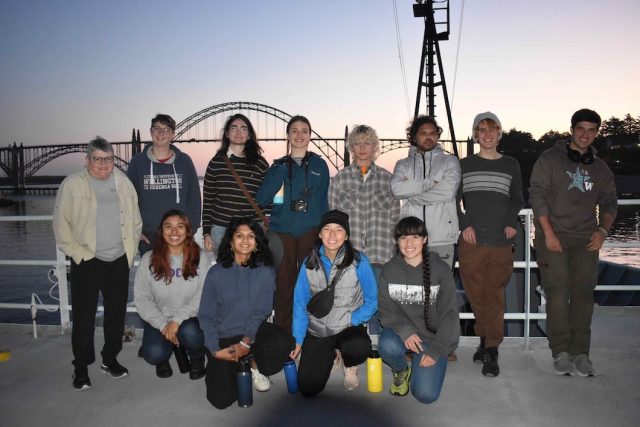
[media-caption path="https://oceanobservatories.org/wp-content/uploads/2023/09/Katie_Studenst_sm-20230908_200403_startL4_ME-copy-scaled-1.jpg" link="#"]First time RCA Chief Scientist Katie Bigham (top row, second from left) with Co-Chief Scientist J. Nelson (far left), RCA technician Andrew Paley (top row, far right) and Leg 4 VISIONS students. Katie was a VISIONS’14 student. Credit: M. Elend, University Washington, V23.[/media-caption]Planning for the RCA 2023 cruise began over a year ago as there is a high demand for NSF’s global class ships that operate throughout the worlds’ oceans. Scheduling is a complex process with lots of moving parts involving minimization of transit lengths, awareness of optimum weather windows, and researchers’ schedules. As soon as lasts year’s cruise ended, RCA instruments recovered in the Fall of 2022, were sent back to vendors for calibration and refurbishment, parts and cables were ordered, and the RCA teams’ eyes were already looking to this year. By late Spring, most of the refurbishment and integration testing of platforms and instruments was complete, the four Legs were planned out in detail, and the nearly 144 berthing assignments were finished. The careful layout of equipment on the aft deck of the Thompson was of critical importance, with nearly 200,000 lbs of gear on the fantail and the need for deck space free of gear to allow for mooring cables to be recovered and redeployed.
So that brings us to now, nearing the end of Leg 4, which will end on September 18 when the Thompson arrives back to Newport, Oregon. Working at sea is just tough, no way around it, and best laid plans are often adjusted before even leaving port (such as happened at the start of Legs 1 and 3) as the weather gods do not care about our schedule. The prior three Legs experienced numerous perturbations due to the loss of a week of operational days when the ROV Jason could not dive due to bad weather and additional loss of time due to ROV issues. Plans were adjusted on the ‘fly’ over and over again to best accomplish all of our goals, including the recovery and re-installation of >100 instruments. Because of this, some work was pushed out into Leg 4, an already complicated Leg because it was especially dependent on having good sea state conditions due to the planned installation and recovery of two deep profiler moorings, the largest of which rises >8000 ft above the seafloor at the base of Axial Seamount.
[media-caption path="https://oceanobservatories.org/wp-content/uploads/2023/09/Float.jpg" link="#"]The float for the Deep Profiler mooring at the Oregon Offshore site being brought onboard the Thompson. Credit: M. Elend, University of Washington; V23.[/media-caption]Almost immediately, Leg 4 plans were adjusted following the first operation – the recovery and reinstallation of the Deep Profiler Mooring at the Oregon Offshore site. The communications and power ‘dock’ at the base of the mooring would not respond after plugging in the seafloor extension cable that connects it to a small substation (junction box) on the seafloor. While the engineers tested various aspects of the cable, and puzzled over the cause, the RCA team continued their work at the Slope Base site. There, the Deep Profiler mooring cable was cleaned, and the instrumented profiling vehicle deployed in 2022 was replaced. Following this operation, the Thompson transited ~ 18 hrs to the base of Axial Seamount, where, instead of turning the mooring, it was decided to just swap out the vehicle, similar to Slope Base.
[media-caption path="https://oceanobservatories.org/wp-content/uploads/2023/09/getting-ready-to-bring-in-the-cable.sm_.PD01B_20230909_132549_recovery_ME-copy-scaled-1.jpg" link="#"]RCA engineers and ship crew getting ready to spool cable onboard from the Offshore Deep Profiler Mooring. Credit: M. Elend, University of Washington, V23.[/media-caption]With this work complete, a series of dives was planned to support researchers’ projects funded by the National Science Foundation outside of the Ocean Observatories Initiative. These dives were to include sampling of hydrothermal vent fluids to investigate viruses and microbes in these extreme environments, the recovery and installation of cabled CTD instruments to test the hypothesis that highly saline fluids are flushed from beneath the seafloor shortly following an eruption, and the recovery of a cabled multibeam sonar (COVIS) focused on making unique fluid flux measurements in the ASHES hydrothermal field. Time allowing, equipment on the Thompson would be used to “talk” to an acoustic array (FETCH) installed in the volcanoes’ caldera for investigation of deformation within this highly active volcano.
There was, however, a small window to complete this work. After investigation of the Deep Profiler Mooring at the Oregon Offshore site, it was determined that the Thompson would need to transit nearly 300 miles back to this area, to install a new extension cable, and/or recover and redeploy the mooring with the one just recovered at the beginning of Leg 4 – an exercise that could take 2-3 days. Indeed, Jason had other ideas because while working at the summit of Axial, there was an issue with the specialized hydrothermal vent sampler on the vehicle, followed by a failure of the power system, preventing more dives. The Jason team worked very hard overnight to fix the power supply, but with ever decreasing time to get the Deep Profiler work done back on the margin, it was decided to abandon remaining work at Axial (a very tough decision as this would impact researchers work over the entire next year) and head to the Offshore site. This also allowed optimal use of the transit time to thoroughly test the repaired power system for Jason. It also provided time for the APL engineers to ready a new extension cable for the Deep Profiler mooring, hoping that this simple fix would solve the problem, and to catch up on much needed sleep. With huge relief, the replacement of the extension cable did the trick on the first dive at the Offshore site. The docking station powered up and the vehicle completed its test profiling run — opening up a three-day window for additional work.
[media-caption path="https://oceanobservatories.org/wp-content/uploads/2023/09/ratail-sulis_20230916210321_rattail_probe_closeup.jpeg" link="#"]A rattail fish came to investigate the UFO fluid sampler as it obtained fluids for Dr. Rika Anderson at Marker 113, a diffuse flow site in Axial Caldera. Credit: UW/NSF-OOI/WHOI, Dive J2-1559, V23.[/media-caption]With a sigh of relief and desperately wanting to support the external researchers work, Chief Scientist, Katie Bigham, asked Captain Eric to turn the ship around and head back out to Axial Seamount. So away they went, following the same track line they had completed less than 24 hrs before. During the next 34 hrs, Jason pounded out the dives and completed all but the FETCH work, before it was time to once again head back to Slope Base to complete two final tasks.
The above description is only part of what goes on during the various legs of these RCA expeditions. It is hard to convey what it is like to be a Chief Scientist on an RCA cruise. As with this cruise, decisions must be made rapidly, but also strategically, with an eye towards the end of a leg and cruise – “Will this decision prevent other work from happening? What is the weather going to be like in 2-3 days? What is the status of equipment? How are the students doing and how are their projects going? Do they need help? Is the team getting enough sleep? Should we transit to another site to help with this? On and on it goes…Awareness of these questions and outcomes are always in a Chief Scientists’ thoughts and are combined with the everyday tasks of writing plans for the next day and operational reports.
This was Katie’s first time being a Chief Scientist. She has done an exceptional job making adjustments to our “best laid plans” on a cruise that has been one for the books in the near decade of RCA operations and maintenance expeditions.
For more information on the RCA’s ninth operations and maintenance expedition, visit here.
Read More
Biogeochemical Sensor Data Best Practices and User Guide Now Available
The Global Ocean Observing System (GOOS) recently endorsed a finalized guide on how to use data generated by biogeochemical (BGC) sensors deployed by the Ocean Observatories Initiative (OOI).
The OOl Biogeochemical Sensor Data Best Practices and User Guide is intended to provide current and prospective users of data generated by BGC sensors deployed on OOI arrays with the information and guidance needed for them to ensure that the data are science ready. The guide is aimed at researchers with an interest or some experience in ocean biogeochemical processes. The guide was written with the assumption that its users would have some background in oceanography but not necessarily any prior experience working with BGC sensors or data they collect.
The guide was created by a 25-member Working Group, with input from 14 Beta Testers who joined the Working Group members for a June 2022 workshop. The draft version of the guide was revised based on Beta Tester feedback, and then circulated for open review by the full scientific community. The finalized guide, incorporating feedback from the open review process, was then endorsed as a best practice by GOOS after this rigorous review.
“We are delighted that our endeavor to make BCG data more broadly usable and accessible to the oceanographic community has been endorsed by GOOS,” said Hilary Palevsky of Boston College and a co-leader of the working group. “This has been a true team effort to develop best practices that will be broadly useful for the community and has demonstrated the importance of broad collaboration. We look forward to this guide enabling new science bringing in new users of OOI BGC data.”
Download the BGC Sensor Data Best Practices Guide.
Read MoreTenth Refresh of the Irminger Sea Array
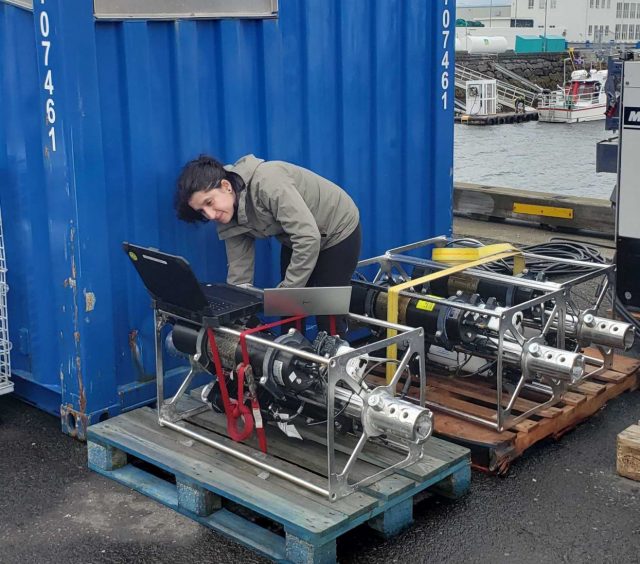
On August 27th, a team of 13 scientists and engineers boarded the R/V Neil Armstrong in Reykjavik, Iceland to head to the Irminger Sea Array. Most of the array’s infrastructure and instrumentation was shipped from Woods Hole Oceanographic Institution (WHOI) in mid-July to Iceland, where it arrived in mid-August. Part of the scientific party traveled to Reykjavik in mid-August to reassemble the moorings and conduct a “burn-in,” a test period for the power, data, telemetry, and instrument systems to ensure everything is operational prior to loading the vessel.
The Irminger Sea Array is in a region with high wind and large surface waves in the North Atlantic and is one of the few places on Earth with deep-water formation that feeds the large-scale thermohaline circulation. Data collected by the Irminger Sea Array are providing critical insights into circulation patterns, ocean processes, and possible climate-induced changes occurring in this important oceanic area.
After an ~ two-day transit (550 nautical miles) to the array site off the tip of Greenland, the team will recover and deploy four moorings and three gliders over the next two and a half weeks. They will conduct CTD (conductivity, temperature, and depth) casts at the deployment/recovery sites and carry out shipboard sampling for field validation of the platforms and sensors that will remain in the water for the next year.
In addition to the recovery and deployment operations, the team will be conducting some CTD calibration casts in support of OSNAP-GDWBC (Overturning in the Subpolar North Atlantic Program-Greenland Deep Western Boundary Current). A participant from the National Oceanic and Atmospheric Administration will also be on board using “Big Eye” binoculars mounted on a forward deck to make observations of marine mammals during the transit and in the Irminger Sea.
[media-caption path="https://oceanobservatories.org/wp-content/uploads/2023/08/Big-eyes.jpg" link="#"]Large, deck-mounted binoculars known as “big eyes” are used for marine mammal observations. NOAA Research Wildlife Biologist Peter Duley will be aboard the R/V Neil Armstrong watching for marine life in the Irminger Sea. Credit: Al Plueddemann ©WHOI.[/media-caption]The Irminger Team will also be testing out some equipment modifications on this deployment. One change is an updated satellite telemetry system. This system would provide higher bandwidth allowing better and quicker data transmission from the global surface mooring potentially saving power, and better remote command and control of the mooring systems. Another change is a revised mounting scheme for the glider optode, which measures dissolved oxygen concentrations in the water column. The new mount may provide better in-air measurements during glider surfacing. The in-air measurements allow scientists to characterize the changing accuracy of the instrument over time.
“It’s always a challenge to get ready for this month-long expedition to this remote, but critical region, but we are ready and eager to get there,” said John Lund, Chief Scientist for Irminger 10. “We are pleased to play a part in collecting data that scientists are using to better understand changes occurring in this region, with implications for both weather and climate.”
The team will reporting regular updates from the field. Bookmark this page so you can follow along on their progress.
Read MoreOOI Engineers Develop New Rechargeable Lithium-ion Battery Pack
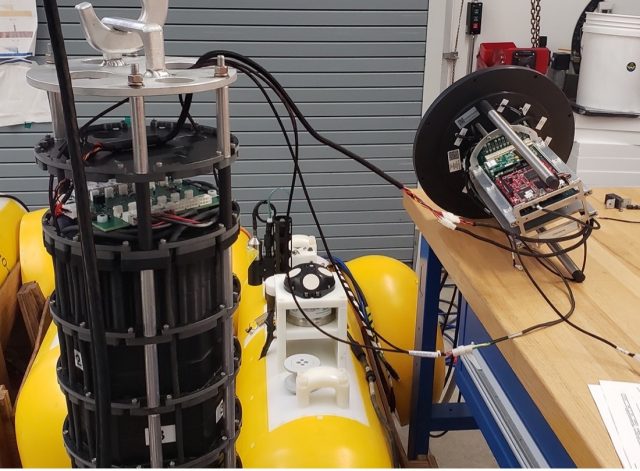
By John Lund, Research Associate, Woods Hole Oceanographic Institution
The final deployment of the Coastal Pioneer Offshore Mooring (CP04OSPM-00016) was the first deployment of a prototype rechargeable lithium-ion battery pack. The deployment was a success with the battery pack providing power throughout the entire 6.5-month deployment.
Working with Mathews Associates Inc. the OOI engineering team developed a drop-in replacement lithium-ion rechargeable battery pack to replace the original one-time use alkaline packs. Each alkaline pack consists of 72 D-sized batteries that are fabricated into a hexagonal assembly. Nine of these battery packs are fitted into a buoy battery chassis that fits inside the buoy well. The packs are wired together in parallel to provide the required voltage to power the computer (buoy controller) responsible for telemetry and data-logging.
Pioneer moorings are nominally deployed for 6-month intervals. Variability in ship scheduling requires that the buoys be capable of operating for 7+ months. The alkaline battery chassis was designed to fit enough packs to power the buoy for the planned duration and or until the recovery ship arrived.
[media-caption path="https://oceanobservatories.org/wp-content/uploads/2023/08/Lithium-batteries.jpg" link="#"]Lithium Battery chassis during testing and integration with the buoy computer. Battery chassis is on the left. Buoy end cap with Linux computer board on the bench. Wire Following Profiler center on the floor collects the majority of the Profiler Mooring data set.[/media-caption]The Offshore mooring was selected to be a test mooring because it is one of the deeper moorings in the New England Shelf (NES) Pioneer Array and as such logs and transmits more data than a shallower mooring. The larger data sets mean that the buoy up-time, and therefore power usage, is greater than one in shallower water so this would be a tougher test of the lithium-ion packs.
Although there is an increased cost to purchasing the initial set of lithium batteries there are many advantages to the rechargeable batteries. Because the alkaline packs are conservatively sized for the deployment there is often a considerable amount of power remaining in the packs when they are recovered, yet this remaining power is insufficient for another full deployment, and new batteries must be used. The chief benefit of the rechargeable batteries will be to keep the one-time use alkaline packs from going to the landfill (~1 ton per year). There is also a considerable labor savings of not having to deconstruct and reload the chassis frames with replacement batteries. Our calculations indicate that we will break in terms of procurement cost compared to alkaline batteries in approximately six years and that the lithium-ion batteries have enough charge cycles (500) to last the duration of the program. With any luck these may be the last batteries we need to purchase for the Profiler Moorings!
Read More
New Controller Latest in OOI Innovations
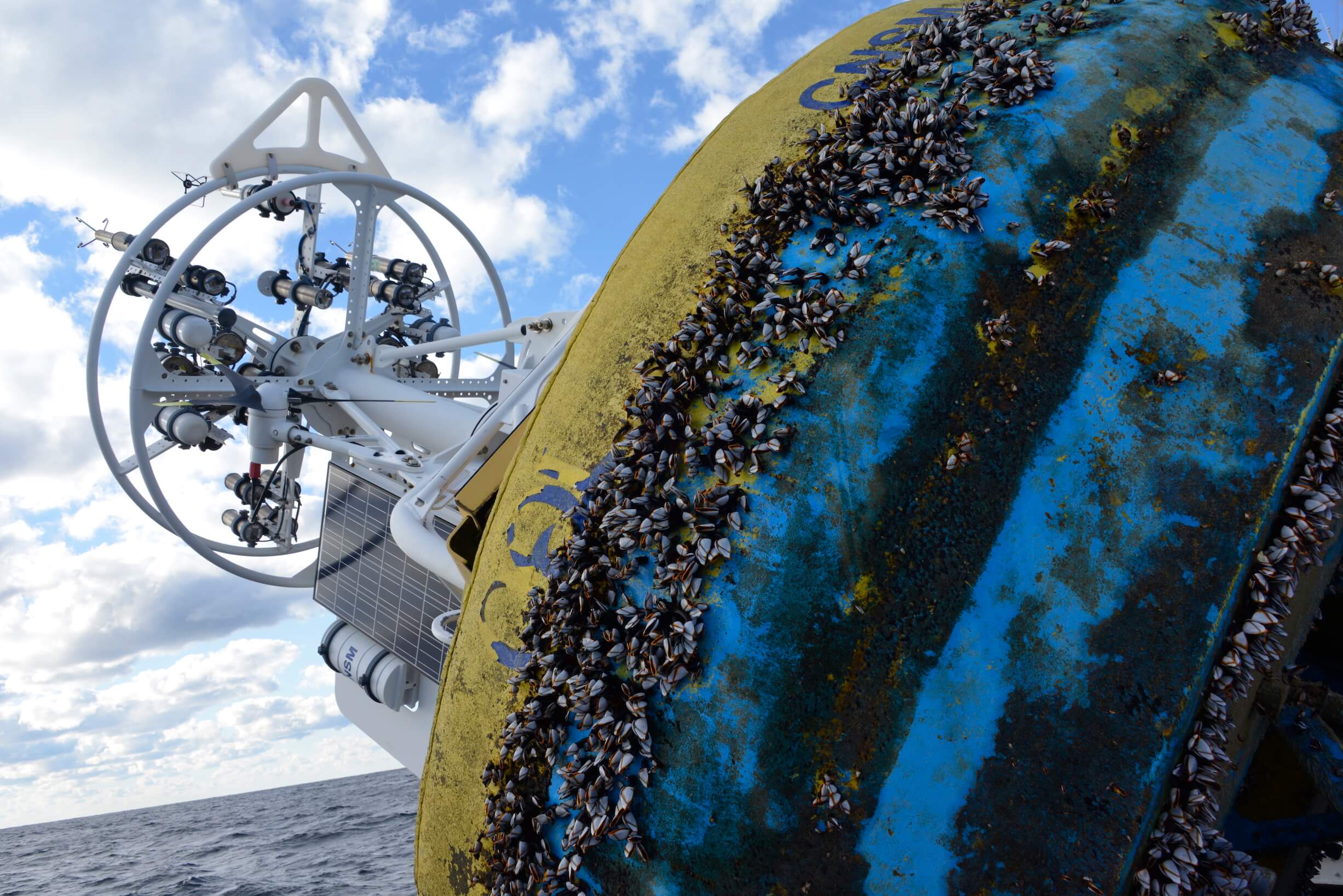
Having equipment in the water around the clock for six months at a time provides many challenges for the land-based OOI engineering team charged with keeping the equipment operational so there is a continual flow of data to shore. Maintaining consistent, reliable power for the ocean observing equipment is at the top of this list of challenges.
OOI’s data-collecting instruments attached to the moorings run on batteries charged by renewable wind and solar energy. OOI is in the process of replacing the current solar panels with new panels that are more efficient at generating energy, even when shaded. To supplement this upgrade, the OOI arrays are also being outfitted with a brand-new solar controller to manage the energy going into the batteries. Like with the new solar panels, OOI engineers looked for a controller that was available commercially for easier repair and replacement.
“What was important to us was finding a way to use these new solar panels in the best, most optimal way,” said Woods Hole Oceanographic Institution (WHOI) engineer Marshall Swartz. “We looked for a company that would help us specify and build a customized algorithm for a controller that would optimize the functionality of the panels by taking into account battery temperatures.”
[media-caption path="/wp-content/uploads/2021/12/DSC0486-2.jpeg" link="#"]Buoys get quite the workout when they are in the water for six months and more. Powered by wind, solar, and batteries, OOI has recently improved the way energy from the solar panels is managed with new controllers. Credit: ©WHOI, Darlene Trew Crist. [/media-caption]
Some larger, older controllers can consume up to 3-5% of the energy coming into the device, but the new controller is smaller and more efficient, helping to optimize the amount of energy harvested.
Temperature conditions play a big role in how effectively the energy is managed. Changing battery temperatures require the controller to adjust its charge settings to maintain battery life and capacity. The controllers used on OOI moorings sense battery temperature and automatically adjust to assure best conditions to assure reliable operation.
“It’s really essential for us to maintain the proper charge levels for existing temperature conditions,” said Swartz. The OOI buoys encounter a wide range of temperatures: from subfreezing temperatures up to 40°C (over 100°F) when a buoy is sitting in the parking lot before it is deployed. When the buoys are deployed, water temperatures can vary widely from -1 to 33°C (~30 to 91°F), depending on seasonal conditions.
The new controller automatically regulates the amount of electricity going into the battery under such varying temperature conditions. If the wind turbines are generating more energy than the battery needs, for example, the controllers direct excess power into an external load that dissipates heat and adds resistance to the spinning of the wind turbines, preventing the turbines from spinning too fast, possibly damaging their bearings.
“As parts of the OOI infrastructure need replacing or to be upgraded, this offers us the opportunity to find more efficient, and often times, off-the-shelf, less-expensive replacements that will help us keep the arrays functioning and data flowing,” Swartz said. “It’s a winning combination for all parts of the operation.”
Read More
Abstracts Welcome for OSM Session on California Current and NE Pacific Ocean
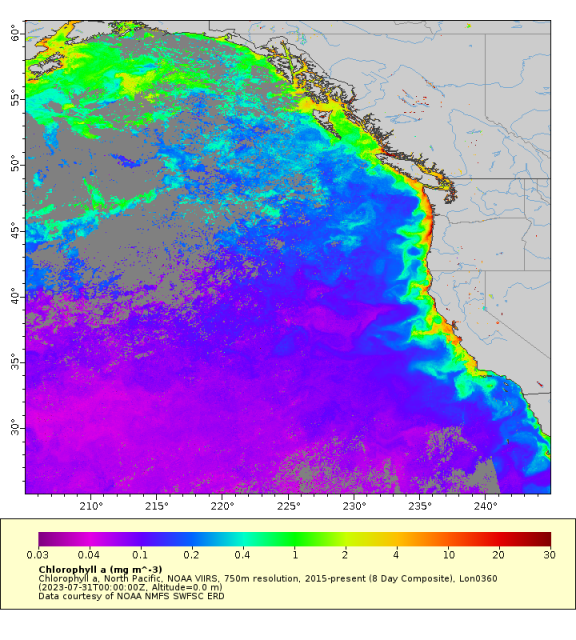
Abstracts are being sought for a session on data and modeling of the California Current System and the Northeast Pacific Ocean during the 2024 Ocean Science Meeting in February in New Orleans. Edward P. Dever, Oregon State University, Richard K. Dewey, Ocean Networks Canada, and Kashish Sadhwani, Indian Institute of Technology Bombay organized the session to maximize use of modeling efforts in the region and to foster further collaboration among researchers.
“The Northeast Pacific Ocean offers researchers opportunities to study many regionally important processes that impact productivity, seasonal hypoxia, and ocean acidification,” said Edward P. Dever, of Oregon State University, who is chair of the session. “We hope to bring researchers together to share their insights about this important region and to help facilitate collaboration among those working in different areas of the Northeast Pacific.”
The deadline for abstract submission is September 13, 2023. Submit here. A description of the session follows:
OT019 – Sustained Data and Models in Support of Research in the California Current System and Northeast Pacific Ocean
The Northeast Pacific Ocean as defined by the California Current System, Salish Sea, and Gulf of Alaska, has long been a focus of sustained observing and modeling efforts. Regionally important physical processes include coastal upwelling, river plumes, and responses to interannual variability (e.g., ENSO, the Pacific Decadal Oscillation, marine heatwaves, and other events). These processes impact primary productivity, phyto- and zooplankton community structures, seasonal hypoxia, and ocean acidification. In this session, we seek to share insights and facilitate collaboration between observations and models and among researchers working in different areas of the Northeast Pacific. We invite contributions in any of the following broad topics:
- syntheses of sustained data sets for model initialization
- forcing and validation
- best practices for inter comparison and networking across observations
- modeled and observed interactions between different sub-regions
- estimation of rate processes
- advances in bio-acoustic, biogeochemical, and bio-optical measurements, and
- predictions of physical and ecosystem responses across relevant temporal and spatial scales.
Read More
RCA Embarks on a 41-day Operations and Maintenance Expedition
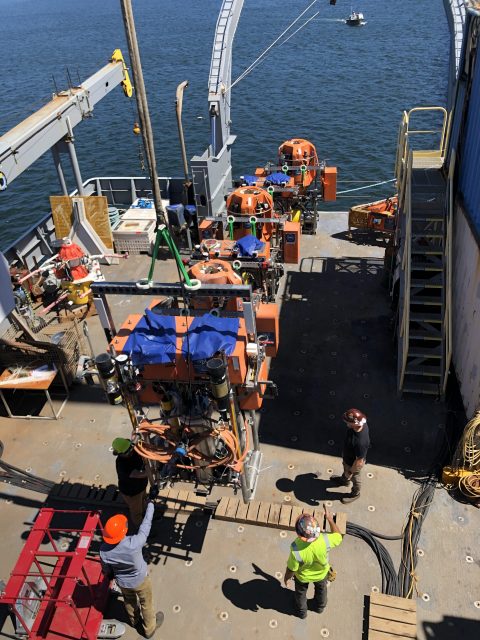
Watch live video here.
The numbers are remarkable for the Regional Cabled Array’s (RCA) Operations and Maintenance Expedition that left Newport, Oregon aboard the R/V Thomas G. Thompson on Sunday August 13. Because of its complexity and the need to move 100 different instruments, the expedition consists of four legs over 41-days. The legs are separated by ~2-3 days port call at NOAA Marine Operation Center in Newport, Oregon. A science team of 12 is conducting the scientific operations, with their work supported by an engineering team of 20 (not all onboard). The Remotely Operated Vehicle (ROV) Jason, operated by a team of 12 from the Woods Hole Oceanographic Institution, is recovering and deploying instrumentation on the RCA for the duration of the expedition.
Finally, 25 students in the University of Washington’s VISIONS Program are onboard during various legs to gain real sea-going experience and work side by side with the scientific team. Additionally, six other guest participants will be onboard, including a children’s author, engineers, and scientists.
The RCA annual expedition is always an exciting opportunity to watch real-life operations at sea. Operations will be live-streamed here. Details about the expedition, who’s involved, and what’s happening and planned can be found here. Daily updates can be found here.
[video width="608" height="1080" mp4="https://oceanobservatories.org/wp-content/uploads/2023/08/Thompson-loading.mp4"][/video] Read MoreSensor Summer School Curriculum and Video Available
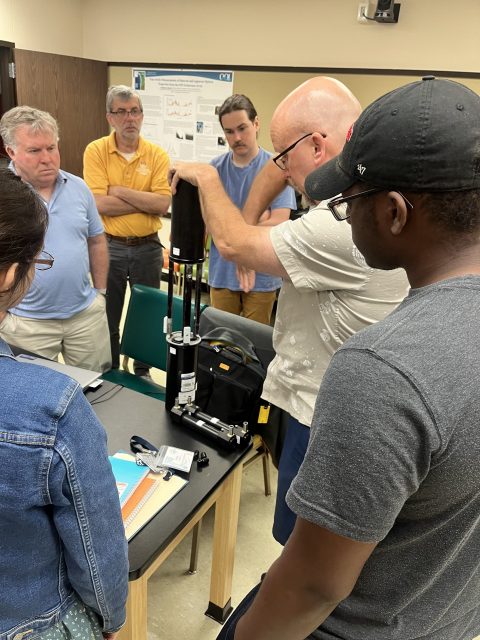
The Ocean Observatories Initiative Facility Board (OOIFB) hosted a 2023 summer school (July 17-21, 2023) at Oregon State University in Corvallis, Oregon that focused on OOI optical attenuation and absorption data. A mix of advanced graduate students, post-doctoral fellows, and early career scientists participated in this hands-on learning experience about how to access, analyze, and interpret data from the Sea-Bird AC-S. Data from the AC-S is used to characterize the absorption and scattering of light in seawater, which provides information on phytoplankton biomass in the measured ocean region.
So others may benefit from what was learned, the curriculum is available online here.
Read More
Spreading Curiosity about Ocean Science with Summer Visitors
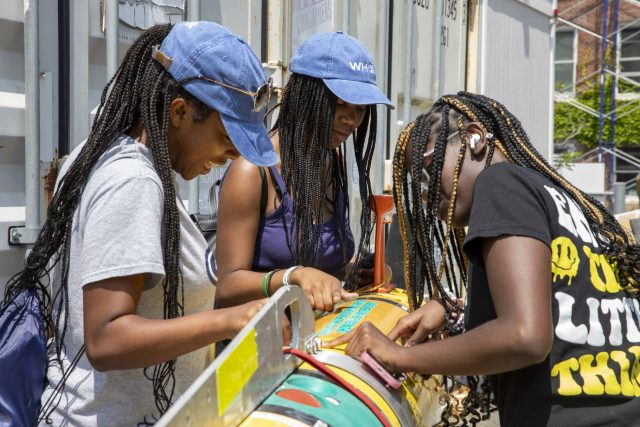
Summertime brings students from all over the country to Woods Hole, Massachusetts to learn about ocean science. June and July 2023 were particularly busy, with the Coastal and Global Scale Nodes (CGSN) division of the Ocean Observatories Initiative (OOI) at Woods Hole Oceanographic Institution (WHOI) hosting four different student groups. CGSN offers student tours of OOI facilities and the chance to talk directly with an ocean scientist or engineer. They engage with students this way in the hope of increasing student interest in marine science and possibly encouraging them to pursue an ocean-related career. During the tours and presentations, students learn about the moorings and vehicles OOI deploys throughout the year and the dissemination of ocean data collected. These hands-on experiences give student visitors the opportunity to see the full scale and complexity of OOI operations.
UMass-Dartmouth REU Students Visit
On June 26, 12 community college engineering student and faculty from a National Science Foundation (NSF) sponsored Research Experience for Undergraduate (REU) at the University of Massachusetts, Dartmouth (UMass-Dartmouth) visited OOI. CGSN staff provided a tour of their operations, including ocean-observing equipment stored outdoors because of its size.
[media-caption path="https://oceanobservatories.org/wp-content/uploads/2023/07/Sheri-with-REUs.jpg" link="#"]CGSN team members, Dr. Sheri White (blue jeans to right) and Irene Duran (next to Dr. White) gave a tour to UMass-Dartmouth REU students. Photo by: Kama Theiler © WHOI.[/media-caption] [media-caption path="https://oceanobservatories.org/wp-content/uploads/2023/07/Colin-Dobson-with-REU.jpg" link="#"]A UMass-Dartmouth REU student asks CGSN glider expert Colin Dobson a question regarding the gliders he works on. Photo by: Kama Theiler © WHOI.[/media-caption]PEP Students Visit
In early July, the CGSN team gave a presentation to Woods Hole Partnership Education Program (PEP) participants, who spend 10-weeks in Woods Hole at WHOI, the Marine Biological Laboratory, Woodwell Climate Research Center, National Oceanic and Atmospheric Administration’s Northeast Fisheries Science Center, Sea Education Association, or the United States Geological Survey’s Woods Hole Coastal and Marine Science Center. The PEP program is designed primarily for college juniors and seniors from underrepresented groups in marine and ocean sciences who want to spend a summer gaining practical experience in marine and environmental science.
Summer 2023 is the 15th summer of the PEP program in Woods Hole. Many former PEP students have returned to Woods Hole and WHOI both as students and professionals (including CGSN’s Irene Duran). Benjamin Harden, PEP professor, stated that OOI’s community outreach is a “great way for these students to hear about the frontiers of oceanography and really helped many of them frame possible careers in the field.”
Black Girls Dive Foundation Visit
July 25th, CGSN’s Electrical Team provided a workshop to the Black Girls Dive Foundation (BGDF) program participants. BGDF provides the space and opportunity to empower young black women to explore their STEM (Science, Technology, Engineering and Mathematics) identity through marine science and conservation, and SCUBA diving. While visiting OOI, the BGDF students learned about pH and concerns about increasing ocean acidification. The students collected local sea water and with the help of the CGSN Instrument Team determined its pH with a probe they calibrated using a microcontroller.
[media-caption path="https://oceanobservatories.org/wp-content/uploads/2023/07/BGDF-with-AUV.jpg" link="#"]During their visit to WHOI, BGDF students had the opportunity to get up close to check out an Autonomous Underwater Vehicle (AUV). Photo by: Jayne Doucette © WHOI.[/media-caption] [media-caption path="https://oceanobservatories.org/wp-content/uploads/2023/07/Jennifer-with-BGDF.jpg" link="#"]CGSN Instrument Lead Jennifer Batryn (far left) shows how she checks OOI instruments operations on her laptop to one of the BGDF visitors. Photo by: Jayne Doucette © WHOI.[/media-caption]SEA Participants Visit
Also in late July a group of students participating in the Sea Education Association’s (SEA’s) High School program visited OOI’s Facility LOSOS on WHOI’s Quissett Campus. This is a study abroad program in Woods Hole for undergraduate, gap year, and high school students, that combines studies in ocean science with at-sea experiences. The students spent an afternoon learning about OOI, its operations, how data are collected and disbursed, and what scientists are learning from OOI data.
[media-caption path="https://oceanobservatories.org/wp-content/uploads/2023/07/Dee-and-Jon-With-SEA-students-2.jpg" link="#"]CGSN team members Dee Emrich (standing left) and John Lund explained OOI operations to high school students from the Sea Education Program. Photo by: Dr. Sheri White © WHOI.[/media-caption] [media-caption path="https://oceanobservatories.org/wp-content/uploads/2023/07/Irene-with-SEA-students.jpg" link="#"]CGSN Engineer Irene Duran (maroon top in center) showed mooring components to high school students from the Sea Education Program. Photo by: Paul Whelan © WHOI.[/media-caption] Read MoreNew Features of Data Explorer Demo
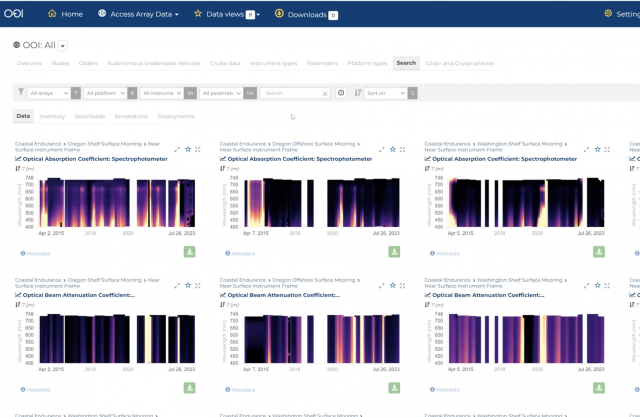
In case you missed it, here is a video of the OOI Town Hall on July 26, 2023 during which the new features of Data Explorer were demonstrated and questions answered.
[embed]https://vimeo.com/849129117[/embed] Read More