
Science Highlights
Explosive Bubble Plume Emissions from Southern Hydrate Ridge
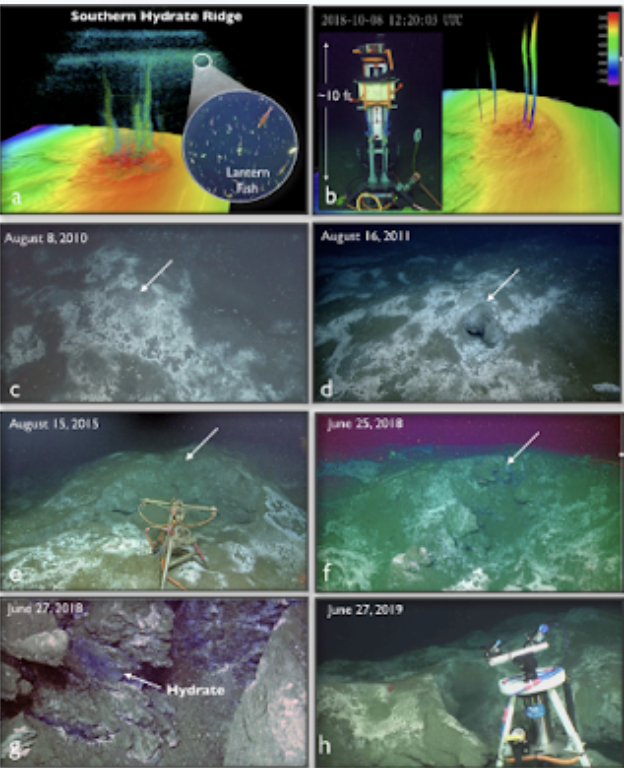
From Marcon and Bohrmann, 13, December 2019.
Remarkable changes in seafloor topography and biological communities, quantification of methane flux, and connections from the seafloor to upper water column methanotrophy.
Southern Hydrate Ridge (SHR) is one of the most active and dynamic methane seep sites known. Repeat investigations during Regional Cabled Array (RCA) cruises show that it is highly dynamic, delineated by exceptional changes in seafloor morphology, venting intensity and temporal variability, and by the distribution and density of associated biological communities (Fig. 1) [1-6]: here, AI is being utilized to quantify the areal extent of seeps and classification of organisms [4,7]. Since first imaged in 2010, the summit of SHR has changed remarkably with areas of smooth, gentle hummocks transformed into extensive, highly rugged and steep-sided collapsed pits from which jets and explosions of bubbles occur (Figs. 1c-h). Equally dynamic are changes in the locations and thicknesses of microbial mats that mark more diffuse seepage of methane from the seafloor. Surprisingly, chemical results from continuous measurements from RCA flow meters show an annual net transport of fluid downward into the sediment resulting in the development of new transport models for these seep environments [8]. At the focused RCA experimental site “Einsteins’ Grotto” and at a site to the north, hydrate is exposed at the seafloor within the collapsed pits (Fig. 1d).
Because of OOI, SHR is one of only three places (the others being Ocean Networks Canada Barkley Canyon and Clayoquot Slope sites) in the oceans where time series investigations of methane release are conducted at hour to year time periods utilizing ship and RCA PI cabled multibeam sonars, cameras and an upward-looking ADCP [2, 5-6, 9-11]. Results from a 3-year investigation of SHR show that the locations of seep activity and bubble release remained unchanged, however, the magnitude of gas release was highly variable on hourly time scales (Fig. 1a) [2]. Bubble plumes rise up to ~480 above the seafloor and in several cases exceed the upper limit of hydrate stability by ∼190 m. Here, shallow subsurface waters, where methane disassociates, is marked by high density regions of lantern fish, consistent with increased biological activity associated with the microbial oxidation of the released methane (Fig. 1a) [2].
As a key cabled site on the RCA, SHR has attracted numerous national and international investigators including a several year program funded by the German Federal Ministry of Education and Research to quantify methane flux from the highly active Southern Hydrate Ridge RCA site (G. Bohrmann and Y. Marcon, MARUM, University of Bremen, Germany; “Sonar monitoring of natural release of methane greenhouse gas from the seafloor – A contribution to the understanding of global change.”). In 2018, it was mapped at submeter resolution and the entire site photo mosaicked as part of a Schmidt-funded program (B. Thornton, University of South Hampton). Cabled infrastructure now installed as part of the MARUM project includes an overview multibeam sonar that completes a 360° scan every 2 hrs and spans a distance of 700 m, imaging all sites of bubble plume emissions at SHR (Fig. 1b) [5-6; 10-11]. Other infrastructure includes a multibeam, very high-resolution sonar that quantifies bubble emissions from Einstein’s Grotto, a 4k video and digital still camera that takes 3 images each hour of the explosive hydrate-bearing site – Einsteins’ Grotto (Fig. 1h), and a CTD to examine the impacts of ocean warming and release of methane into the hydrosphere. Automated plume imaging is now utilized for time-series hourly imaging by the RCA digital still camera [5-6]. The images, available through the OOI Data Portal, document remarkable changes of the collapse pit over time and in associated biology.
[blockquote][1] Kelley, D.S. (2016) Real-time multidisciplinary monitoring of a highly dynamic methane seep: The OOI Cabled Array at Southern Hydrate Ridge. Gordon Conference Natural Hydrate Systems. Interfacial science advances towards understanding and monitoring gas hydrate systems. Galveston, February 28 – March 4, 2016.
[2] Philip. B.T., Denny, A.R., Solomon, E.A., and Kelley, D.S. (2016) Time-series measurements of bubble plume variability and water column distribution above Southern Hydrate Ridge. Geochemistry, Geophysics, Geosystems, 17 (3) 10.1002/2016GC006250.
[3] Bigham, K., Kelley, D.S., Solomon, E.A., and Delaney, J.R. (2017) Extreme Morphologic and Venting Changes in Methane Seeps at Southern Hydrate Ridge, Cascadia Margin. American Geophysical Union, Fall Meeting 2017, OS53B-1199.
[4] Bigham, K., Kelley, D.S., Marburg, A., and Delaney, J.R. (2017) Further Interpretation of the Relationship between Faunal Community and Seafloor Geology at Southern Hydrate Ridge, Cascadia Margin: Exploring Machine Learning, American Geophysical Union, Fall Meeting 2017, U21B-09.
[5] Bohrmann, G., and Marcon, Y., (2019) Long-term monitoring of gas emissions at Southern Hydrate Ridge. American Geophysical Union, Fall Meeting 2019. OS51A-04.
[6] Marcon, Y., and Bohrmann, G. (2019) Long-term monitoring of gas emissions at Southern Hydrate Ridge. American Geophysical Fall Meeting 2019, OS51A-04.
[7] Marburg, A., and Bigham, K., (2016) Deep learning for benthic fauna identification, Oceans 16 MTS/IEEE Monterey, 10.1109/OCEANS.2016.7761146.
[8] Whorley, T.L., Solomon, E.A., Kowalski, L., and Centurion, R., (2019) Persistent downward flow of seawater beneath Beggiatoa mat communities at Hydrate Ridge – mechanisms and biogeochemical implications. American Geophysical Union, Fall Meeting 2019, OS43B-1706.
[9] Philip. B.T., Kelley, D.S., Solomon, E.A., and Delaney, J.R. (2016) Monitoring methane emissions at Southern Hydrate Ridge using an OOI Cabled Array Acoustic Doppler Current Profiler. OCEANS 2016 MTS/IEEE Monterey, 10.1109/OCEANS.2016.7761469
[10] Marcon, Y., Sahling, H., von Wahl, T., Spiesecke, U, Vittori, V., Leymann, T., and Bohrmann, G., (2018) M³: Towards Long-Term Acoustic Monitoring of Gas Emissions using Underwater Cabled Observatory Technology. Ocean Sciences Meeting, doi.org/10.1002/essoar.b8ca5006b4256b34.3745ac673d8f4f8a.1.
[11] Marcon, Y., Kopiske, E., Leymann, T., Spiesecke, U., Vittori, V., von Wahl, T., Wintersteller, P., Waldmann, C., and Bohrmann, G., (2019) A rotary sonar for long-term acoustic monitoring of deep-sea gas emissions. OCEANS19 – Marseille, IEEE. 10.1109/OCEANSE.2019.8867218.
[/blockquote] Read More
A Marine Heat Wave Identified on the New England Shelf
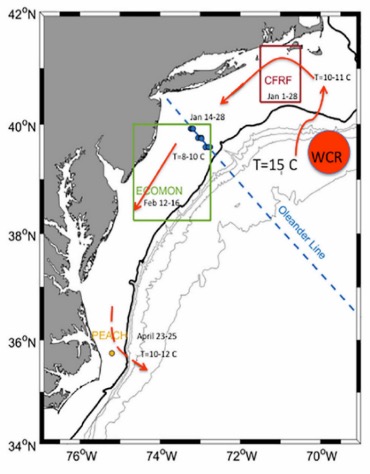
From Gawarkiewicz et al., 22 November 2019
Marine heat waves are warm anomalies persisting for days to months and on spatial scales from 1-1000 km (Hobday et al., 2016). These heat waves disturb the marine environment and may have significant feedbacks on the atmosphere. Recent studies suggest that the New England continental shelf is increasingly impacted by Warm Core Rings (WCR) initiating from the Gulf Stream. Gawarkiewicz et al 2019 describe a strong marine heatwave in early 2017 that was apparently initiated by a WCR intrusion onto the shelf.
The first indication of the 2017 heatwave was from a Rhode Island fisherman who noticed unusual species (typically found in Gulf Stream waters) in his catch from the New England shelf. This indicated unusually warm waters on the shelf, and researchers began to investigate the regional extent. A number of different data sources, including OOI Pioneer Array assets, were necessary to track the anomalies along the length of the Middle Atlantic Bight (MAB).
Temperature anomalies measuring up to 6 C and salinity anomalies exceeding 1 PSU were found. The duration of the heatwave was approximately 4 months, initiating near Nantucket Shoals in Jan 2017, traversing the entire MAB, and dissipating offshore of Cape Hatteras in April. The advective path of the heatwave extended roughly 850 km.
Comparison with historical records from 1940 to 1996 showed that the 2017 heatwave was an unprecedented event in terms of temperature and salinity anomalies. The heat wave had significant impacts, including shoreward shift of the shelfbreak front, lowered chlorophyll concentrations, and the presence of warm water fish in New England coastal waters.
Read MoreTime Series Allows Investigation of Wind Forcing and Physical and Bio-Optical Variability
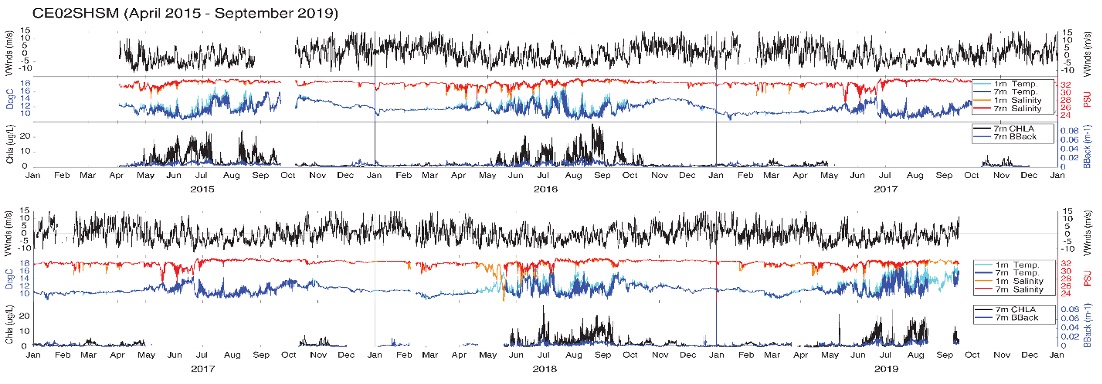
From Dever et al., 29 September 2019
The full scope of OOI Endurance Array surface moorings has been deployed since April 2015. The moorings are deployed off Grays Harbor, Washington and Newport, Oregon at inner shelf, shelf and slope depths. They include surface meteorology, physical oceanographic, chemical and biological sensors. During the summer of 2019, EA staff reviewed mooring data since inception. In September 2019, we presented a poster of these data at the annual Eastern Pacific Ocean Conference (EPOC). The objectives of the poster were to show the time series data and discuss their availability and quality issues with research community members. To stimulate discussion, we reported on seasonal variability in wind forcing, water temperature, and chl-a fluorescence. We described the mooring measurements and how to access the data.
The Oregon and Washington shelves are part of the northern California Current Marine Ecosystem. They exhibit characteristic responses to spring and summer upwelling winds and winter storms. In the above figure, we show representative time series of near surface measurements at the Oregon shelf mooring since its start in April 2015 through the present. As part of the poster, we also presented similar data from the other OOI surface moorings and calculated lagged correlations between wind, temperature, and chlorophyll, and commented on the observed variability.
We also pointed viewers to example Matlab and Python scripts to download and plot the OOI data presented in the poster via the Machine to Machine (M2M) interface on the OOI Data Portal.
Read MoreAnomalous Shallow Strong Currents Off the Oregon Margin
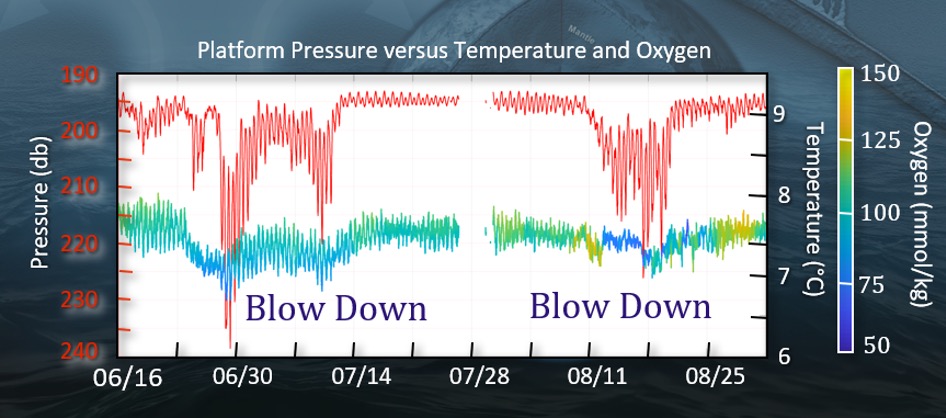
Blow down of the 200-meter Shallow Profiler Mooring Platform 2019
K. Roseburg and W. Ruef, Regional Cabled Array and P. MacCready, University of Washington, 20 August 2019
In June and August, 2019, the Slope Base Shallow Profiler Mooring was impacted by two substantial “blow down” events: these were the first observances of blow downs since the moorings were installed in 2014. The largest of these events, which occurred near the end of July and which lasted over two weeks, resulted in a deepening of the 12 ft across, 7,000 lb. platform nearly 50 m and migration of the platform ~ 150 m to the west. Results from pressure, ADCP, temperature and oxygen data pulled from CI using M2M, indicate that as the currents strengthened, the float was depressed into ~ 0.25-0.50°C cooler water with slightly decreased oxygen concentrations. An evaluation of the eddy kinetic energy calculated from the ADCP data, does not support eddy-driven water mass transport. The lower oxygen concentrations could reflect lower amounts of photosynthesis as the platforms are pushed deeper into the water column. We do not know of other documented blow down events such as these in the PNW.
Read MoreFirst Continuous Temperature Measurements Spanning >2600 m water depth

Deep temperature modulations at Axial Base
From Interactive Oceans Data Portal, 21 July 2019
Axial Base is the only site in the world’s oceans where continuous full water column measurements are being made, spanning >2600 m to ~ 5 m beneath the oceans’ surface (a & b). The Axial Base Deep Profiler (DP) Mooring has been operational for >17 months, completing two profiles a day from ~2650 m to 127 m (b). Since August 2019, DP vehicle measurements overlap with those made by instruments on the Shallow Profiler Mooring, which conducts nine profiles a day (a): since 2015, the three Shallow Profiler science pods have conducted >40,000 profiles. The high-resolution temperature measurements delineate fine scale structure both in shallow waters and below 1000 m water depth (c&d) marked by regular vertical striations . These perturbations may result from the vertical advection of the temperature field by passing semidiurnal internal tides (D. Luther, pers. com). Some modulations may be wind-driven inertial waves. Examination of dissolved oxygen concentrations during this same time period are not consistent with drawdown caused vehicle movement. Additional analyses are required, however, to unequivocally determine the processes responsible for these perturbations. A Jupyter notebook on the UW interactiveoceans data portal is now developed to analyze MODIS satellite data (chlorophyll) with measurements being made by instruments on the Shallow Profiler mooring (interactive oceans.washington.edu).
Read MoreNew Estimate of Boundary Current Transport

From Hopkins et al., 23 April 2019
Hopkins et al., 2019 use data from the OOI Irminger Sea flanking moorings to create the longest continuous record to date of Deep Western Boundary Current (DWBC) volume transport in the region. This study, part of the Overturning in the Subpolar North Atlantic Program (OSNAP), used data from two OOI flanking moorings, along with three U.S. OSNAP moorings, and five U.K. OSNAP moorings to determine the 22-month mean DWBC volume transport, and its spatial structure off Greenland (Figure above).
Determining DWBC properties is critical to understanding the transport of heat, salt, nutrients, and carbon by the Atlantic Meridional Overturning Circulation (AMOC), part of a system of currents that form the global thermohaline circulation. The combined OSNAP/OOI mooring array deployed at 60°N in the Irminger Sea during 2014 – 2015 provides the longest continuous record of DWBC volume transport at this latitude. This enables not only the most reliable estimate available of the mean transport, but the ability to investigate temporal variability.
Several key points are made by the authors. First, the average volume transport of deep water was 10.8 ± 4.9 Sv (mean ± 1 std) to the south. Of the total transport, North East Atlantic Deep Water accounted for about 6.5 Sv while about 4.1 Sv was associated with the Denmark Strait Overflow. Second, the long record allows the first systematic investigation of DWBC variability. The observed transport shows a shift from high to low frequency fluctuations with increasing distance from the East Greenland coast. High‐frequency fluctuations (2–8 days) dominate close to the continental slope, likely associated with topographic Rossby waves and/or cyclonic eddies. In deeper water, transport variance at 55 days dominates. Finally, the results indicate a modest (1.8 Sv) increase in total transport since 2005–2006, but this difference can be accounted for by a range of methodological and data limitation biases. This is of interest because although AMOC variability related to climate change is expected to be reflected in DWBC transport and properties, conclusive observational evidence of transport change has been elusive.
Read MoreStrong Variability in Irminger Sea Winter Heat Loss Measured

From Josey et al., 18 December 2018
A recent paper by Josey et al. [1] use data from the OOI Irminger Sea surface mooring to present the first characterization of multi-winter surface heat exchange at a high latitude North Atlantic site based on in-situ measurements. Heat loss in the North Atlantic is a primary determinant of how much deep water is formed in a given winter, which ultimately influences the strength of the Atlantic circulation. The Irminger Sea is a key deep convection site [2], [3], but the amount of heat lost is poorly known because winter measurements are difficult to obtain in the harsh environment [1].
Data from the first four deployments of the Irmginer surface mooring provided early winter observations in three consecutive years – 2014, 2015 and 2016. Strong variations on times scales of days to weeks are apparent in the air-sea flux components. These combine to create net heat losses exceeding 400 W/m^2 on at least one occasion each winter (Fig. 1 d).
The integrated effects of the anomalously strong heat loss events in 2014–2015 result in cumulative net heat loss significantly greater than following years (Fig. 1 e,f) This is primarily due to variations in frequency of intense short timescale (1–3 days) forcing (Fig. 1g) that would be difficult to detect without the mooring observations.
Interpreting the observations in the context of a high-resolution atmospheric model (European Centre for Medium Range Weather Forecasts Reanalysis 5) shows that the main source of multi-winter variability is changes in the frequency of Greenland tip jets that can result in hourly mean heat loss exceeding 800 W/m2 (Fig. 1g). The tip-jet events result from the mountainous Greenland terrain, which focuses winds into narrow, very strong jets over the ocean [4], [5]. Josey et al. [1] suggest how changing atmospheric circulation may influence the number of events and hence the ocean heat loss.
Improved understanding of Irminger Sea winter heat loss is likely to be critical to reliable projections of future changes in both the North Atlantic overturning circulation and climate variability.
[blockquote][1] Josey, S.A., M.F. de Jong, M. Oltmanns, G.K. Moore and R.A. Weller, 2019. Extreme variability in Irminger Sea winter heat loss revealed by ocean observatories initiative mooring and the ERA5 reanalysis, Geophys. Res. Lett., 46. https://doi.org/10.1029/ 2018GL080956
[2] de Jong, M.F. and L. de Steur, 2016. Strong winter cooling over the Irminger Sea in winter 2014–2015, Geophys. Res. Lett., 43, 106–107. https://doi.org/10.1002/2016GL069596
[3] de Jong, M.F., M. Oltmanns, J. Karstensen, and L. de Steur, 2018. Deep convection in the Irminger Sea observed with a dense mooring array. Oceanography, 31(1), 50–59. https://doi.org/10.5670/oceanog.2018.109
[4] Doyle, J.D. and M.A. Shapiro, M. A., 1999. Flow response to large-scale topography: The Greenland tip jet. Tellus A: Dynamic Meteorol. and Oceanog., 51(5), 728–748. https://doi.org/10.3402/tellusa.v51i5.14471
[5] Moore, G. W. K., & Renfrew, I. A. (2005). Tip jets and barrier winds: A QuickSCAT climatology of high wind speed events around Greenland, J. Climate, 18(18), 3713-3725, https://doi.org/10.1175/JCLI3455.1.
[/blockquote] Read More
Unique Offshore Transport of Shelf Water by Subduction Identified
From Zhang and Partida, 15 October 2018
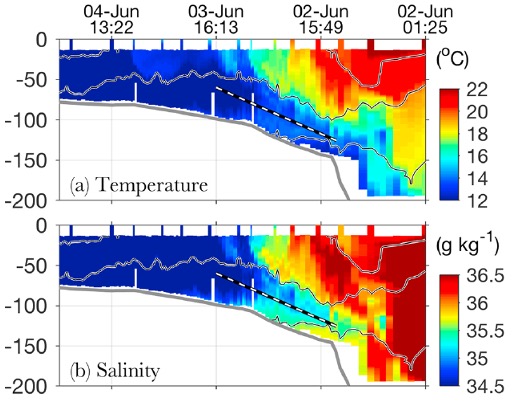
The shelf break front is a persistent feature in the Middle Atlantic Bight, with the foot of the front found near the 100 m isobath. Warm core rings pinched off from the Gulf Stream are found over the continental slope, and have significant impacts on the frontal system when they impinge on the shelf. Zhang and Partida, 2018 use data from OOI Pioneer Array moorings and gliders to document a unique shelf/slope interaction related to the presence of a warm core ring.
Satellite SST imagery shows a well-formed ring impinging on the shelf south of New England during June 2014. Observations from the Pioneer Offshore and Central Offshore moorings are able to identify relatively cold, fresh shelf water that migrates downward with time during the period that ring water is at the surface. Relatively high dissolved oxygen concentration indicates that the shelf water was recently exposed to the surface. This suggests that shelf water filaments are being subducted at the edge of the ring. A cross-shelf section from the Pioneer EB glider (Figure above) clearly shows the cold, fresh shelf water beneath warm, salty ring water. The shelf water is seen well offshore of 100 m where the frontal boundary would be expected in the absence of interaction with the ring.
Computer simulations reproduce the observed phenomenon and reveal the underlying mechanism. The onshore movement of the warm-core ring sharpens the interface between the ring and shelf waters. The subducted flow results from circulation trying to relax the sharpening interface and serves to transport sub mesoscale filaments of shelf water offshore. This offshore flow of subducted shelf water may be a significant exchange mechanism, but has not been well studied. It does not have a surface signature and cannot be seen by satellites.
Read MoreHypoxic Conditions Over the Oregon Shelf Respond to Wind Forcing on Time Scales of Days

From Barth et al., 9 February 2018
In recent years, hypoxic and even anoxic events have regularly occurred off Washington and Oregon as they have in upwelling regions worldwide [1, 2]. The OOI Endurance Array’s location, platforms and sensors were designed to address major OOI Science Themes with a particular focus on Hypoxia on Continental Shelves and Shelf/Slope Exchange [3]. Since its first full deployment in April 2015, the Endurance Array has maintained oxygen sensors at 6 fixed locations near the surface and near the bottom over the Washington and Oregon shelf and slope. Similar oxygen sensors are found on Endurance Array profilers and gliders and across other OOI arrays.
OOI marine operators, systems engineers and data team members have worked together to continually improve the quality of the OOI dissolved oxygen data products. We have worked with the vendor to improve their calibration of sensors; have compared data to physical samples [4]; and have implemented a UV-based biofouling mitigation [5].
Science Highlight: OOI Endurance Array data [6] describe low-oxygen events off central Oregon. Data from July 2017 illustrate variability on time scales of days as the wind-driven upwelling circulation advects low oxygen waters back and forth across the shelf. (Figure 1).
During this time, near-bottom oxygen levels at the OOI Oregon Inshore Surface mooring were often below the hypoxia threshold. When winds blow to the south, the near-bottom temperature decreases due to coastal upwelling, with a slight lag relative to the wind. During these events, near-bottom oxygen usually decreases (e.g., 23-25 July). Conversely, during low or northward winds the near-bottom temperature and oxygen increase rapidly. These changes are consistent with the upwelling circulation drawing near-bottom cold water low in dissolved oxygen toward the coast during upwelling and pushing warm water containing more oxygen down and away from the coast near the bottom during downwelling. The dissolved oxygen does not follow the winds or temperature as clearly as temperature follows the wind because there are the additional biological processes of photosynthesis and microbial decay that raise or lower dissolved oxygen levels, respectively.
Since this report [6], researchers continue to use OOI data to characterize hypoxia in summer 2018. There is also increasing interest in, and use of, OOI data by mission-oriented agencies such as the Oregon Department of Fish and Wildlife.
[blockquote][1] Grantham, B. A., Chan, F., Nielsen, K.J., Fox, D.S., Barth, J.A., Huyer, A., Lubchenco, A., Menge, B.A. (2004). Upwelling-driven nearshore hypoxia signals ecosystem and oceanographic changes in the northeast Pacific. Nature, 429, 749-754. DOI: 10.1038/nature02605.
[2] Chan, F., Barth, J.A., Lubchenco, J., Kirincich, A., Weeks, H., Peterson, W.T., Menge, B.A. (2008). Novel emergence of anoxia in the California Current System. Science, 319, 920, DOI: 10.1126/science.1149016
[3] ORION Executive Steering Committee (2007). Ocean Observatories Initiative Scientific Objectives and Network Design: A Closer Look. Joint Oceanographic Institutions, Inc. Washington, DC.
[4] Holm, C., R.T. Rohrer, E.P. Dever, and J.P. Fram (2018) Quality Assessment of Moored Near Surface Instrument Time Series on the OOI Endurance Array, Abstract IS14A-2541 presented at 2018 Ocean Sciences Meeting, Portland, OR, 12-16 Feb.
[5] Wingard, C.E., R.A. Desiderio, J.P. Fram, and E.P. Dever (2018) Time Series Measurements of Inherent and Apparent Optical Properties from the OOI Endurance Array, Abstract IS14A-2543 presented at 2018 Ocean Sciences Meeting, Portland, OR, 12-16 Feb.
[6] Barth, J. A., J. Fram, E. P. Dever, C. Risien, C. Wingard, R. W. Collier, and T. D. Kearney, 2018. Warm blobs, low-oxygen events and an eclipse: The Ocean Observatories Initiative Endurance Array captures them all, Oceanography 31(1): 90-97, https://doi.org/10.5670/oceanog.2018.114.
[/blockquote] Read More
Glider Observations Provide Insight into Spatial Patterns in Satellite Bio-Optical Measurements
From Henderikx et al., 9 February 2018
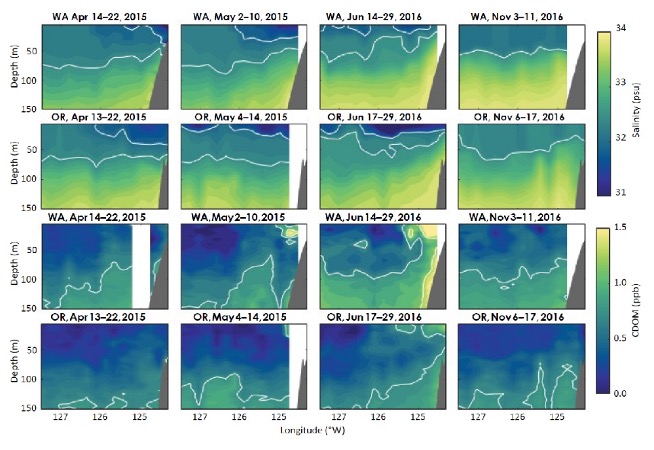
Hendrikx Freitas et al., 2018 compare satellite and Endurance Array glider estimates of chromophoric dissolved organic matter (CDOM) to characterize seasonal patterns and latitudinal and cross-shore gradients in particle concentrations between the Washington and Oregon shelves. While the Oregon and Washington shelves are both highly productive regions of the northern California Current Ecosystem, there are significant differences in the physical processes, with the central Washington shelf generally subject to weaker upwelling and a stronger Columbia River influence. The difference in physical forcing is reflected in satellite estimates of chlorophyll, which show higher concentrations off the Washington coast.
The conclusions from satellites contrast with in situ observations from gliders. Despite the differences in physical forcing, Henderikx et al., 2018 find OOI glider fluorescence based measurements of chlorophyll to be similar in magnitude across the Oregon and Washington shelves. Their research suggests that latitudinal differences in CDOM may be a partial explanation for perceived trends in satellite-derived chlorophyll. The OOI gliders gather simultaneous chlorophyll and CDOM fluorescence from an integrated three-channel sensor. While the glider observations indicate similar levels of chlorophyll fluorescence, they also show an increased presence of suspended sediments and CDOM off WA. The OOI observations, although temporally limited, indicate potential contamination of satellite retrievals of chlorophyll due to CDOM and suspended materials in the water column, particularly off the WA shelf, that should caution further attribution of satellite chlorophyll signals to differences in production.
Read More